
Table of Contents
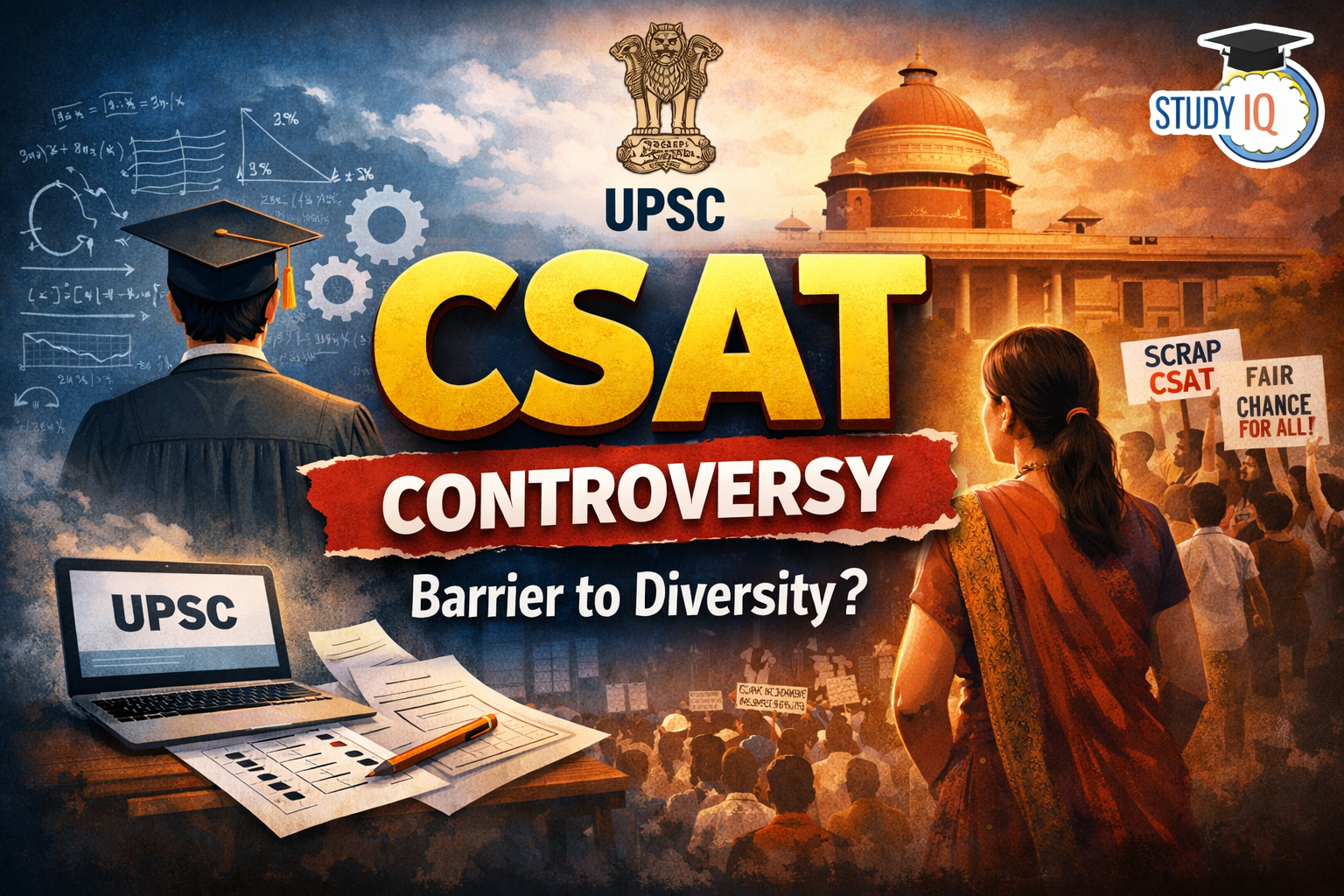
CSAT Controversy Explained: The debate around the Civil Services Aptitude Test (CSAT) has resurfaced in 2026 after remarks by Brij Lal, who termed it the “biggest barrier to diversity” in the Civil Services Examination (CSE).
The issue is not new; it dates back to 2011, when CSAT was introduced by the Union Public Service Commission as part of Prelims reform.
At its core, the debate raises a critical question: Does CSAT promote meritocracy, or does it unintentionally disadvantage certain groups of aspirants?
CSAT Controversy: What is CSAT in UPSC?
CSAT (General Studies Paper-II) is one of the two papers in the UPSC Prelims.
Key Features:
- Introduced in 2011
- Total Marks: 200
- Qualifying Nature: 33% (66 marks required)
- Questions: 80 MCQs
- Negative Marking: 1/3rd
Syllabus:
- Reading comprehension
- Logical reasoning
- Analytical ability
- Decision-making
- Basic numeracy (Class 10 level)
- Data interpretation
Purpose: To test aptitude, not rote learning
CSAT Controversy: Why Was CSAT Introduced?
Before 2011, UPSC Prelims had:
- General Studies paper
- Optional subject paper (23 options)
Problems in Old Pattern:
- Scaling issues
- Optional subject bias
- Overemphasis on memorization
Reform Recommendations:
- Second Administrative Reforms Commission chaired by M Veerappa Moily
- Committee led by Y.K. Alagh
Objective:
- Standardize evaluation
- Test analytical ability
- Ensure fairness across backgrounds
Why is CSAT Controversial?
1. Alleged Bias Against Humanities Students
Critics argue that:
- CSAT is math and logic-heavy
- Engineering/science students have an advantage
Supporting Data:
Between 2017–2021:
- Science/Engineering graduates: ~500–700 selections/year
- Humanities graduates: ~80–100 selections/year
This creates a perception of skewed representation
2. Language Barrier & Rural Disadvantage
Major Concerns:
- Poor quality Hindi translations
- Limited availability of study material in regional languages
- English comprehension passages dominate
Trend:
- Hindi-medium candidates dropped sharply after CSAT introduction
- English-medium dominance increased
Raises issue of linguistic inequality
3. Disconnect with Civil Services Role
Critics highlight:
- Civil services require knowledge of:
- Polity
- Governance
- Ethics
- But CSAT tests:
- Maths
- Logical puzzles
Question: Is CSAT testing the right skills?
4. Rising Difficulty Level
Even though CSAT is qualifying:
- Difficulty has increased in recent years
- Many aspirants fail to clear even 33% cutoff
This makes CSAT a decisive elimination stage
What Does the Data Say?
Stream-wise Selection Trends:
| Year | Science/Engineering | Humanities |
|---|---|---|
| 2017 | 715 | 106 |
| 2018 | 528 | 81 |
| 2019 | 595 | 77 |
| 2020 | 566 | 84 |
| 2021 | 497 | 88 |
Interpretation:
- STEM dominance is clear
- However:
- Many science graduates choose humanities in Mains
- So CSAT may not be the sole factor
Correlation ≠ Causation
Arguments in Favour of CSAT
1. Tests Essential Skills
Civil servants need:
- Analytical thinking
- Decision-making ability
- Problem-solving skills
CSAT ensures a minimum competency threshold
2. Only Qualifying (Since 2015 Reform)
After protests (notably in 2014), CSAT was made:
- Qualifying only
- Marks not counted in merit
Reduces its impact on final selection
3. Promotes Meritocracy
- Eliminates advantage of rote memorization
- Creates uniform testing standard
- Aligns with global aptitude testing models
Government & UPSC Position
The government has maintained that:
- CSAT is language-neutral
- The exam ensures equal opportunity
- Candidates voluntarily choose English medium
No major rollback has been implemented
Key Issue: CSAT or Systemic Inequality?
The real debate is deeper:
Is CSAT the problem?
OR
Is it the unequal ecosystem (education, language, resources)?
Structural Factors:
- Urban vs rural divide
- Coaching access
- School-level maths exposure
- Language proficiency
Way Forward: Reform, Not Removal
1. Rationalise Difficulty
- Focus on basic aptitude
- Avoid overly complex maths
2. Improve Language Accessibility
- High-quality translations
- Equal resources in Hindi & regional languages
3. Increase Transparency
- Publish data on:
- Medium-wise selection
- Background-wise success
4. Align with Administrative Needs
- Include:
- Case studies
- Decision-making scenarios
UPSC Aspirants: What Should You Do?
Strategy:
- Treat CSAT as high-risk paper
- Practice:
- Comprehension daily
- Basic maths (Class 8–10 level)
- Solve PYQs (2011–2025)
Golden Rule:
“Never ignore CSAT—even toppers fail because of it.”
 UPSC Mains Exam Date 2026: Complete Sche...
 UPSC NDA I Admit Card 2026 OUT – Downl...
 UPSC CDS 2 Final Result 2025 Out: Check ...






 WhatsApp





