
Table of Contents
Context
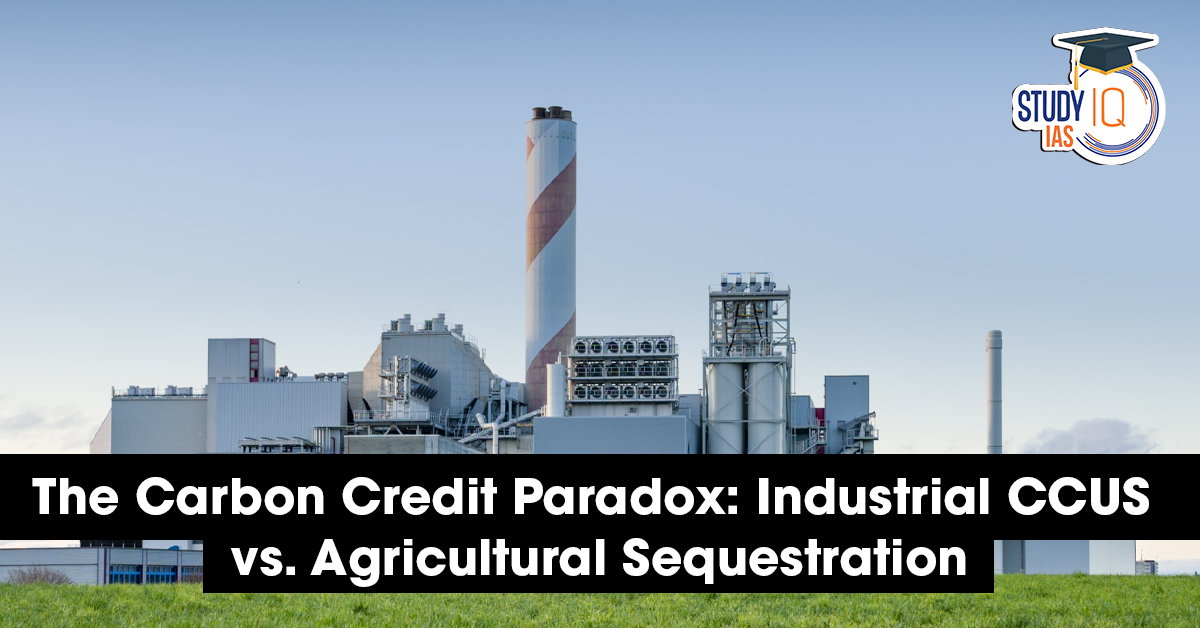
The Union Budget 2026’s ₹20,000 crore allocation for a “carbon credit programme” has triggered a conceptual conflict between a high-tech industrial roadmap and a popular narrative centered on agrarian climate solutions.
CCUS for Hard-to-Abate Sectors
The technical architecture of this budgetary outlay is defined by the Department of Science and Technology’s (DST) “R&D Roadmap for CCUS” (2025). The primary objective is the decarbonization of “hard-to-abate” industries.
- Target Sectors: Steel, cement, thermal power, refineries, and chemicals.
- Technical Logic: These industries produce “process emissions” ie. CO2 is generated by chemical reactions rather than just energy use. Since these cannot be eliminated by switching to renewables, Carbon Capture, Utilization, and Storage (CCUS) is the only viable pathway.
- Mechanism: Point-source capture technology intercepts CO2 at the factory flue, subsequently diverting it for industrial utilization (e.g., urea or CO2-to-fuel) or permanent geological storage.
CCUS vs. CDR
A significant communication gap has led to the assumption that this fund supports farmers. However, the DST roadmap explicitly excludes agriculture based on two scientific distinctions:
- Emission Profile: Agricultural emissions (methane and nitrous oxide) are diffuse and biologically mediated, making them incompatible with the mechanical, point-source hardware of CCUS.
- Avoidance vs. Removal: CCUS is an Emission Avoidance strategy (preventing new industrial CO2 from entering the atmosphere). Agriculture is a Carbon Dioxide Removal (CDR) strategy (sequestering existing atmospheric CO2 into soil and biomass).
Critical Challenges
- Policy Conflation: The use of the broad term “carbon credit programme” has blurred the lines between state-funded industrial subsidies and the Voluntary Carbon Market (VCM) where nature-based solutions operate.
- Technological Cost: CCUS is prohibitively expensive. The ₹20,000 crore outlay, while substantial, may only cover the initial infrastructure and R&D for a few pilot clusters, leaving a massive funding gap for full-scale industrial transition.
- Verification and Permanence: For agricultural credits, measuring Soil Organic Carbon (SOC) accurately across diverse Indian terrains remains a logistical and scientific challenge.
- Additionality: Ensuring that credits are awarded only for new sustainable practices (not existing ones) is essential for the environmental integrity of the market.
Way Forward
- Bifurcated Policy Framework: The government must officially demarcate the “Smokestack” (Industrial CCUS) and “Soil” (Agricultural CDR) pathways. The former requires direct capital subsidies, while the latter requires a Trusted Domestic Regulatory Market.
- Standardization of Protocols: Developing low-cost, high-integrity monitoring and verification (MRV) tools is essential to transform Indian farms into viable carbon sinks.
- Incentivizing Private Capital: Beyond the ₹20,000 crore seed fund, the government should create “Carbon Contracts for Difference” (CCfDs) to guarantee a minimum carbon price for industries investing in expensive CCUS tech.
- Extension Services: To bridge the gap for farmers, the Ministry of Agriculture must integrate carbon-farming training into existing Krishi Vigyan Kendras (KVKs).
|
Read More Notes |
|
| Environment Notes | Art and Culture Notes |
| Science and Tech | History Notes |
| Geography Notes | Indian Polity Notes |
| General Knowledge | International Relation |
|
Explore StudyIQ Courses |
|
 Explained: India’s West Asia Reset Ami...
 Cholesterol Makes Cell Nuclei Squishy: H...











 WhatsApp





