
Table of Contents
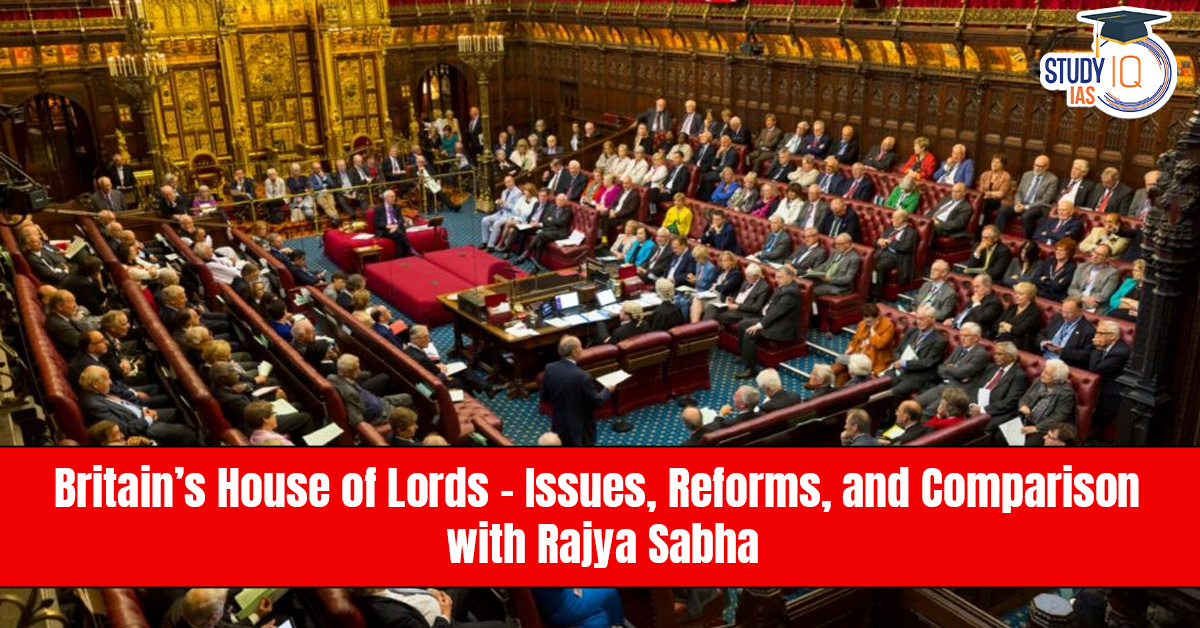
The House of Lords is the upper chamber of the Parliament of the United Kingdom. Unlike most upper houses in democratic systems, it is largely unelected and primarily functions as a revising and scrutinizing body. Over time, it has faced criticism regarding its size, composition, and democratic legitimacy, leading to several reform efforts.
For comparative constitutional analysis, it is useful to examine the House of Lords alongside India’s Rajya Sabha, the upper house of the Parliament of India.
Composition and Structure of the House of Lords
The House of Lords consists of three main categories of members:
1. Life Peers
Appointed by the Monarch on the advice of the Prime Minister or the House of Lords Appointments Commission. They serve for life.
2. Hereditary Peers
After reforms, only 92 hereditary peers remain, elected internally among themselves.
3. Lords Spiritual
Senior bishops of the Church of England.
Key Features
-
Members are not elected by the public.
-
Life peers serve without fixed tenure.
-
It does not represent territorial units.
-
It acts mainly as a revising chamber.
Its legislative powers are limited by the Parliament Acts, which ensure that the elected House of Commons ultimately prevails in case of disagreement.
Powers and Functions of the House of Lords
1. Legislative Scrutiny
The House of Lords examines and suggests amendments to bills passed by the House of Commons. It is known for detailed clause-by-clause scrutiny.
2. Delaying Power
It can delay ordinary (non-money) bills for up to one year but cannot permanently block legislation.
3. Money Bills
It cannot amend or reject Money Bills and can only delay them for one month.
4. Judicial Role (Historical)
Until 2009, it functioned as the highest court of appeal. This role was transferred to the Supreme Court of the United Kingdom under the Constitutional Reform Act 2005.
Issues and Criticisms of the House of Lords
1. Democratic Deficit
Members are appointed rather than elected, raising concerns about democratic accountability.
2. Excessive Size
The House of Lords is one of the largest legislative chambers in the world, often criticized for inefficiency.
3. Political Patronage
Appointments are sometimes viewed as political rewards, leading to accusations of favoritism.
4. Lack of Federal Representation
Unlike upper houses in federal systems, it does not represent regional or state interests.
Major Reforms of the House of Lords
House of Lords Act 1999
Removed most hereditary peers, reducing their number to 92.
Constitutional Reform Act 2005
Ended its judicial function and established the UK Supreme Court.
Ongoing Reform Proposals
-
Fully elected second chamber
-
Partially elected model
-
Fixed terms for members
-
Reduction in overall size
Despite debates, comprehensive reform has not yet been implemented.
Comparison: House of Lords vs Rajya Sabha
| Feature | House of Lords (UK) | Rajya Sabha (India) |
|---|---|---|
| Nature | Mostly appointed | Indirectly elected |
| Federal Role | No | Yes – represents states |
| Maximum Strength | No fixed constitutional cap | 250 (currently 245) |
| Tenure | Life (for life peers) | 6 years (1/3 retire every 2 years) |
| Money Bill Power | Delay up to 1 month | Recommend changes only |
| Democratic Legitimacy | Limited | Derived from state legislatures |
Federal Character
The Rajya Sabha represents states under Article 80 of the Indian Constitution. Members are elected by state legislative assemblies through proportional representation.
In contrast, the House of Lords does not represent territorial units and operates within a largely unitary constitutional framework.
Legislative Powers Comparison
Both chambers:
-
Cannot ultimately block Money Bills.
-
Function as revising bodies.
However, the Rajya Sabha has special constitutional powers:
-
Article 249: Authorizes Parliament to legislate on State List matters in national interest.
-
Article 312: Enables creation of All India Services.
The House of Lords does not possess such federal constitutional powers.
Democratic Legitimacy and Accountability
The Rajya Sabha derives indirect democratic legitimacy through elected state legislators. Members have fixed terms and may be disqualified under constitutional provisions.
The House of Lords, being largely appointed for life, faces criticism for lacking electoral accountability.
Conclusion
The House of Lords remains a unique unelected upper chamber known for expertise-driven debates and strong legislative scrutiny. However, concerns regarding democratic legitimacy, size, and political patronage persist.
The Rajya Sabha, by contrast, is constitutionally entrenched within India’s federal structure and balances representation, continuity, and democratic accountability.
A comparative study of these two institutions highlights fundamental differences between the UK’s parliamentary sovereignty model and India’s federal-parliamentary constitutional framework.
|
Read More Notes |
|
| Environment Notes | Art and Culture Notes |
| Science and Tech | History Notes |
| Geography Notes | Indian Polity Notes |
| General Knowledge | International Relation |
|
Explore StudyIQ Courses |
|
 World Day of Social Justice 2026: Theme,...
 NHAI to Develop India’s First Bee Corr...
 Loggerhead Turtles – Ecology, Habitat,...











 WhatsApp





