
Table of Contents
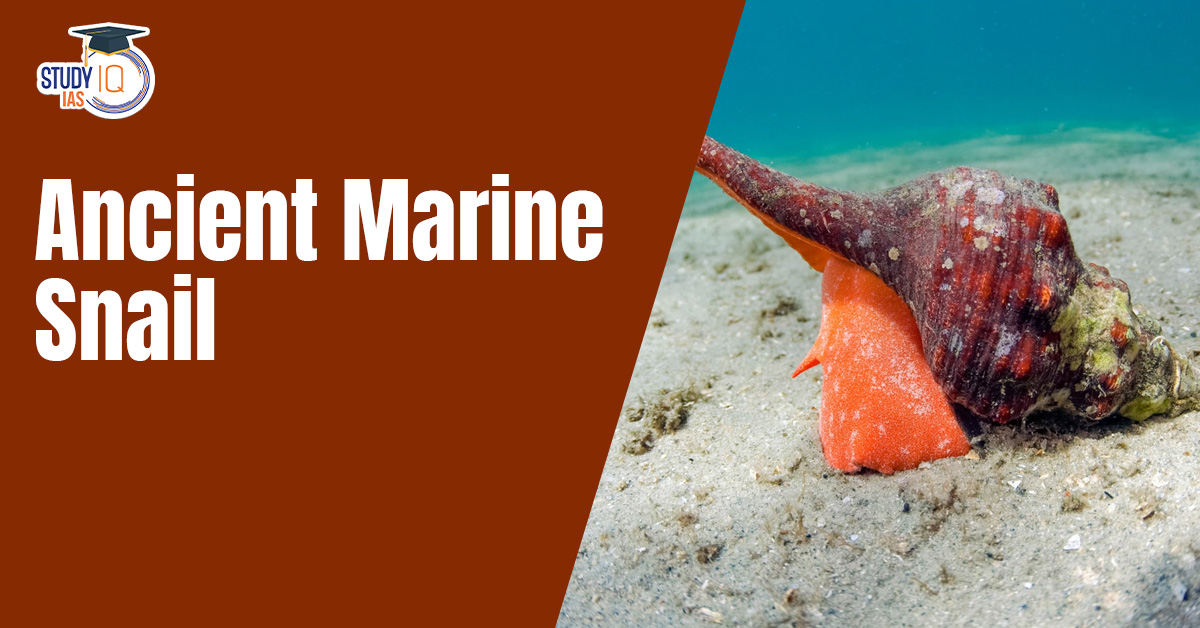
Context: A collaborative team from IIT Bombay, ISI, and IISER Kolkata has discovered four new species of 20-million-year-old marine snails in the Dwarka Basin.
About the New Species of Ancient Marine Snail
- The fossils date back roughly 20 million years (Early Miocene, part of the Neogene Period).
- These fossils are “micro-fossils,” often smaller than 5 mm
| New Species | Features/Significance |
| Jujubinus dwarkaensis | Top-shaped; lacks an umbilicus (hole at the base); features a beaded pattern of ribs. |
| Cerithium bardhani | Slender, cone-like; distinguished by 15 vertical ribs forming tiny nodules (bumps). |
| Nassarius anisi | Part of a diverse “graveyard” of Miocene marine life. |
| Clelandella saurashtraensis | Contributes to the understanding of regional biodiversity. |
Significance of the Discovery
Finding these specific filter-feeding snails allows geologists to reconstruct the ancient environment:
- Ocean Upwelling: Their presence proves the ancient Dwarka coastline experienced strong upwelling—a process where deep, cold, nutrient-rich water rises to the surface.
- Productivity: Such a high density of life suggests a highly productive marine ecosystem, similar to modern-day regions with rich fisheries.
- Global Warming Analog: These fossils act as “microscopic time capsules,” showing how marine life responded to natural periods of global warming in the deep past, long before human intervention.
| Dwarka Basin |
|
|
Read More Notes |
|
| Environment Notes | Art and Culture Notes |
| Science and Tech | History Notes |
| Geography Notes | Indian Polity Notes |
| General Knowledge | International Relation |
|
Explore StudyIQ Courses |
|

 Great Atlantic Sargassum Belt (GASB): Gr...
 China’s Global Ocean Mapping Initiativ...
 Biologics and Non-Animal Methodologies (...













 WhatsApp





