
Table of Contents
Context
DRDO’s Aeronautical Development Agency (ADA) shortlisted three private-sector contenders for the AMCA prototype development phase:
- Tata Advanced Systems Limited (standalone bid)
- A consortium led by Larsen & Toubro with Bharat Electronics Limited
- A consortium led by Bharat Forge Limited with BEML Limited and Data Patterns
This marks the first time a major fighter aircraft programme may be led by a private Indian firm instead of a public sector unit.
More about the News
- HAL’s Exclusion from Prototype Phase
- Hindustan Aeronautics Limited (HAL), traditionally India’s sole aircraft integrator, was reportedly not shortlisted due to technical and financial qualification criteria in the Expression of Interest (EoI).
- HAL, however, may still bid later during the licensed manufacturing stage. The government appears to want HAL to focus on Tejas production timelines.
- Shift in Defence Industrial Policy
- The AMCA bidding reflects a major structural reform in India’s defence sector Moving away from single-PSU dominance and Encouraging multiple production lines
- This aligns with Atmanirbhar Bharat and defence indigenisation goals.
|
What is AMCA? |
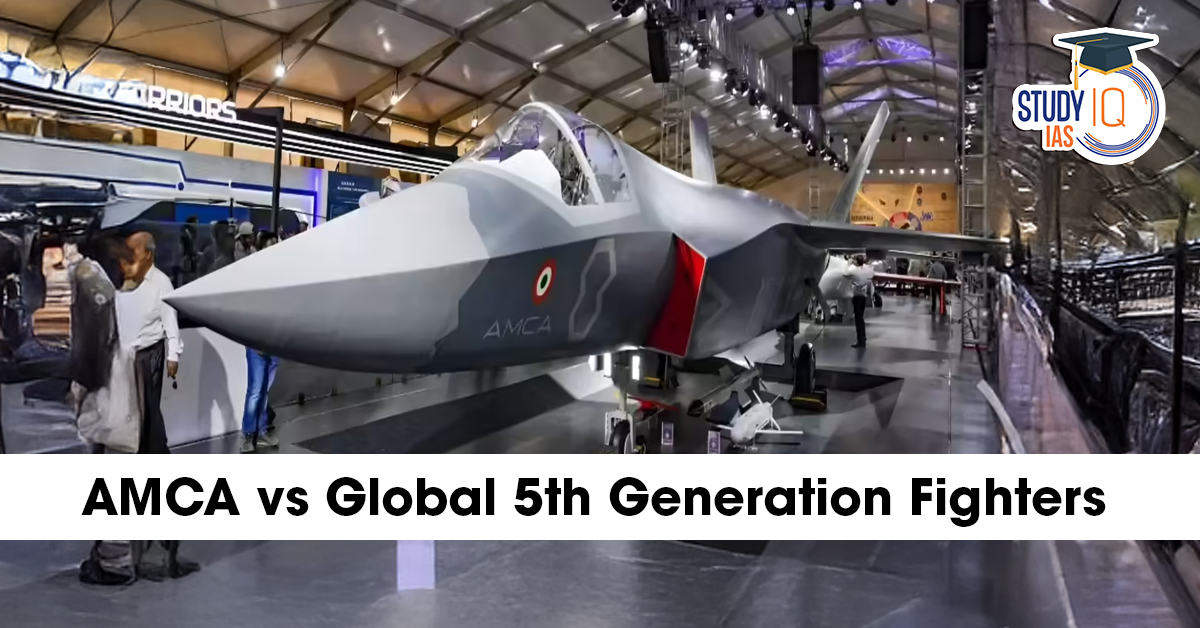
| ● The Advanced Medium Combat Aircraft (AMCA) is India’s indigenous fifth-generation stealth fighter jet.
● It will be: Single-seat, Twin-engine and Equipped with advanced stealth features ● It aims to place India among countries operating fifth-generation fighters such as: USA (F-22, F-35), China (J-20) and Russia (Su-57) Key Technical Features ● AMCA will feature: ○ Internal weapons bays (to avoid radar reflection) ○ Serpentine air intakes ○ Advanced radar-absorbing materials ○ These reduce radar signature and enhance survivability. ● Supercruise Capability: The aircraft will be capable of sustained supersonic flight without afterburners, improving fuel efficiency and combat endurance. ● Engine Configuration ○ Mk-1 Variant: Powered by GE F-414 engines (USA) ○ Mk-2 Variant: Planned indigenous 120 kN thrust engine in collaboration with French company Safran |
Why Does India Need AMCA?
- Countering China’s Air Superiority: China has already deployed Chengdu J-20 and is testing sixth-generation systems. Pakistan is reportedly exploring the J-35 stealth fighter. Without AMCA, India risks a generational capability gap in air dominance.
- Declining Squadron Strength: The Indian Air Force (IAF) is sanctioned for 42 squadrons but currently operates around 30–32 squadrons. Many legacy aircraft are being phased out.
- AMCA will help restore long-term force structure.
- Strategic Autonomy: Dependence on foreign fighter jets limits operational sovereignty. Indigenous development:
- Reduces import dependence
- Ensures control over upgrades
- Protects operational secrecy
- Future Air Combat Requirements: Modern warfare requires:
- Stealth penetration
- Electronic warfare dominance
- Drone teaming
- AI-enabled decision-making
AMCA is designed for next-generation battlefield scenarios.
|
India’s Current Fighter Fleet |
| ● Sukhoi-30MKI: Backbone of IAF fleet; assembled by HAL. Heavy, long-range multirole fighter.
● Rafale: India operates 36 Rafales, with 114 more recently cleared for procurement. Highly advanced 4.5-generation aircraft. ● Tejas (LCA): Indigenous Light Combat Aircraft built by HAL. Tejas Mk-1A production is ongoing. ● MiG Series (Phasing Out): MiG-21 and MiG-29 fleets are aging and gradually being retired. ● Jaguar and Mirage-2000: Undergoing upgrades but represent older generation platforms. Capability Gap: While India has strong 4th and 4.5-generation fighters, it lacks an operational fifth-generation stealth aircraft — which AMCA aims to fill. |
 West Bengal Elections 2026: Full Schedul...
 ISRO Launches Mission MITRA in Ladakh: A...
 Disaster Management in India, Classifica...













 WhatsApp





