
Table of Contents
Context
- In the 2026-27 Budget, the outlay for the PM-KUSUM scheme nearly doubled to ₹5,000 crore, with the government considering a National Agri-photovoltaics Mission to achieve 10 GW of capacity.
- This move positions Agri-photovoltaics (agriPV) as a primary solution to India’s land-use conflict between food security and the 300 GW solar target for 2030.
Key Features of Agri-photovoltaics (AgriPV)
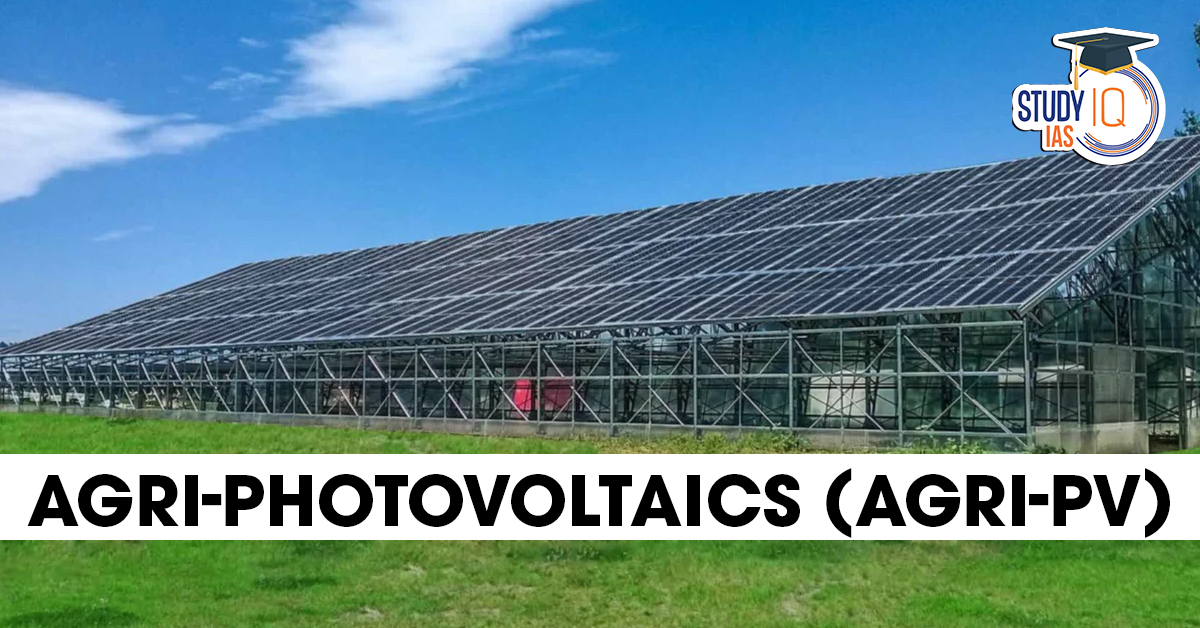
- Elevated Mounting: Panels are fixed several meters high to ensure enough clearance for farmers, labourers, and even tractors to operate beneath them.
- Variable Design: Systems can be row-based (panels between crops), vertical (bifacial panels capturing sun from both sides), or greenhouse-integrated.
- Micro-climate Control: The panels create a shading effect that can reduce soil temperature and protect sensitive crops from extreme weather like hail.
- Technical Optimization: Uses specific spacing and tilt to balance the Light Saturation Point of crops with maximum solar energy capture.
Opportunities for India in agriPV
- Income Diversification: Farmers gain a secondary, stable revenue stream from selling surplus power or leasing land to developers.
- Water Conservation: Partial shading reduces evapotranspiration, allowing the soil to retain moisture longer and reducing irrigation needs.
- Land Neutrality: It solves the food vs. fuel debate by utilising existing agricultural land for solar without diverting it from food production.
- Rural Industrialization: Generated power can run on-farm ancillary services like cold storage, reducing post-harvest losses.
- Climate Resilience: Panels act as a physical shield against increasing instances of heatwaves and unseasonal heavy rainfall.
Initiatives Taken
- PM-KUSUM 2.0: Budget 2026-27 increased funding to ₹5,000 crore to promote decentralised solar power centred on farmers.
- Proposed National Agri-photovoltaics Mission: A dedicated 10-GW component aimed at scaling the technology beyond pilot stages.
- Viability Gap Funding (VGF): The government plans to provide financial support to offset the high initial capital costs of elevated solar structures.
- Pilot Installations: Approximately 50 national-level pilots are currently evaluating different panel-crop combinations across diverse agro-climatic zones.
Also Read: India’s Solar Waste Management
Challenges Associated
- High Capital Intensity: Elevated structures require more steel and specialised engineering, making them costlier than ground-mounted solar.
- Yield Uncertainty: Incorrect shading or poor design can lead to reduced photosynthesis and lower agricultural output.
- Regulatory Hurdles: Lack of clear guidelines on land-use classification (Agri vs. Industrial) can lead to legal and tax complications.
- Technical Skill Gap: Maintaining both a high-tech solar array and a sensitive crop matrix requires a dual skill set that most farmers currently lack.
- Grid Connectivity: Many remote farms lack the last-mile infrastructure to feed surplus power back into the national grid.
Way Ahead
- Region-Specific Planning: Develop a Crop-Matrix for different states (e.g., Ragi for Karnataka, Turmeric for MP) to optimize shade-yield ratios.
- Clear Governance Frameworks: Establish uniform Dual-Use land laws to protect farmers’ land rights and provide long-term revenue clarity.
- Accessible Finance: Create low-interest Agri-Solar Loans and involve FPOs to aggregate small landholdings for better bargaining power.
- Standardization of Design: The CWC and Ministry of Power should issue benchmark designs for mounting structures to reduce investor uncertainty.
- R&D Expansion: Increase the number of Live Labs across all 15 agro-climatic zones to gather more empirical evidence on long-term soil health.
|
Read More Notes |
|
| Environment Notes | Art and Culture Notes |
| Science and Tech | History Notes |
| Geography Notes | Indian Polity Notes |
| General Knowledge | International Relation |
|
Explore StudyIQ Courses |
|

 Urea Production, Process, Key Issues and...
 Delhi’s Smog-Eating Road Initiative: T...
 Erratic Weather in March, Causes and Imp...













 WhatsApp





