
Table of Contents
Context
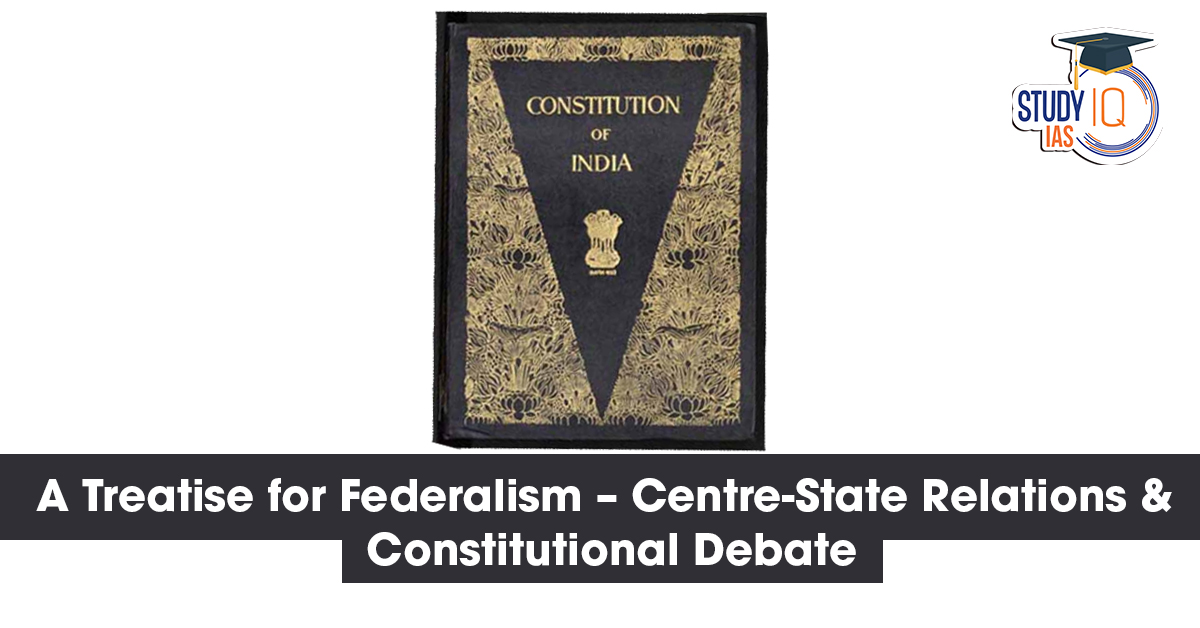
A high-level committee on Union–State relations appointed by the Government of Tamil Nadu, chaired by former Supreme Court judge Kurian Joseph, has presented a detailed report warning against the growing centralisation of power in India. The report calls for urgent corrective steps to protect and strengthen federal democracy.
Core Findings of the Report
- Rising centralisation of power: The report observes that decision-making authority is increasingly concentrated in the Union government, weakening the autonomy of States.
- Federal balance under strain: It argues that excessive central control undermines cooperative federalism, which is vital for a country as large and diverse as India.
- Call for a “structural reset”: The committee suggests reforms comparable in scale to the economic reforms of 1991, to restore balance between the Centre and States.
- Use of constitutional history and scholarship: The report draws from Constituent Assembly debates and earlier commissions on Centre–State relations to support its conclusions.
Historical Context
- Central tilt at the time of Constitution-making: The framers adopted a stronger centre due to Partition and the integration of princely States.
- Reinforcement over decades: Subsequent laws, constitutional amendments, and administrative practices gradually strengthened the Union’s dominance.
Key Areas of Concern Highlighted
- Ease of constitutional amendment: The report notes that amendments affecting federal balance can be passed relatively easily, enabling further centralisation.
- Reorganisation of states: The 2019 reorganisation of Jammu and Kashmir into two Union Territories is cited as an example of the Centre’s overriding authority over States.
- Language policy debates: Efforts to promote a single national language are seen as creating tensions in a multilingual country.
- Role of Governors: The report points to increasing friction between Governors and elected State governments, affecting State autonomy.
- Delimitation concerns: Proposed reallocation of Lok Sabha seats has raised fears among States that successfully controlled population growth, as they may lose relative representation.
- Central control over key sectors: Areas like education, health, and elections are witnessing greater Union involvement, reducing State flexibility.
- Impact of GST regime: The Goods and Services Tax system has altered fiscal relations, with States depending more heavily on Union transfers.
|
Read More Notes |
|
| Environment Notes | Art and Culture Notes |
| Science and Tech | History Notes |
| Geography Notes | Indian Polity Notes |
| General Knowledge | International Relation |
|
Explore StudyIQ Courses |
|
 Legal Issues in the Definition of Rape â...
 A Tribal Hamlet’s tryst with AI: Limbu...
 US Supreme Court Rejects Trump Tariffs â...










 WhatsApp





