Table of Contents
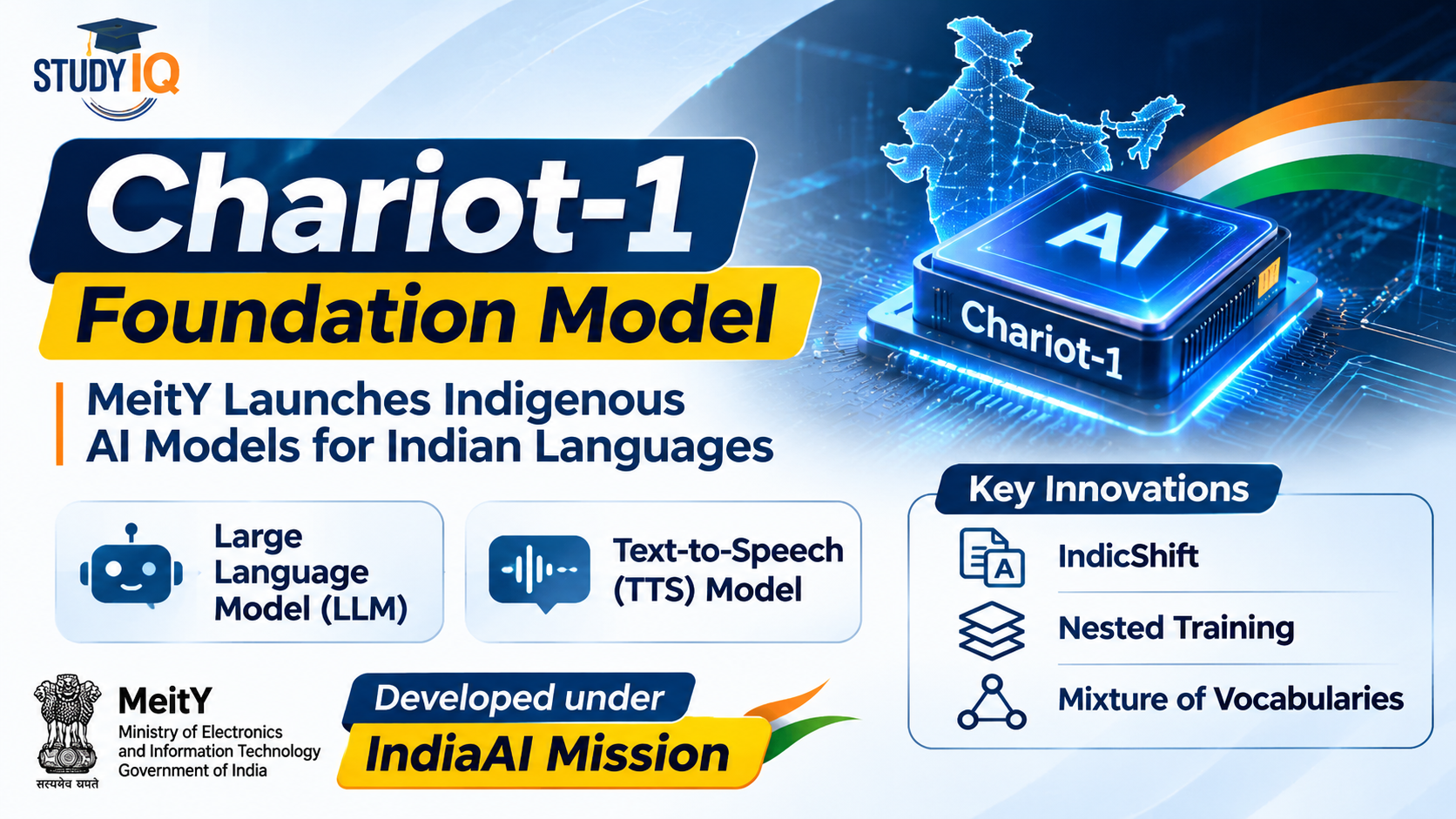
The Ministry of Electronics and Information Technology (MeitY) has launched the Chariot-1 Foundation Models, a suite of indigenous Artificial Intelligence (AI) models designed to strengthen India’s capabilities in developing AI technologies for Indian languages.
Developed by Chariot Artificial Intelligence Pvt. Ltd. under the IndiaAI Mission, the models include a Large Language Model (LLM) and a Text-to-Speech (TTS) model. They have been pre-trained from scratch in India, highlighting the country’s efforts to develop indigenous AI infrastructure and reduce dependence on foreign AI technologies.
What is the Chariot-1 Foundation Model?
Chariot-1 is a suite of indigenous AI foundation models designed to support language processing and speech generation.
It consists of two major components:
- Large Language Model (LLM): An AI model designed to understand and generate human language.
- Text-to-Speech (TTS) Model: An AI model that converts written text into natural-sounding speech.
The models have been developed by Chariot Artificial Intelligence Pvt. Ltd. under the IndiaAI Mission.
Their development aims to improve AI capabilities for Indian languages while making advanced AI technologies more accessible across different computational environments.
Three Key Research Innovations of Chariot-1
The Chariot-1 development team has introduced three major research innovations to improve training efficiency and performance.
1. IndicShift
IndicShift is an open-source technology that introduces a shared alphabet for Indian scripts.
Key Features:
- It creates a shared representation for different Indian language scripts.
- It improves model performance on Indian languages by approximately 5–8%.
- It achieves these improvements using the same computing resources.
- It maintains performance in English and coding-related tasks.
2. Nested Training
Nested Training is a technique that enables multiple model sizes to be trained simultaneously through a single training run using a shared set of weights.
Key Features:
- It enables the simultaneous training of three different model sizes.
- It reduces the need for separate training processes.
- It reportedly improves training speed by 62% compared with training the three model sizes independently.
3. Mixture of Vocabularies
This technique divides the model’s vocabulary into 11 different groups.
Key Features:
- It reduces the number of vocabulary entries evaluated per word by approximately 5.7 times.
- It improves training speed by 38% on the same GPUs.
- It maintains model performance with negligible changes in model loss.
These innovations aim to make AI model development more computationally efficient.
Key Features of Chariot-1 Large Language Model (LLM)
The Chariot-1 Large Language Model is an 11-billion-parameter Mixture-of-Experts (MoE) model.
Its major features include:
- Total Parameters: 11 billion.
- Active Parameters: 4 billion per token.
- Architecture: Mixture-of-Experts (MoE).
- Model Sizes: 10.7 billion, 1.7 billion and 745 million parameters.
The availability of multiple model sizes allows deployment across different computational environments and hardware capabilities.
Key Features of Chariot-1 Text-to-Speech (TTS) Model
The Chariot-1 Text-to-Speech model is designed to convert written text into speech in English and 10 Indian languages.
Supported Indian Languages:
- Hindi
- Bengali
- Marathi
- Tamil
- Telugu
- Kannada
- Malayalam
- Gujarati
- Punjabi
- Odia
Major Capabilities
- It can generate speech in English and 10 Indian languages.
- It understands contextual information while converting text into speech.
- It can determine how numbers, dates, currencies, measurement units, URLs and abbreviations should be pronounced.
- It recorded more than 97% verbalisation accuracy on the Async TTS Pronunciation Benchmark.
This capability can improve accessibility and make digital information more useful for people who prefer listening to content in their own languages.
Significance of Chariot-1 Foundation Models for India
The launch of Chariot-1 is significant for India’s growing indigenous AI ecosystem.
1. Promoting AI in Indian Languages
India has considerable linguistic diversity. Indigenous AI models can help make digital services and AI-based applications more accessible to people speaking different Indian languages.
2. Strengthening Digital Inclusion
Text-to-Speech technology can support people who prefer audio-based communication and improve access to digital information.
3. Reducing Dependence on Foreign AI Models
Developing foundation models within India can strengthen domestic technological capabilities and encourage indigenous AI research.
4. Improving Computational Efficiency
Innovations such as IndicShift, Nested Training and Mixture of Vocabularies can improve model training efficiency and optimise the use of computing resources.
5. Supporting India’s AI Ecosystem
The development of indigenous foundation models can encourage innovation, research and entrepreneurship in India’s AI sector.
What is the IndiaAI Mission?
The IndiaAI Mission is a Government of India initiative aimed at strengthening the country’s artificial intelligence ecosystem.
It seeks to build a comprehensive AI ecosystem through improved access to computing infrastructure, support for indigenous AI development, innovation, research and skill development.
The mission focuses on making AI accessible, promoting responsible AI development and strengthening India’s position in the global AI landscape.
Chariot-1 Foundation Model: Important Facts for UPSC
| Particulars | Details |
|---|---|
| Launched by | Ministry of Electronics and IT (MeitY) |
| Developed by | Chariot Artificial Intelligence Pvt. Ltd. |
| Government initiative | IndiaAI Mission |
| Model components | LLM and TTS |
| LLM architecture | Mixture-of-Experts |
| Total LLM parameters | 11 billion |
| Active parameters | 4 billion per token |
| Model sizes | 10.7B, 1.7B and 745M |
| IndicShift improvement | 5–8% |
| Nested Training speed improvement | 62% |
| Mixture of Vocabularies speed improvement | 38% |
| TTS language support | English and 10 Indian languages |
| TTS verbalisation accuracy | Over 97% |

Frequently Asked Questions (FAQs)
Q1. What is the Chariot-1 Foundation Model?
Answer: Chariot-1 is a suite of indigenous AI models consisting of a Large Language Model (LLM) and a Text-to-Speech (TTS) model.
Q2. Under which government initiative was Chariot-1 developed?
Answer: It was developed under the IndiaAI Mission.
Q3. Which organisation developed the Chariot-1 Foundation Models?
Answer: Chariot Artificial Intelligence Pvt. Ltd.
Q4. What are the three major research innovations introduced in Chariot-1?
Answer: IndicShift, Nested Training and Mixture of Vocabularies.
Q5. How many Indian languages are supported by the Chariot-1 TTS model?
Answer: Ten Indian languages, in addition to English.
Q6. What is the architecture of the Chariot-1 Large Language Model?
Answer: It is an 11-billion-parameter Mixture-of-Experts model with 4 billion active parameters per token.
 Delimitation in India 2026: Meaning, Con...
 Red Planet Day 2026: History, Significan...
 Karnataka Judiciary Notification 2026 Ou...












 WhatsApp