Table of Contents
India and Nepal share a unique relationship shaped by geographical proximity, historical connections, cultural similarities and economic interdependence. Their open border, religious ties and extensive people-to-people contacts make Nepal an important partner in India’s Neighbourhood First Policy.
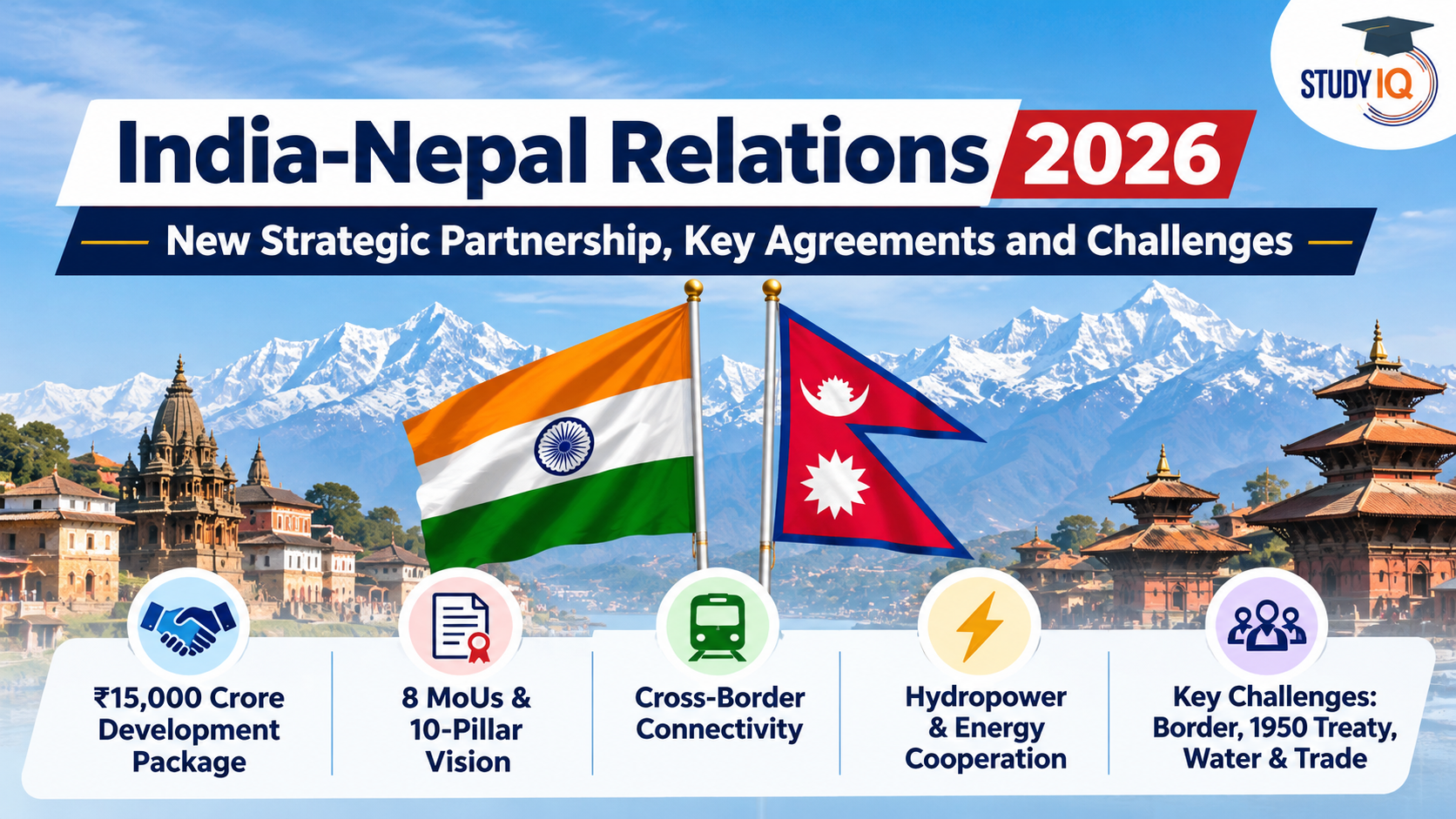
In November 2026, India and Nepal took significant steps to strengthen bilateral relations during Nepalese Prime Minister Balendra Shah’s first bilateral visit to India since assuming office. The two countries signed eight Memorandums of Understanding (MoUs), announced a ₹15,000 crore Indian development cooperation package and adopted a 10-pillar Joint Vision Document titled Viksit Bharat and Samunnat Nepal: Re-imagining the Partnership. These initiatives aim to transform traditional bilateral ties into a modern development-oriented partnership.
Major Outcomes of the India-Nepal Partnership 2026
1. Economic and Development Cooperation
India announced a development cooperation package worth ₹15,000 crore (NPR 24,000 crore) to support Nepal’s reconstruction and economic development.
-
₹3,500 crore in grant assistance for reconstruction and infrastructure.
-
₹11,500 crore in rupee-denominated Line of Credit for energy projects.
-
Cooperation in establishing Special Economic Zones (SEZs), export-oriented manufacturing facilities and IT parks.
-
Improved access to India’s Kandla and Paradip ports for Nepal’s international trade.
These initiatives aim to strengthen Nepal’s economic diversification, investment opportunities and regional trade integration.
2. Eight MoUs and 10-Pillar Joint Vision
Both countries signed eight MoUs covering emerging and traditional areas of cooperation, including technology, healthcare, education and institutional development.
The 10-pillar vision document focuses on:
-
Economic and development partnership.
-
Physical and digital connectivity.
-
Energy cooperation.
-
Technology and innovation.
-
Education and healthcare.
-
Agriculture and industrial development.
-
Culture, tourism and people-to-people relations.
It provides a framework for aligning India’s Viksit Bharat 2047 vision with Nepal’s development aspirations.
3. Physical and Digital Connectivity
Connectivity is central to strengthening bilateral economic relations.
Major initiatives include:
-
Sarayu-Kamala Express connecting Ayodhya and Janakpur.
-
Dharchula-Darchula motorable bridge across the Mahakali River.
-
Development of Integrated Check Posts at Banbasa, Bhairahawa, Sunauli and Dodhara Chandani.
-
Expansion of Jayanagar-Bardibas and Jogbani-Biratnagar railway links.
-
Proposed Siliguri-Jhapa petroleum pipeline.
-
Expansion of cross-border UPI-based digital payments.
These projects will improve trade efficiency, tourism and cross-border mobility.
4. Hydropower and Energy Cooperation
Nepal possesses enormous hydropower potential, while India has growing electricity requirements. This creates opportunities for mutually beneficial energy cooperation.
Important projects include:
-
Lower Arun Hydroelectric Project: Foundation stone laid for the 669-MW project.
-
Arun-3 Hydropower Project: Commitment to timely completion.
-
Motihari-Amlekhgunj Pipeline: Inauguration of its second phase.
-
Jhapa Petroleum Terminal: Advancement of petroleum infrastructure development.
Energy cooperation can strengthen Nepal’s export potential and India’s regional energy security.
Major Challenges in India-Nepal Relations
Despite renewed diplomatic engagement, several challenges require attention.
1. Border Dispute: Nepal’s territorial claims over Kalapani, Lipulekh and Limpiyadhura remain unresolved.
2. 1950 Treaty: Nepal has sought a review of the Treaty of Peace and Friendship to reflect contemporary political and economic realities.
3. Water-Sharing Issues: Differences concerning river-water utilisation, hydropower development and flood management require sustained negotiations.
4. Trust Deficit: Concerns regarding sovereignty, economic dependence and perceived political interference periodically affect bilateral relations.
5. Trade Imbalance: Nepal’s considerable dependence on India for trade and transit highlights the need for economic diversification.
Both governments have emphasised resolving outstanding issues through dialogue and mutual understanding.
Way Forward
India and Nepal should focus on the following measures:
-
Respect Sovereignty: Strengthen relations based on equality, mutual trust and non-interference.
-
Resolve Border Disputes: Institutionalise diplomatic dialogue to address territorial disagreements.
-
Improve Connectivity: Complete cross-border railway, road and energy infrastructure projects.
-
Promote Economic Integration: Encourage investment, manufacturing and regional supply chains.
-
Strengthen Cultural Diplomacy: Expand Ramayana, Buddhist and Shiv-Shakti tourism circuits.
-
Ensure Implementation: Establish effective monitoring mechanisms to ensure timely execution of bilateral agreements.
Conclusion
India-Nepal relations are entering a new phase of strategic and economic cooperation. The 2026 Joint Vision Document provides an opportunity to expand collaboration in infrastructure, energy, technology, trade and human development.
However, the success of this partnership will depend on addressing longstanding differences, respecting each other’s sovereignty and ensuring the timely implementation of commitments. A stable, prosperous and economically integrated Nepal is essential for India’s regional connectivity, security and broader vision of a peaceful South Asia.

Frequently Asked Questions (FAQs)
Q1. What is the significance of the India-Nepal Joint Vision Document 2026?
It provides a 10-pillar framework to strengthen bilateral cooperation in economic development, connectivity, energy, technology, education and healthcare.
Q2. What is the development package announced by India for Nepal in 2026?
India announced a ₹15,000 crore development cooperation package comprising ₹3,500 crore in grants and ₹11,500 crore in a Line of Credit.
Q3. Which major border areas are disputed between India and Nepal?
Kalapani, Lipulekh and Limpiyadhura are the major disputed territorial areas.
Q4. Why is hydropower cooperation important for India and Nepal?
Nepal can utilise its hydropower potential to generate electricity for export, while India can strengthen its access to clean and renewable energy.
Q5. What is the 1950 India-Nepal Treaty of Peace and Friendship?
It is a bilateral treaty that provides the foundation for close relations, including provisions concerning security, trade, movement and reciprocal privileges between the two countries.
 National Landslide Susceptibility Mappin...
 Asia Power Index 2026: India Retains 3rd...
 GSSSB CCE Admit Card 2026: Download Grou...














 WhatsApp