Table of Contents
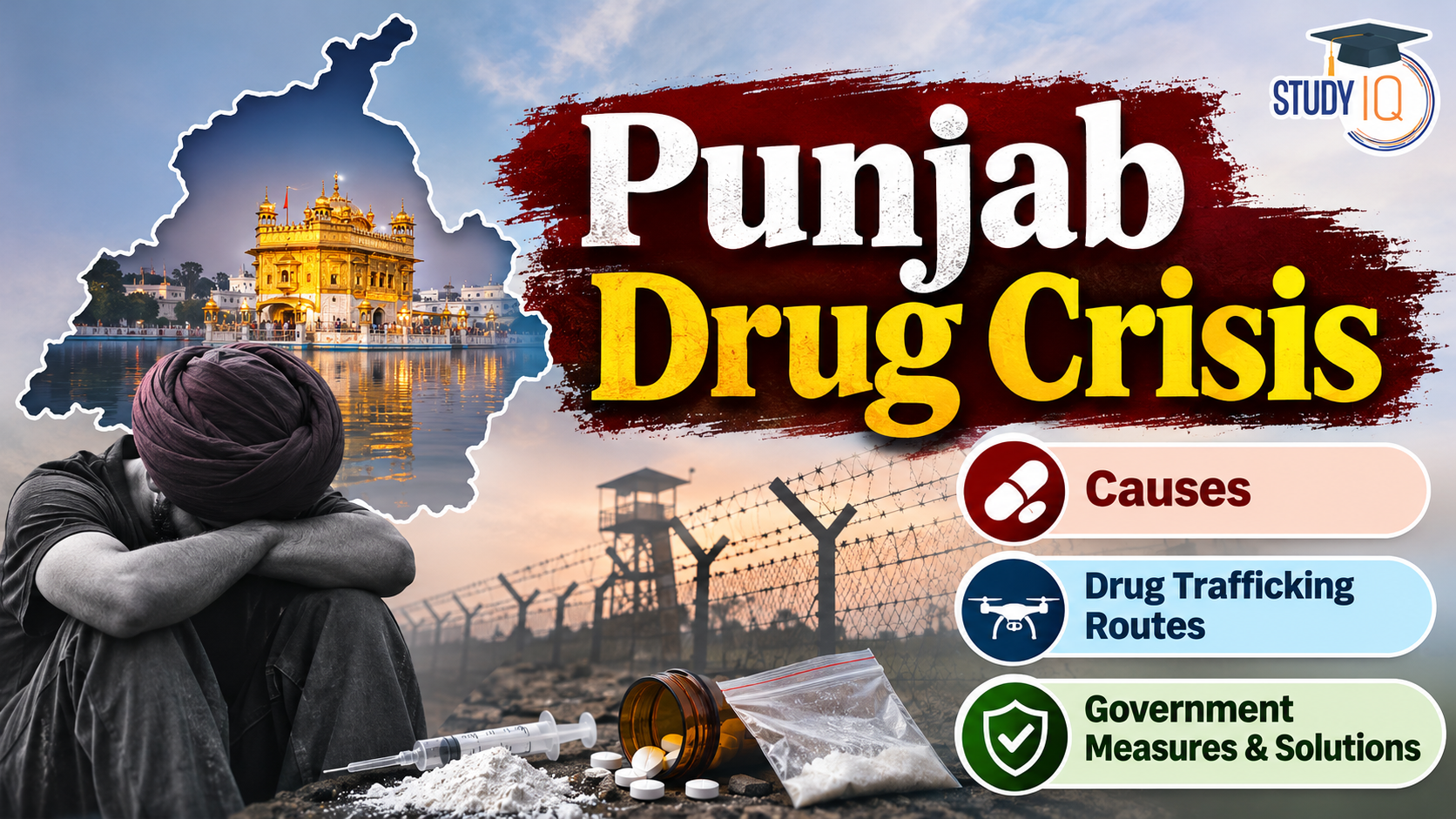
Punjab Drug Crisis has once again become a major concern following suspected overdose deaths and violence linked to illegal drug sales. Recently, 35-year-old Daljit Singh died of a suspected overdose, while activist Parvinder Singh Jhota was shot dead on October 13 after confronting a chemist over the alleged sale of prohibited drugs.
With Assembly elections approaching in 2027, drug abuse and trafficking have emerged as major political and social issues in Punjab.
Read Also: UPSC Daily Current Affairs 2026
Scale of the Drug Problem
According to NCRB 2024 data, released in September 2026:
-
Punjab recorded 6,060 drug trafficking cases, the highest among Indian states.
-
It reported 106 overdose deaths, second only to Tamil Nadu (313).
These figures highlight the continuing challenge of controlling drug trafficking despite repeated government interventions.
Major Causes of the Punjab Drug Crisis
1. Historical and Social Factors
Opium and poppy husk consumption have historical roots in Punjab. Before Independence, these intoxicants were socially accepted in certain communities. Despite restrictions after Independence, opium consumption continued in rural areas through illegal supply networks.
2. Geographical Vulnerability
Punjab shares a 553-km international border with Pakistan, making it vulnerable to cross-border drug trafficking.
-
The Golden Crescent (Pakistan, Afghanistan and Iran) is a major global heroin-producing region.
-
Heroin (chitta) is smuggled through the Pakistan border.
-
Opium and poppy husk enter through Rajasthan and Madhya Pradesh.
-
Charas and hashish are supplied from Himachal Pradesh.
Drug trafficking networks are also linked to concerns about narco-terrorism and the financing of organised crime.
3. Pharmaceutical Drug Abuse
The illegal sale of pharmaceutical drugs has become another major challenge.
-
In 2024, India seized approximately 5.13 crore pharmaceutical drug units.
-
Punjab accounted for 2.94 crore units.
-
Around 25% of Punjab Police NDPS FIRs in 2022 involved pharmaceutical drugs.
Illegal diversion from pharmaceutical manufacturing and distribution networks contributes to drug availability.
4. Drone-Based Smuggling
Drone-based smuggling has increased significantly along the India-Pakistan border. BSF data indicates that drone sightings and recoveries associated with smuggling increased from 3 in 2021 to more than 200 in 2025.
Small quadcopters are used to transport heroin and weapons, particularly in the Amritsar–Tarn Taran–Ferozepur–Gurdaspur belt.
5. Unemployment and Organised Crime
High profits from drug trafficking attract economically vulnerable youth. A single drug-carrier operation can reportedly earn around ₹1 lakh. The alleged nexus between traffickers, police officials and politicians further weakens enforcement.
Government Measures
Punjab follows an approach based on Enforcement, De-addiction and Prevention (EDP).
Major initiatives include:
-
War Against Drugs (2014): Strengthened action against traffickers and promoted awareness and rehabilitation.
-
Yudh Nasheyan Virudh (2025): Targeted drug trafficking networks and properties allegedly acquired through drug money.
-
Pind De Pehredar (2026): Deployed more than 1.5 lakh village volunteers to strengthen community participation and grassroots monitoring.
-
Border surveillance: BSF and Punjab Police have strengthened anti-drone capabilities to prevent cross-border smuggling.
Challenges and Way Forward
Despite these initiatives, drug availability remains a concern. Major challenges include weak rehabilitation facilities, unemployment, corruption, alternative trafficking routes and inadequate pharmaceutical regulation.
A comprehensive strategy should focus on:
-
Border security: Deploy advanced anti-drone technology and improve intelligence-sharing.
-
Pharmaceutical regulation: Monitor manufacturing, distribution and illegal medicine sales.
-
Institutional accountability: Break the trafficker-police-politician nexus through transparent investigations.
-
Rehabilitation: Expand affordable de-addiction centres and psychological counselling.
-
Employment: Promote skill development, entrepreneurship and rural employment.
-
Community participation: Involve schools, Panchayats, NGOs and families in drug prevention.
Conclusion
The Punjab drug crisis is not merely a law-and-order issue but also a serious public health, socio-economic and internal security challenge. Enforcement alone cannot eliminate it. A sustainable solution requires coordinated action involving border management, employment generation, pharmaceutical regulation, prevention and rehabilitation.
The ultimate objective should be to transform the fight against drugs into a society-wide movement for a drug-free Punjab.

 Khelo India Sports Goods Manufacturing S...
 Digital Arrest Fraud in India: Supreme C...
 E100 Flex-Fuel Vehicles in India: Meanin...













 WhatsApp