Table of Contents
Context
-
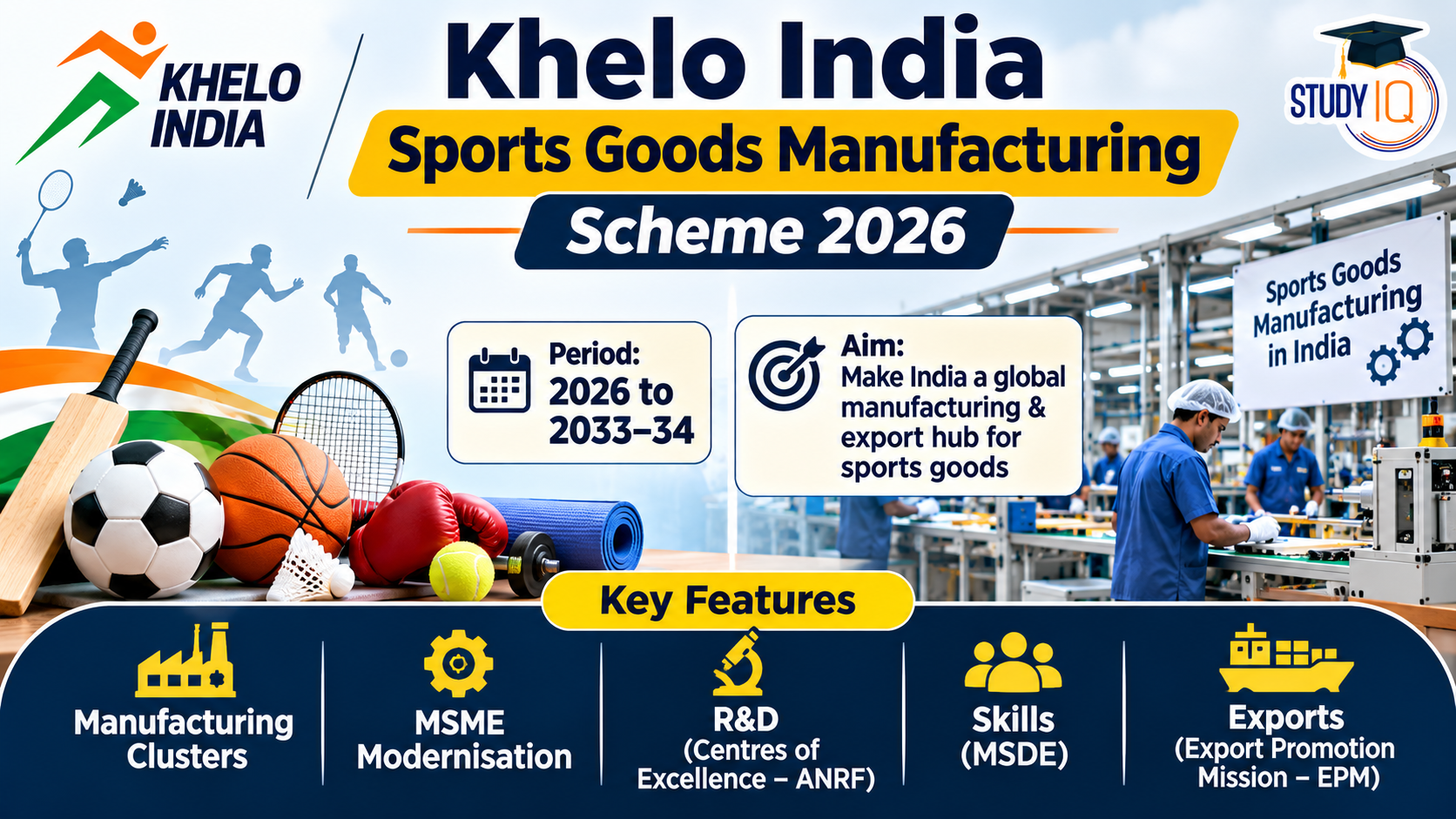
The Union Cabinet approved the Khelo India Sports Goods Manufacturing Scheme.
-
Implementation period: 2026 to 2033–34.
-
The scheme aims to develop India as a global hub for sports goods manufacturing and exports.
About the Scheme
-
Ministry: Ministry of Youth Affairs and Sports.
-
Nature: Central Sector Scheme.
-
Objective: Promote domestic sports goods manufacturing and reduce import dependence.
-
Focus Areas: Manufacturing infrastructure, MSME modernisation, research and development, skill development and exports.
Key Features
– Manufacturing Clusters:
-
Develop integrated manufacturing zones with production units, testing laboratories and prototyping facilities.
-
Utilise BHAVYA and NICDC industrial parks.
– MSME Modernisation:
-
Support traditional manufacturing hubs such as Jalandhar and Meerut.
-
Establish Common Facility Centres (CFCs).
-
Promote modern equipment and shared infrastructure.
– Research and Development:
-
Establish Centres of Excellence with ANRF support.
-
Focus on smart sports equipment, advanced polymers, carbon composites and protective gear.
– Skill Development:
-
Training and skill development through the Ministry of Skill Development and Entrepreneurship (MSDE).
– Export Promotion:
-
Strengthen international branding and market access through the Export Promotion Mission (EPM).
Significance of the Scheme
-
Atmanirbhar Bharat: Reduces dependence on imported sports goods.
-
Employment Generation: Creates manufacturing and skill-based employment opportunities.
-
MSME Development: Modernises traditional sports goods manufacturing clusters.
-
Innovation: Encourages indigenous R&D and advanced manufacturing technologies.
-
Export Competitiveness: Strengthens India’s position in the global sports goods market.
-
Sports Ecosystem: Supports the development of affordable and high-quality sports equipment.
Challenges
-
Limited investment in sports goods R&D.
-
Dependence on imported raw materials and advanced components.
-
Inadequate testing and certification infrastructure.
-
Competition from established global manufacturing hubs.
-
Skill gaps and limited technology adoption among MSMEs.
Way Forward
-
Strengthen industry-academia collaboration.
-
Promote indigenous materials and advanced manufacturing.
-
Improve international quality certification.
-
Provide technology and credit support to MSMEs.
-
Develop globally competitive Indian sports goods brands.
Conclusion
The Khelo India Sports Goods Manufacturing Scheme can strengthen India’s domestic manufacturing ecosystem by integrating infrastructure, innovation, skill development and export promotion. It can contribute to Atmanirbhar Bharat, employment generation and India’s emergence as a global sports goods manufacturing hub.

 Punjab Drug Crisis: Causes, Drug Traffic...
 Digital Arrest Fraud in India: Supreme C...
 E100 Flex-Fuel Vehicles in India: Meanin...












 WhatsApp