Table of Contents
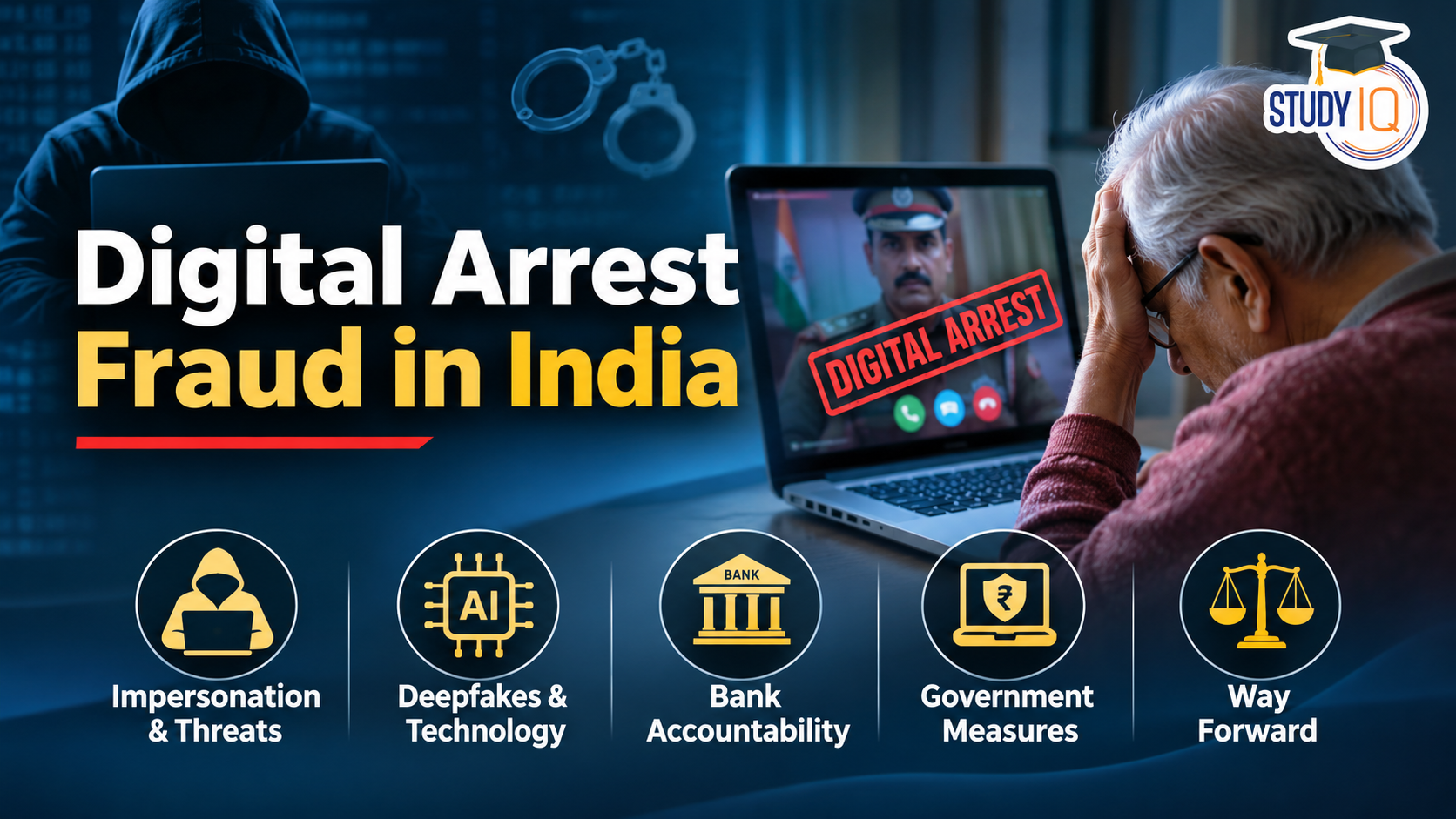
Digital arrest fraud has emerged as one of India’s most alarming forms of cybercrime. Fraudsters impersonate police officers, CBI officials, judges and other government authorities to threaten victims with fabricated allegations of money laundering, drug trafficking and other serious offences.
The Supreme Court of India has described digital arrest as the “biggest financial fraud” on the economy and raised concerns about the involvement and accountability of banks in such cases.
The Court has also explored whether banks should compensate victims and face prosecution where failure of due diligence facilitates fraudulent transactions.
As of January 2026, losses from digital arrest scams had reportedly exceeded ₹3,000 crore, with senior citizens among the most vulnerable victims.
What is Digital Arrest Fraud?
Digital arrest is a type of cyber-enabled financial fraud in which criminals impersonate law enforcement agencies or judicial authorities to psychologically manipulate victims.
Fraudsters convince victims that they are under investigation or facing imminent arrest and force them to remain under continuous surveillance through video or audio calls.
Common methods used by fraudsters:
-
Fake Government Identity: Criminals pose as police officers, CBI officials, customs officers or judges.
-
False Allegations: Victims are accused of involvement in money laundering, drug trafficking or financial crimes.
-
Video Surveillance: Victims are instructed to remain on video calls, sometimes for several hours or days.
-
Fake Legal Documents: Forged arrest warrants, court orders and investigation notices are used to create credibility.
-
Financial Extortion: Victims are pressured to transfer money into accounts supposedly meant for verification or security deposits.
Important: There is no legal procedure called digital arrest in India. Police or investigating agencies cannot arrest individuals through video calls or demand money for avoiding arrest.
Why Have Digital Arrest Frauds Increased Sharply in India?
Several technological, psychological and institutional factors have contributed to the rapid growth of digital arrest scams.
A. Digitalisation Without Adequate Awareness
The rapid expansion of smartphones, UPI and internet banking has increased digital financial participation. However, awareness about cybercrime prevention has not developed at the same pace.
-
Cybercrime complaints increased from 39,925 in 2022 to 1,23,672 in 2024.
-
Reported financial losses increased from ₹91 crore to ₹1,935 crore during the same period.
This gap between digital adoption and digital literacy makes citizens vulnerable to online manipulation.
B. Fear and Psychological Manipulation
Fraudsters exploit people’s fear of arrest, social embarrassment and legal consequences.
-
Victims are threatened with serious criminal charges.
-
Fake investigations create panic and confusion.
-
Many victims avoid contacting family members or authorities due to fear and shame.
The amicus curiae informed the Supreme Court that even educated individuals fall victim because their fear of arrest becomes stronger than their ability to verify the claims.
C. Sophisticated Social Engineering and Artificial Intelligence
Cybercriminals increasingly use advanced technological tools to create convincing fraudulent identities.
Common techniques include:
-
Caller ID spoofing.
-
Fake police and CBI identity cards.
-
Forged court orders and arrest warrants.
-
Mock police stations and courtrooms during video calls.
-
AI-generated deepfake videos and voice cloning.
In some cases, fraudsters have even impersonated senior judicial and investigating authorities using forged Supreme Court documents.
D. Easy Access to Criminal Infrastructure
The availability of digital tools and financial intermediaries makes these scams easier to execute.
-
SIM Boxes: Help criminals manipulate calling systems and disguise their identities.
-
Encrypted Applications: Make communication and investigation difficult.
-
Mule Bank Accounts: Allow criminals to receive and transfer stolen money.
-
Data Leaks: Exposed Aadhaar and financial information make fraudulent calls appear authentic.
E. Organised Cross-Border Cybercrime Networks
Digital arrest scams are increasingly linked to organised transnational criminal syndicates.
-
Major scam hubs have been reported in Cambodia, Laos and Myanmar.
-
Indian hotspots include Mewat, Jamtara and Ahmedabad.
-
Organised groups use trained callers, scripts and knowledge of Indian legal procedures.
Such networks make investigation, financial recovery and international cooperation more challenging.
Why Does the Supreme Court Want Banks to Be Accountable?
The Supreme Court has questioned whether banks should bear responsibility when their failure to exercise due diligence facilitates digital arrest fraud.
A. Massive Financial Losses
Digital arrest scams have caused losses worth thousands of crores.
The Court highlighted the scale of the problem and referred to victims losing substantial amounts despite increasing public awareness.
One victim reportedly lost ₹2.5 crore just a week before the hearing.
B. Banks Are the Financial Choke Points
Almost every digital arrest scam ultimately involves the transfer of money through bank accounts.
Fraudsters commonly use mule accounts to receive and rapidly move stolen funds.
Therefore, banks can play a critical role in:
-
Identifying suspicious transactions.
-
Detecting unusual account activity.
-
Flagging high-risk transfers.
-
Temporarily holding suspicious transactions.
-
Coordinating with law enforcement agencies.
C. Failure of Due Diligence
Banks are expected to maintain effective Know Your Customer (KYC) procedures and transaction-monitoring mechanisms.
However, inadequate monitoring may allow suspicious accounts to receive large amounts of money from unsuspecting victims.
The Chief Justice questioned why banks that waive thousands of crores through one-time settlements should not also be accountable for preventing losses suffered by cybercrime victims.
D. Weaknesses in Existing Regulatory Guidelines
The Supreme Court expressed concerns that advisory guidelines may not be sufficient to address the growing problem.
It favoured stronger and enforceable safeguards, including:
-
Temporary suspension of unusual transactions.
-
Full verification before releasing suspicious transfers.
-
Zero-debit safeguards in appropriate cases involving victims.
-
Clear compensation and accountability mechanisms.
The Attorney General also indicated that RBI guidelines were expected by December.
E. Concerns Regarding Blanket Bank Liability
However, imposing automatic liability on banks for every digital arrest fraud could create practical and legal challenges.
-
Not every fraudulent transaction results from negligence by bank employees.
-
Some bank officials have proactively identified and prevented suspicious transfers.
-
Excessive restrictions could affect legitimate banking transactions.
-
Establishing the connection between bank negligence and financial loss requires proper investigation.
Therefore, accountability should be linked to demonstrable failure of due diligence rather than automatic liability.
Measures Taken by the Government and Judiciary to Curb Digital Arrest Fraud
India has introduced several institutional, technological and regulatory measures to strengthen its response to cybercrime.
A. Supreme Court’s Judicial Intervention
The Supreme Court initiated suo motu proceedings to examine the growing threat of digital arrest fraud.
Its interventions have focused on:
-
Preservation of digital evidence and financial records.
-
Coordination between ministries and investigating agencies.
-
Protection and assistance for victims.
-
Standard Operating Procedures (SOPs) for temporary debit holds.
-
e-Zero FIR mechanisms.
-
Shared-liability frameworks.
-
Faster recovery and return of defrauded money.
B. Institutional Coordination
Several government institutions are involved in preventing and investigating cybercrime.
| Institution | Major Role |
|---|---|
| Indian Cyber Crime Coordination Centre (I4C) | Coordinates cybercrime prevention and investigation. |
| Central Bureau of Investigation (CBI) | Investigates major and complex cybercrime cases within its jurisdiction. |
| Joint Cyber Coordination Teams | Improve coordination among state and central agencies. |
| Inter-Departmental Committee | Coordinates policy and institutional responses. |
| Ministry of Home Affairs | Oversees national cybercrime coordination initiatives. |
C. Blocking Misused Telecom Resources
The Department of Telecommunications (DoT) has taken steps to prevent the misuse of telecom infrastructure.
By the end of 2025, reported blocking measures included:
-
More than 7.8 lakh SIM cards.
-
More than 2.9 lakh IMEIs.
-
Over 83,000 WhatsApp accounts.
-
More than 3,900 Skype IDs.
These actions aim to disrupt fraudulent communication networks and prevent the repeated use of compromised telecom resources.
D. Cybercrime Reporting and Financial Fraud Prevention
The government has established multiple mechanisms to help citizens report cybercrime and prevent further financial losses.
Important initiatives:
-
1930 Cybercrime Helpline: Enables victims to report financial cyber fraud quickly.
-
National Cyber Crime Reporting Portal (NCRP): Provides an online platform to report cybercrime.
-
Citizen Financial Cyber Fraud Reporting and Management System (CFCFRMS): Facilitates coordination between banks, financial intermediaries and law enforcement agencies to prevent the movement of fraudulent funds.
-
Samanvaya Platform: Supports coordination and analysis of cybercrime-related information.
-
Pratibimb Platform: Helps identify and map cybercriminal networks and their digital infrastructure.
E. International Cooperation
Since many digital arrest scams involve foreign-based criminal syndicates, India has strengthened its focus on international coordination.
An inter-ministerial committee was established in May 2024 to address transnational cybercrime challenges.
International cooperation is essential for:
-
Identifying overseas scam centres.
-
Tracing cross-border financial transactions.
-
Sharing intelligence.
-
Securing extradition of accused persons.
-
Dismantling organised cybercrime networks.
Way Forward: How Can India Effectively Prevent Digital Arrest Fraud?
A comprehensive response requires stronger banking regulation, telecom security, international cooperation and public awareness.
A. Mandatory Banking Safeguards
The RBI should establish enforceable guidelines requiring banks to:
-
Detect unusual and high-value transactions through AI-based monitoring.
-
Introduce additional verification for suspicious transfers.
-
Strengthen monitoring of accounts receiving multiple suspicious deposits.
-
Provide rapid temporary debit-hold mechanisms.
-
Establish clear compensation rules where negligence is established.
B. Strengthening the Fight Against Mule Accounts
Mule accounts are a major link between victims and organised cybercriminal networks.
Measures should include:
-
Strict KYC compliance.
-
Risk-based monitoring of newly opened accounts.
-
Faster identification and freezing of suspicious accounts.
-
Accountability for financial institutions that repeatedly fail to detect suspicious accounts.
-
Improved information-sharing between banks and law enforcement agencies.
C. Closing Telecom Security Gaps
Telecom infrastructure should be strengthened to prevent caller ID spoofing and impersonation.
-
Block fraudulent SIM cards and compromised IMEI numbers.
-
Strengthen international VoIP monitoring.
-
Improve detection of spoofed Indian mobile numbers.
-
Expand the use of Sanchar Saathi for telecom fraud prevention.
D. Strengthening Global Cooperation
India should work with international organisations and partner countries to dismantle transnational cybercrime networks.
A coordinated BRICS or G20 cybercrime cooperation mechanism could support intelligence-sharing, financial tracking and cross-border law enforcement.
E. Dedicated Cybercrime Courts
Specialised cybercrime courts and trained prosecutors can improve the speed and quality of cybercrime trials.
They can also strengthen victim protection, evidence management and financial recovery.
F. Awareness and Digital Literacy
Public awareness campaigns must focus on practical behavioural changes rather than general warnings.
The message should be simple:
Ruko, Socho, Action Lo.
-
Never share OTPs, passwords or banking information.
-
Never transfer money under pressure from someone claiming to be a police officer.
-
Verify suspicious calls independently.
-
Inform family members immediately.
-
Preserve call recordings, messages and transaction details.
-
Report financial cyber fraud immediately through 1930 or the National Cyber Crime Reporting Portal.
Most importantly, victims should not feel ashamed. Prompt reporting can improve the possibility of stopping fraudulent transactions and recovering money.
Conclusion
Digital arrest fraud represents a serious challenge to India’s digital economy, financial security and citizens’ trust in public institutions.
While technological innovation has expanded financial inclusion, cybercriminals are exploiting gaps in digital literacy, banking safeguards and law enforcement coordination.
The Supreme Court’s intervention highlights the need to move beyond awareness campaigns towards a comprehensive system of institutional accountability.
India needs a coordinated cyber-security framework in which banks, telecom operators, law enforcement agencies and citizens work together to make digital transactions safer and protect vulnerable sections of society.
Important Facts
| Topic | Important Fact |
|---|---|
| Digital Arrest | A cyber-enabled impersonation and financial fraud |
| 1930 | National Cybercrime Helpline for financial fraud reporting |
| NCRP | National Cyber Crime Reporting Portal |
| I4C | Indian Cyber Crime Coordination Centre |
| CFCFRMS | Citizen Financial Cyber Fraud Reporting and Management System |
| DoT | Department of Telecommunications |
| Sanchar Saathi | Telecom security and citizen protection initiative |
| Mule Account | Bank account used to receive or transfer proceeds of illegal activities |
| SIM Box | Device used to route large volumes of calls through SIM cards |
| Spoofing | Manipulating caller identification or digital identity |
| Deepfake | AI-generated or manipulated audio-visual content |

 Punjab Drug Crisis: Causes, Drug Traffic...
 Khelo India Sports Goods Manufacturing S...
 E100 Flex-Fuel Vehicles in India: Meanin...














 WhatsApp