
Table of Contents
Context
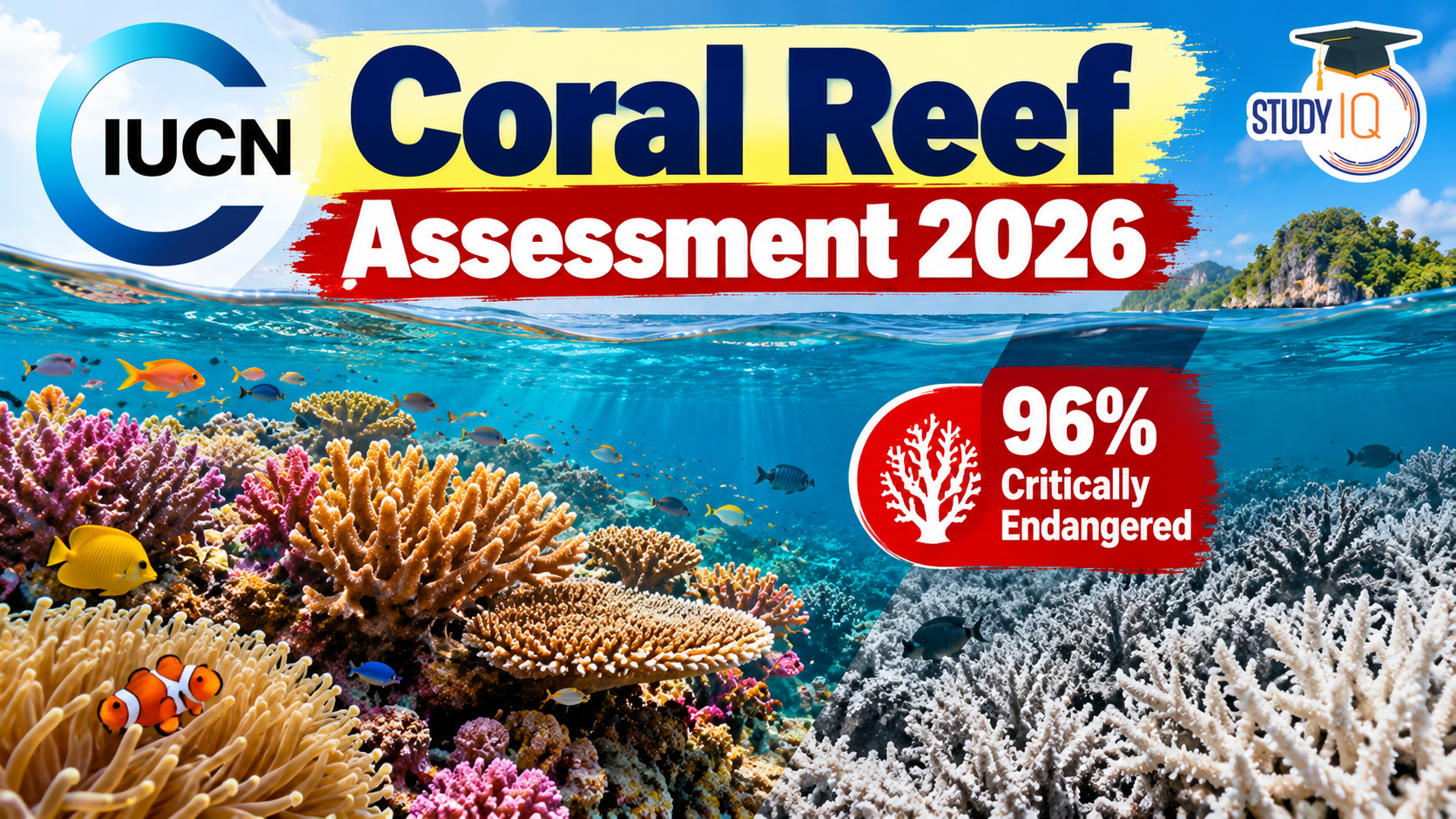
The IUCN released its first global assessment of coral reefs under the IUCN Red List of Ecosystems. It was released at the UN Biodiversity Conference (COP17), Yerevan, Armenia. It warns that nearly all shallow-water reefs face a very high risk of collapse by 2075, with 96% classed as Critically Endangered.
About Coral Reefs
- Nature: Underwater structures built by coral polyps that secrete calcium carbonate (CaCO₃).
- Symbiosis: Polyps live with algae called zooxanthellae. The algae give corals up to 90% of their energy and their colour.
- Collapse: Extreme heat kills corals. Reefs can then be replaced by algae, rubble and sponges.
Key Findings
- Threat Level: 122 of 127 reef ecoregions (96%) are Critically Endangered.
- Collapsed: The Western Galápagos ecosystem is classed as collapsed.
- Observed vs Projected: 24% of reefs are critically endangered on observed change. This rises to 96% when projected warming is counted.
- Biodiversity: Reefs cover under 0.2% of the ocean floor but support over 25% of known marine species.
- Main Threats: Marine heat stress affects 77% of ecoregions, and overfishing affects 63%.
Importance
- Biodiversity: Breeding and nursery grounds for marine life, as in the Great Barrier Reef and Coral Triangle.
- Coastal Defence: Act as natural breakwaters that absorb up to 97% of wave energy.
- Livelihoods: Support fisheries and eco-tourism for coastal communities.
- Medicine: Called the “ocean’s medicine chest”. They have given anti-cancer and anti-viral compounds (e.g., Ara-A) and bone-graft materials.
Major Threats
- Marine Heatwaves and Bleaching: Heat breaks the coral–zooxanthellae bond. Corals expel the algae and starve. The Great Barrier Reef had mass bleaching in 2016, 2017, 2020 and 2024.
- Overfishing: Loss of grazers such as parrotfish lets algae smother young corals.
- Land-Based Pollution: Farm runoff, sewage and industrial waste cause eutrophication and turbidity. Examples are Palk Bay and the Andaman Islands.
- Outbreaks and Disease: Crown-of-Thorns Starfish and fast-spreading pathogens attack stressed corals.
Conservation Initiatives
- Kunming–Montreal Global Biodiversity Framework: Promotes 30×30 targets, restoration and monitoring.
- GCRMN and ICRI: Coordinate global reef monitoring. They back the Coral Reef Breakthrough, with a $12 billion resilience target.
- India: Corals are protected under the Wildlife (Protection) Act, 1972. Marine Protected Areas include the Gulf of Mannar, Gulf of Kutch and island territories.
- Restoration Technology: Biorock, coral micro-fragmentation and larval seeding.

 Punjab Drug Crisis: Causes, Drug Traffic...
 Khelo India Sports Goods Manufacturing S...
 Digital Arrest Fraud in India: Supreme C...













 WhatsApp






