Table of Contents
Context
The Ministry of Road Transport and Highways has proposed making AEBS mandatory in all new passenger car models from 1 October 2030. Cars already in production must comply by 1 October 2032.
About AEBS
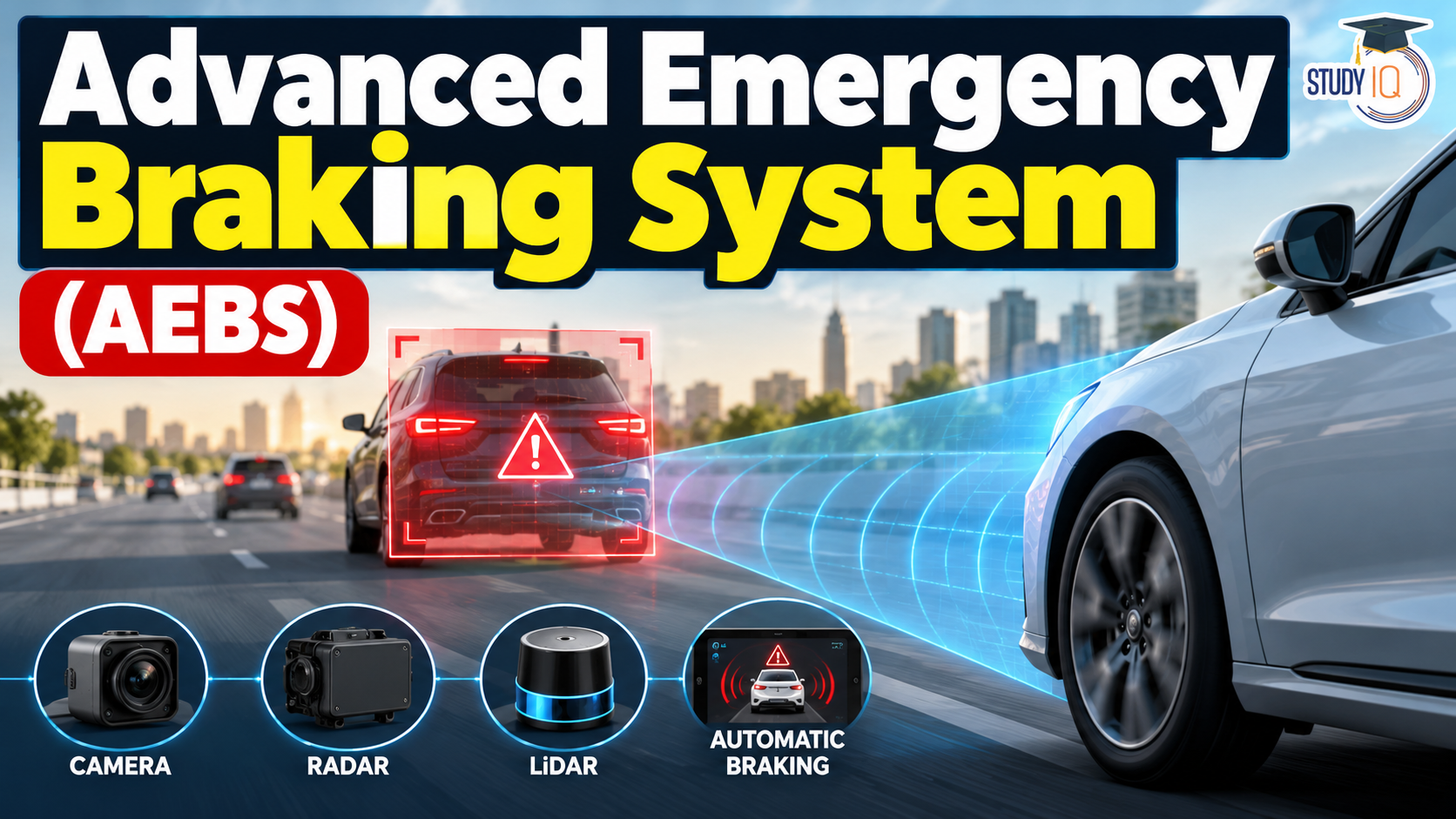
- Nature: An active safety technology and key part of Advanced Driver Assistance Systems (ADAS). It scans the road ahead, warns the driver of crash risk and brakes automatically if the driver does not react in time.
- Aim: To prevent rear-end collisions, protect pedestrians and cyclists, cut driver reaction delay and reduce road deaths.
How It Works
- Sensing: Radar, cameras and LiDAR spot obstacles and measure their speed and distance. The system then calculates time-to-collision (TTC).
- Stage 1 – Warning: Visual, audible and dashboard alerts urge the driver to brake.
- Stage 2 – Pre-Braking: If the driver does not respond, the system builds up brake pressure, boosts braking help and may start slowing the vehicle.
- Stage 3 – Emergency Braking: When the risk turns critical, it applies strong automatic braking. This may stop the vehicle or cut the impact speed.
Key Features
- Sensor Fusion: Joins camera recognition with radar and LiDAR data to detect vehicles, pedestrians and obstacles in different conditions.
- Vulnerable Road User (VRU) Protection: Detects pedestrians, cyclists and two-wheelers in the vehicle’s path.
- Works with ABS and ESC: Integrates with the Anti-lock Braking System and Electronic Stability Control to keep the vehicle stable and avoid wheel lock.
- Collision Mitigation: Helps avoid low-speed city crashes and lessens the severity of high-speed ones.
- Limitations: Performance may drop in heavy rain, dense fog, poor visibility or when a sensor is blocked. Sharp curves and false detections can also affect it.
Applications
- Prevents rear-end collisions in city traffic and on highways, in private cars, taxis and light delivery vehicles.
- Reduces crashes involving trucks and buses approaching stationary or slow traffic on highways.
- Adds safety to electric buses, autonomous shuttles and semi-autonomous fleets.

 Vigilance Awareness Week 2026: Theme, Hi...
 Cyclone Arnab 2026: Andhra Pradesh on Re...
 Operation Trident 2026: Drug Trafficking...














 WhatsApp