Table of Contents
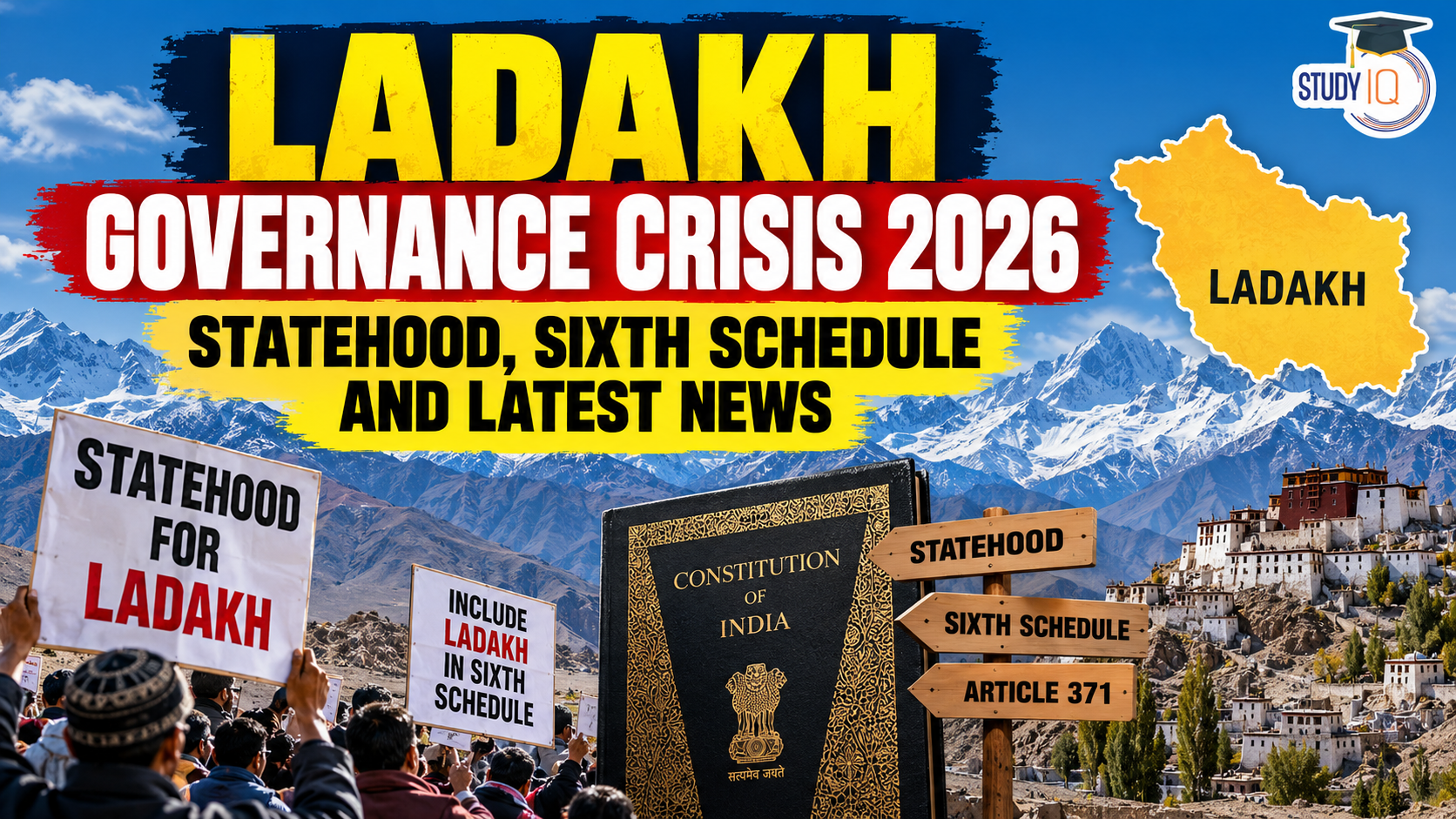
Ladakh Governance Crisis 2026: The Ladakh governance crisis has renewed the debate over federalism, democratic representation and constitutional safeguards in India. Since becoming a Union Territory (UT) without a legislature in 2019, Ladakh has witnessed demands for statehood and protection of its land, employment, culture and indigenous identity.
In October 2026, the Ministry of Home Affairs (MHA) shared a 32-page draft governance proposal with Ladakh’s representatives, while the administration formally notified Sankoo as the region’s eighth district. These developments highlight two distinct approaches: political empowerment through constitutional reform and administrative decentralisation through new districts.
Ladakh Governance Crisis 2026: Latest News
Two important developments took place in October 2026:
-
MHA draft proposal: On October 15, the Centre shared a proposed framework for a Union Territory-level governing body. The proposal triggered disagreement over the body’s legislative authority, administrative control and constitutional protection.
-
Creation of Sankoo district: On October 16, the Ladakh administration notified Sankoo as a new district, with Sankoo designated as its headquarters. The measure aims to improve administrative access and public service delivery.
The two developments are significant because Ladakh’s political representatives continue to seek a governance framework that combines effective local administration with meaningful democratic authority.
Why Is Ladakh Demanding Statehood?
Ladakh was separated from the former state of Jammu and Kashmir and established as a Union Territory under the Jammu and Kashmir Reorganisation Act, 2019. Unlike Jammu and Kashmir, Ladakh does not have an elected legislative assembly.
The principal demands include:
-
Statehood: An elected legislature and government with meaningful decision-making powers.
-
Land protection: Safeguards against changes that could adversely affect local communities.
-
Employment security: Greater protection of job opportunities for local residents.
-
Cultural preservation: Protection of indigenous languages, traditions and customary practices.
-
Democratic representation: Greater participation in decisions affecting local development and natural resources.
Ladakh’s strategic location along sensitive international borders and its fragile Himalayan ecosystem make governance arrangements particularly important.
Why Did LAB and KDA Reject the MHA Draft Proposal?
The Leh Apex Body (LAB) and Kargil Democratic Alliance (KDA) rejected the October 15 draft, arguing that it differed from the understanding reached during negotiations in May 2026.
Their principal objections were:
-
Limited legislative powers: The proposed body would make regulations on specified subjects rather than exercise the broader legislative authority sought by local representatives.
-
Lieutenant Governor’s oversight: The draft provides for the Lieutenant Governor’s assent to regulations and retains significant administrative oversight.
-
Control over bureaucracy: The representatives want greater authority over transfers, postings and supervision of officials working under the elected government.
-
Constitutional safeguards: They seek stronger protection for land, natural resources, employment, culture and customary practices.
-
Difference over the governance model: LAB and KDA favour a legislature and executive with constitutionally guaranteed powers.
The MHA document is a consultation draft, not a final government decision. Talks remain unresolved, and the differences concern the legal foundation, authority and accountability of the proposed governing body.
What Is the Sixth Schedule, and Why Does Ladakh Want It?
The Sixth Schedule of the Indian Constitution provides for Autonomous District Councils and, where applicable, Regional Councils in specified tribal areas of Assam, Meghalaya, Tripura and Mizoram.
These institutions can exercise powers over certain matters, including customary practices, land use and local governance, subject to constitutional provisions.
Ladakh’s demand for Sixth Schedule inclusion is rooted in concerns about:
-
Protecting tribal identity and traditional practices.
-
Preserving local control over land and resources.
-
Safeguarding employment opportunities.
-
Ensuring greater participation in decisions affecting indigenous communities.
Ladakh is not currently covered by the Sixth Schedule. An alternative arrangement under Article 371 has also featured in negotiations. Any new protection would require an appropriate constitutional and legal framework.
How Will New Districts Improve Governance in Ladakh?
Ladakh’s vast area, difficult terrain and scattered settlements create challenges for public administration. The region previously had two districts: Leh and Kargil.
The creation of six additional districts—Sankoo, Sham, Nubra, Changthang, Zanskar and Drass—is intended to bring government services closer to residents. The administration has also proposed hill councils for the new districts, expanding opportunities for local representation.
The expected benefits include:
-
Better accessibility: Residents may need to travel shorter distances to access administrative offices.
-
Improved service delivery: Local authorities can respond more effectively to area-specific needs.
-
Decentralised planning: Development priorities can reflect local geographical and social conditions.
-
Greater representation: Elected local institutions can provide channels for citizen participation.
Nevertheless, administrative decentralisation cannot by itself replace a legislative assembly or provide constitutional guarantees.
Challenges and the Way Forward
The Ladakh governance crisis highlights several interconnected challenges: democratic representation, cultural protection, regional diversity, environmental sustainability and national security.
A constructive way forward would involve:
-
Resuming sustained dialogue between the Centre and representative organisations.
-
Clearly defining the powers of an elected body and the Lieutenant Governor.
-
Establishing credible safeguards for land, employment, culture and local resources.
-
Strengthening existing hill councils and local institutions.
-
Ensuring fair representation for both Leh and Kargil.
-
Balancing infrastructure development with the protection of Ladakh’s fragile Himalayan ecosystem.
Conclusion
The Ladakh Governance Crisis 2026 demonstrates that effective administration and political empowerment are related but distinct objectives. New districts may improve service delivery, while constitutional safeguards and meaningful elected authority are central to the wider debate over self-governance.
A durable solution requires transparent negotiations, constitutionally sound arrangements and public participation. Reconciling local aspirations with ecological and strategic considerations will be essential to strengthening democratic governance in Ladakh.
 UN Reform 2026: Challenges, Proposals an...
 China Zorrilla: World’s Largest Batter...
 Oskar Klein Medal 2026: Ashoke Sen Wins ...









 WhatsApp