Table of Contents
Context
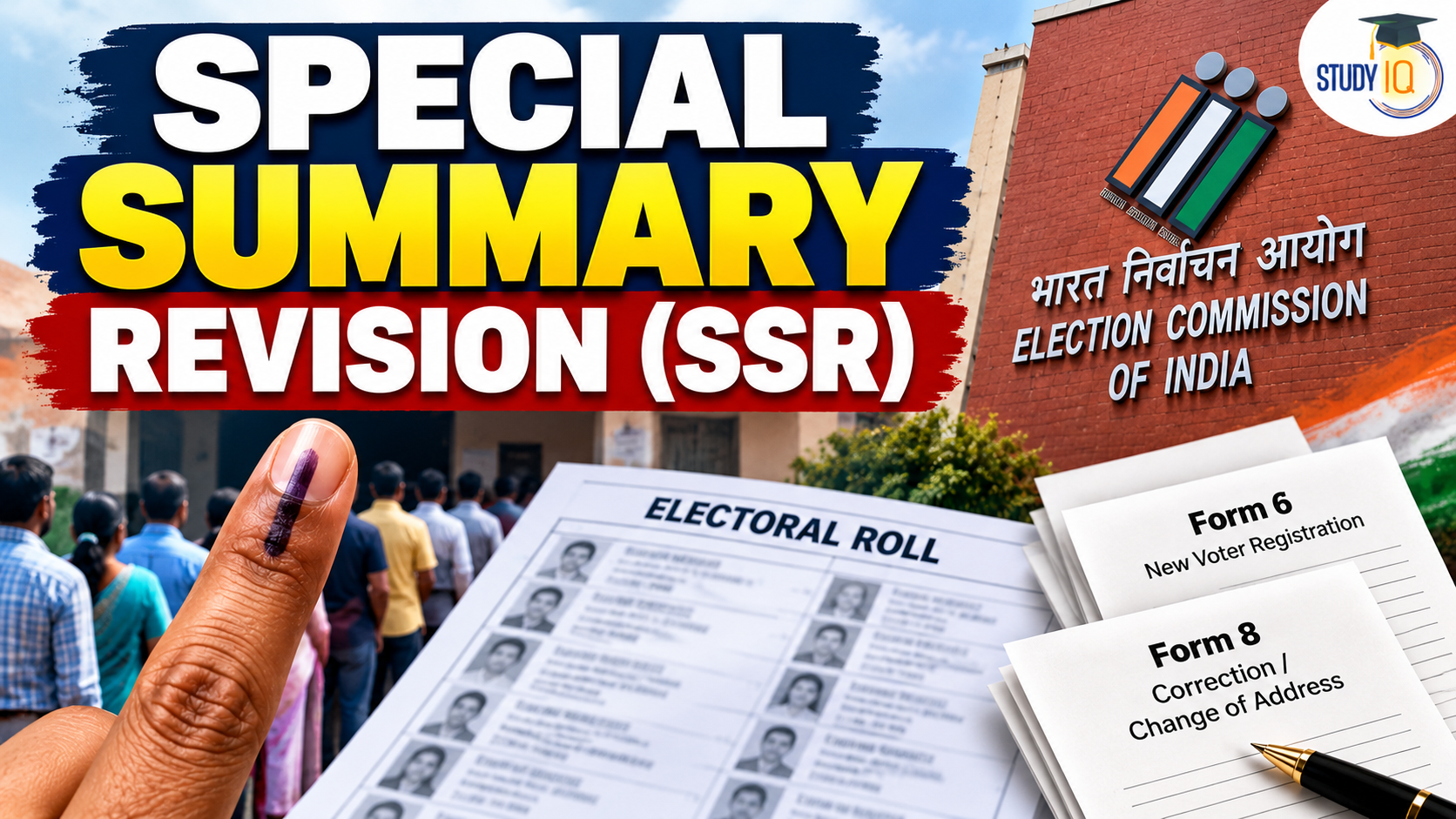
The Election Commission of India (ECI) announced the schedule for the Special Summary Revision (SSR) of electoral rolls across 17 States and Union Territories, with 1 January 2027 as the qualifying date.
About Special Summary Revision (SSR)
- Nature: Routine annual exercise to update electoral rolls by adding eligible voters, correcting details and removing deceased or duplicate entries.
- Constitutional Basis: Article 324 empowers the ECI to supervise, direct and control the preparation of electoral rolls.
- Legal Framework: Section 21(2) of the Representation of the People Act, 1950, and the Registration of Electors Rules, 1960.
- Implementing Authorities: Electoral Registration Officers (EROs), Assistant EROs and Booth Level Officers (BLOs).
Key Features
- Existing Electors: Names on the existing roll are carried forward to the draft roll; fresh enumeration forms are not required.
- New Registrations: Eligible first-time voters use Form 6.
- Corrections and Shifting: Existing voters use Form 8 to correct electoral details or change their address.
- Safeguards Against Deletion: Proposed deletions require prescribed procedures, including individual notices and hearings where mandated by law.
- Revision Schedule: Includes polling-station rationalisation, publication of the draft roll, a period for claims and objections, and publication of the final roll.
- Coverage: The announced exercise covers 17 States and UTs, including Assam, Uttar Pradesh, Tamil Nadu and West Bengal.
| Key Differences Between Special Summary Revision (SSR) and Special Intensive Revision (SIR) | ||
| Parameter | Special Summary Revision (SSR) | Special Intensive Revision (SIR) |
| Basic Approach | Updates existing electoral rolls while generally retaining registered voters. | Conducts fresh verification of electoral rolls and reassesses voter eligibility. |
| Verification Requirements | Existing voters generally need not undergo re-verification; applications are required for new registrations or corrections. | Involves voter enumeration and eligibility verification; supporting documents may be required. |
| Deletion of Names | Deletions follow prescribed verification, notice and hearing procedures. | Unverified electors may be excluded from draft rolls, subject to claims and objections. |
| Verification Method | Primarily relies on field verification and public scrutiny. | May use software-based discrepancy detection alongside verification notices and enumeration. |
| Frequency | Generally conducted annually. | Conducted periodically as directed by the Election Commission of India (ECI). |

 Global Hunger Index 2026: India Ranks 10...
 France Protests 2026: Cost of Living, Sc...
 PUFFINS Telescope Mission: NASA’s $20 ...












 WhatsApp