Table of Contents
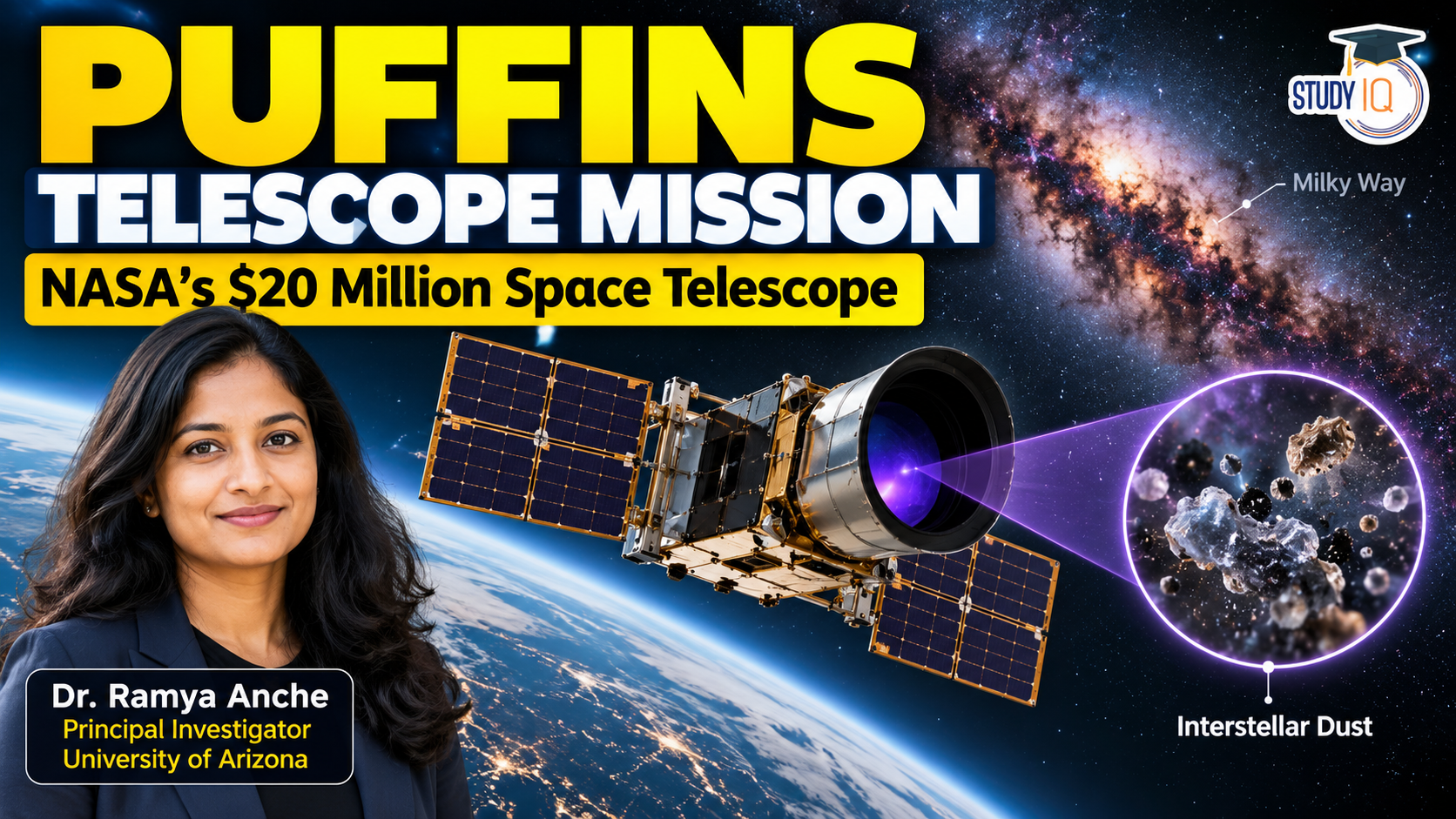
The PUFFINS Telescope Mission is a NASA-funded space mission designed to study tiny dust particles present in the space between stars. Led by Bengaluru-born astronomer Dr. Ramya Anche of the University of Arizona, the mission will use ultraviolet observations to investigate interstellar dust and its relationship with the Milky Way’s magnetic field.
Selected under NASA’s Astrophysics Pioneers programme, PUFFINS has a $20 million funding award. It is an important Science and Technology current affairs topic for UPSC Prelims 2027.
PUFFINS Telescope Mission: Latest News
In October 2026, the PUFFINS mission attracted attention following the announcement of NASA funding for the University of Arizona-led research team. Dr. Ramya Anche, an assistant research professor at the university’s Steward Observatory, is the mission’s principal investigator.
The mission is being developed to observe ultraviolet light from approximately 70 stars. Its findings are expected to improve scientific understanding of small interstellar dust grains and their interaction with magnetic fields.
What Is the PUFFINS Telescope Mission?
PUFFINS stands for Polarimetry in the Ultraviolet to Find Features in INterStellar dust.
It is a SmallSat mission that will investigate interstellar dust using ultraviolet spectropolarimetry. The telescope is expected to have an aperture of approximately 10 inches and will examine how dust particles alter the light travelling from distant stars.
Interstellar dust consists of tiny solid particles distributed throughout the space between stars. These particles influence the absorption and scattering of starlight and play an important role in the physical and chemical processes associated with star and planet formation.
How Will the PUFFINS Telescope Work?
PUFFINS will employ ultraviolet spectropolarimetry, a technique that combines two scientific methods:
- Spectroscopy: Studies light at different wavelengths.
- Polarimetry: Measures the polarisation properties of light.
As ultraviolet light travels through the interstellar medium, dust grains can absorb, scatter and polarise it. By analysing these changes, scientists aim to determine the properties of small dust particles and investigate their alignment with the Milky Way’s magnetic field.
This technique offers valuable information about dust grains that may be difficult to characterise through conventional optical and infrared observations alone.
Key Features of the PUFFINS Mission
- Space agency: NASA.
- Programme: Astrophysics Pioneers.
- Principal investigator: Dr. Ramya Anche.
- Funding: $20 million.
- Mission type: Small satellite (SmallSat).
- Telescope aperture: Approximately 10 inches.
- Observation targets: Around 70 stars.
- Primary objective: Study small interstellar dust grains.
- Scientific technique: Ultraviolet spectropolarimetry.
The launch timeline remains provisional. NASA’s programme page and the University of Arizona’s announcement have listed different target years, so aspirants should verify the latest official schedule.
Significance of the PUFFINS Telescope Mission
1. Understanding interstellar dust: The mission will improve knowledge of the size, properties and alignment of dust grains in the interstellar medium.
2. Studying galactic magnetic fields: Polarisation measurements can help scientists investigate the relationship between dust grains and magnetic fields in the Milky Way.
3. Insights into star formation: Interstellar dust plays an important role in the environments where stars and planetary systems develop.
4. Advancing small-satellite astronomy: PUFFINS demonstrates how compact satellite platforms can support specialised astrophysical research.
5. Supporting future space research: Its findings may help researchers evaluate ultraviolet spectropolarimetry for future astronomical missions.
What Is NASA’s Astrophysics Pioneers Programme?
NASA’s Astrophysics Pioneers programme supports innovative astrophysics investigations using relatively small platforms, including SmallSats and scientific balloon payloads. It aims to enable important scientific research through cost-effective missions.
PUFFINS demonstrates how specialised instruments and smaller satellites can contribute to our understanding of the universe.
PUFFINS Telescope Mission: Important Facts for UPSC
| Feature | Details |
|---|---|
| Full form | Polarimetry in the Ultraviolet to Find Features in INterStellar dust |
| Agency | NASA |
| Programme | Astrophysics Pioneers |
| Funding | $20 million |
| Mission type | SmallSat |
| Main technique | Ultraviolet spectropolarimetry |
| Research focus | Interstellar dust and magnetic fields |

 France Protests 2026: Cost of Living, Sc...
 World Food Day 2026: Strengthening Nutri...
 International Day for the Eradication of...














 WhatsApp