Table of Contents
Japan’s Prime Minister has called for the removal of the “enemy state” references from the UN Charter, bringing renewed attention to provisions that originated in the aftermath of World War II.
The clauses were framed when the United Nations was established in 1945 and referred to states that had been enemies of the Allied powers during the Second World War. Although they are widely regarded as obsolete, the provisions formally remain part of the UN Charter.
For UPSC aspirants, the issue is important for International Relations, United Nations, UN reforms and global governance.
Read Also: UPSC Daily Current Affairs 2026
What Are the Enemy State Clauses?
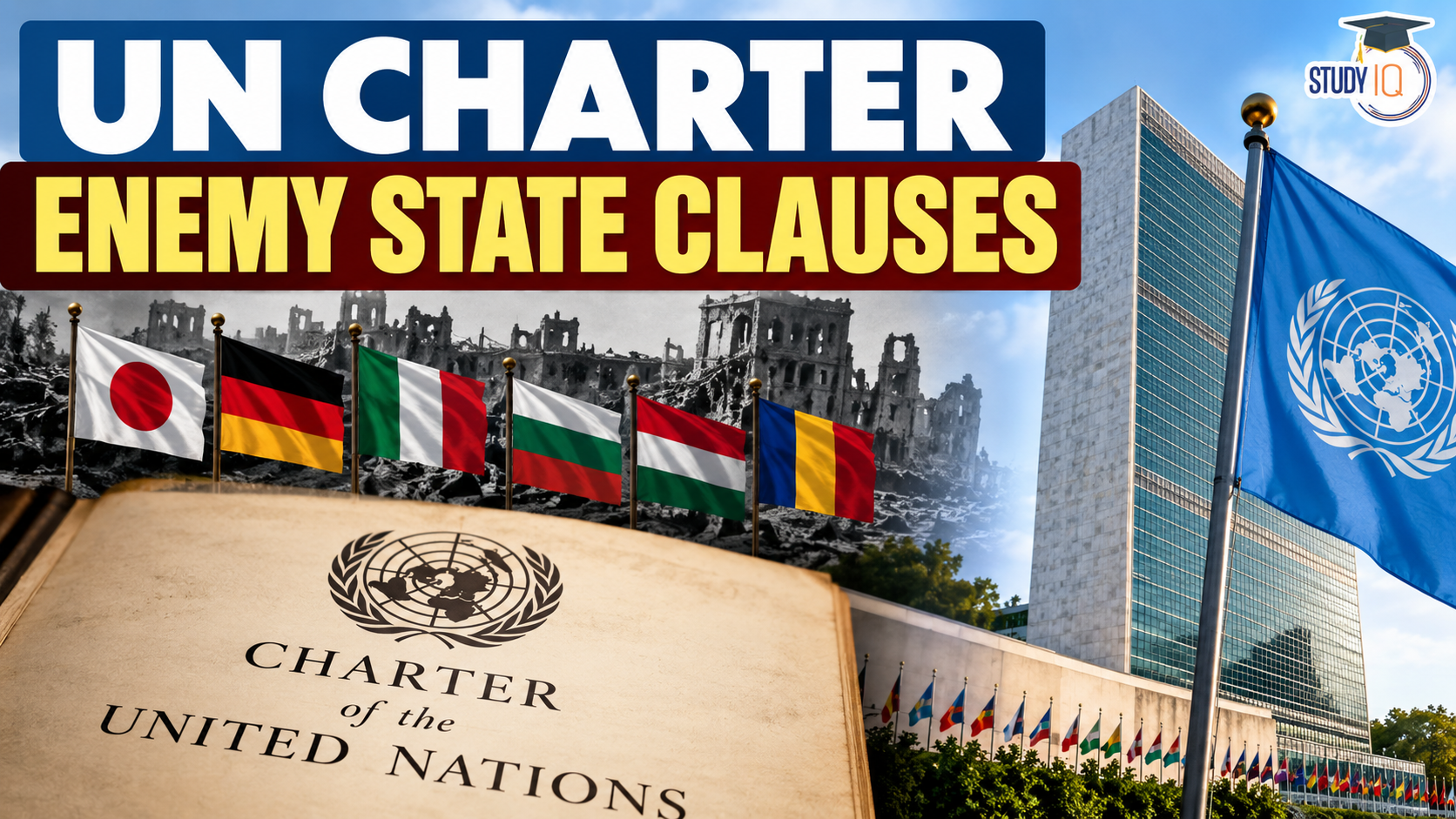
The Enemy State Clauses are provisions in the UN Charter that refer to countries that were considered enemy states during World War II.
They were included as transitional arrangements in the 1945 UN Charter, particularly in relation to the former Axis powers.
Historically, the provisions applied to countries including:
- Germany
- Japan
- Italy
- Hungary
- Romania
- Bulgaria
The terminology reflects the geopolitical circumstances prevailing at the end of World War II.
Which Articles Contain Enemy State References?
Three provisions are particularly relevant:
| Article | Provision |
|---|---|
| Article 53(1) | Contains provisions concerning enforcement action against an enemy state in specified circumstances without the normal requirement of prior Security Council authorisation. |
| Article 77(1)(b) | Refers to territories detached from enemy states as part of the UN trusteeship framework. |
| Article 107 | Preserves actions taken or authorised as a consequence of World War II against states that had been enemies of the signatories. |
Article 53
Article 53 deals with regional arrangements and enforcement action.
Its reference to an “enemy state” is linked to the special circumstances created by World War II and the establishment of the UN system.
The provision is generally regarded as having little or no practical relevance today.
Article 107
Article 107 is one of the clearest examples of the post-war character of these provisions.
It preserves the validity of actions taken against former enemy states as a consequence of World War II.
Article 77
Article 77 concerns the UN Trusteeship System.
Article 77(1)(b) refers to territories that could be placed under the trusteeship system after being detached from enemy states as a consequence of World War II.
Why Are These Clauses Considered Obsolete?
The geopolitical environment in which the clauses were created has fundamentally changed.
Former enemy states such as Japan, Germany and Italy subsequently became members of the United Nations and established close political, economic and security relationships with other UN members.
The provisions therefore have largely historical significance rather than practical application.
The UN General Assembly recognised the clauses as obsolete in 1995, and the 2005 World Summit Outcome supported their deletion from the Charter.
However, recognising a provision as obsolete is different from formally removing it from the Charter.
Why Have the Clauses Not Been Removed?
The principal issue is the UN Charter amendment procedure.
Under Article 108, amendments to the UN Charter require:
- Adoption by a two-thirds majority of the UN General Assembly.
- Ratification by two-thirds of UN member states.
- Ratification by all five permanent members of the UN Security Council.
The five permanent members are:
- United States
- Russia
- China
- France
- United Kingdom
Thus, deleting the enemy state references requires a formal Charter amendment rather than simply a General Assembly resolution declaring them outdated.
Why Does Japan Seek Their Removal?
For Japan, the clauses are closely tied to its status as a former Axis power and the post-World War II structure of international relations.
Removing the references would symbolically acknowledge the international system’s transformation since 1945 and eliminate terminology associated with wartime state classifications.
The issue also fits into Japan’s broader interest in UN reform and changes to the Security Council.
Link With UN Security Council Reform
The debate over enemy state clauses is also relevant to the broader question of reforming the United Nations.
The UN Charter was drafted in a very different international environment. Since then:
- The number of UN member states has increased substantially.
- Global economic and political power has shifted.
- New regional powers have emerged.
- Calls for greater representation in the Security Council have intensified.
Countries including Japan, India, Germany and Brazil have advocated reforms to the Security Council, including expansion of its membership.
Therefore, any discussion about formally amending the Charter can potentially raise broader questions about the structure and functioning of the UN.
Enemy State Clauses vs UN Security Council Reform
| Issue | Enemy State Clauses | UNSC Reform |
|---|---|---|
| Origin | Post-World War II | Post-World War II |
| Main concern | References to former enemy states | Representation and decision-making |
| Key Charter provisions | Articles 53, 77 and 107 | Mainly Chapter V and related provisions |
| Current debate | Formal deletion | Expansion and reform |
| Amendment requirement | Article 108 | Requires Charter amendment |
 World Tourism Day 2026: Theme, India Tou...
 Anti-Goonda Bill 2026 Explained: Why Pre...
 Cool Leaders Award 2026: Winners, Global...














 WhatsApp