Table of Contents
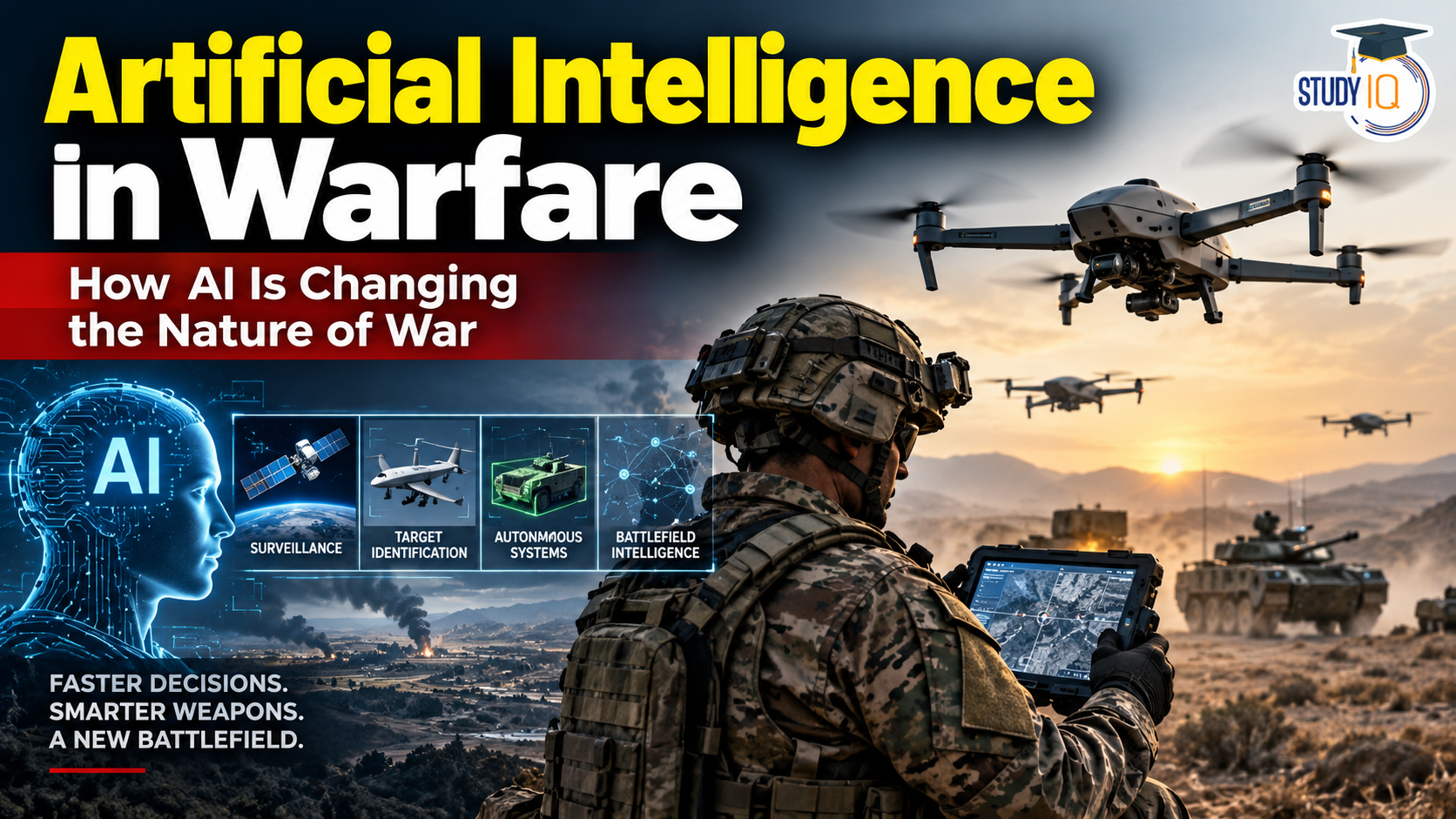
Artificial Intelligence (AI) is rapidly changing the character of modern warfare. Advances in machine learning, computer vision, autonomous systems, drones and data analytics are allowing militaries to process battlefield information and make decisions at unprecedented speed.
The transformation is particularly visible in conflicts where drones, electronic warfare, satellite imagery and AI-enabled intelligence systems are being used together. Instead of relying exclusively on human operators, some military systems can increasingly navigate, identify objects and operate in environments where traditional communication links are disrupted.
The result is a battlefield where the boundary between human-controlled and machine-assisted warfare is becoming increasingly blurred.
Read Also: UPSC Daily Current Affairs 2026
What Is AI Warfare?
AI warfare refers to the use of artificial intelligence and machine-learning technologies in military operations.
It can involve AI systems being used for:
- Intelligence, Surveillance and Reconnaissance (ISR)
- Battlefield data analysis
- Target detection and classification
- Drone navigation
- Threat identification
- Electronic warfare
- Logistics and supply-chain management
- Cyber operations
- Command-and-control systems
- Autonomous or semi-autonomous weapons
AI does not necessarily mean that weapons operate completely without humans. Many systems are designed with human oversight, while others can perform specific functions autonomously.
How AI Is Changing Modern Warfare
1. AI-Powered Drones
Drones have become one of the most visible technologies of modern warfare.
AI can assist drones with:
- Navigation
- Object recognition
- Terrain analysis
- Target identification
- Route planning
- Tracking moving objects
- Operating in environments with disrupted communications
This is particularly important in areas where GPS, radio communications or satellite links are subject to electronic jamming.
2. From Remote Control to Autonomy
Traditional military drones generally depend heavily on human operators.
AI-enabled systems can increasingly perform certain tasks independently.
Traditional model:
Human operator → Drone → Target
AI-assisted model:
Sensors → AI analysis → Target identification → Human decision → Action
More autonomous model:
Sensors → AI perception → Decision-making system → Autonomous action
The level of autonomy varies considerably between different military systems.
3. AI and Target Identification
One of the most significant applications of AI is computer vision.
AI systems can analyse images and video collected by:
- Drones
- Satellites
- Reconnaissance aircraft
- Ground-based cameras
- Other battlefield sensors
Machine-learning models can be trained to recognise objects such as vehicles, infrastructure and other battlefield features.
This can help military personnel process large amounts of visual information much faster than manual analysis alone.
4. The Battlefield Data Revolution
Modern militaries generate enormous quantities of data.
This includes:
| Data Source | Possible AI Application |
|---|---|
| Drones | Image and video analysis |
| Satellites | Terrain and movement analysis |
| Radar | Object detection |
| Sensors | Battlefield monitoring |
| Communications | Pattern analysis |
| Reconnaissance systems | Intelligence processing |
AI can potentially combine information from multiple sources to create a more comprehensive picture of battlefield conditions.
This is sometimes described as creating a “sensor-to-shooter” or “sense-to-decision” architecture.
5. Faster Decision-Making
One of AI’s major military advantages is speed.
Humans may need considerable time to collect, compare and interpret information. AI systems can process very large datasets rapidly.
This can shorten the military decision cycle:
Observe → Orient → Decide → Act
The faster this cycle becomes, the greater the importance of reliable AI systems and effective human oversight.
6. AI and Electronic Warfare
Electronic warfare involves disrupting or manipulating an opponent’s use of the electromagnetic spectrum.
AI can potentially help systems:
- Detect communication patterns
- Identify signals
- Adapt to changing electromagnetic environments
- Detect jamming
- Select alternative navigation methods
- Analyse large quantities of electronic information
This is particularly important because modern military operations depend heavily on communications, navigation and network connectivity.
7. Low-Cost Drones and Mass Warfare
AI is also contributing to a shift toward large numbers of relatively inexpensive autonomous or semi-autonomous systems.
Instead of relying exclusively on a small number of extremely expensive platforms, militaries can potentially deploy large numbers of drones and other autonomous systems.
This creates a different strategic problem:
How should an expensive traditional defence system respond to large numbers of relatively inexpensive autonomous platforms?
The issue is especially important for air defence and battlefield surveillance.
Human Control vs Autonomous Warfare
The growing use of AI raises an important question: How much decision-making should be delegated to machines?
Human-in-the-loop
A human makes the final decision before a weapon is used.
Human-on-the-loop
The system can operate with greater autonomy, while humans supervise and can intervene.
Human-out-of-the-loop
The system can potentially select and engage targets without real-time human intervention.
The distinction is crucial because the greater the autonomy, the more difficult questions arise concerning accountability, reliability and international law.
Major Advantages of AI in Warfare
AI can potentially provide several military advantages:
- Speed: Rapid processing of battlefield information
- Persistence: Autonomous systems can operate for extended periods
- Precision: Better identification and tracking can potentially improve accuracy
- Reduced human exposure: Uncrewed systems can perform some dangerous missions
- Data processing: AI can analyse huge datasets
- Adaptability: Machine-learning systems can respond to changing conditions
- Scalability: Large numbers of relatively inexpensive autonomous platforms can potentially be deployed
However, these benefits depend heavily on the quality of data, algorithms, sensors and human supervision.
Risks and Challenges of AI Warfare
1. Wrong Target Identification
AI systems can make mistakes.
Poor-quality data, unusual conditions, camouflage or adversarial techniques may cause an AI system to incorrectly classify an object.
In warfare, such errors can have serious consequences.
2. Accountability
If an autonomous system makes a harmful decision, determining responsibility can become complicated.
Possible actors include:
- Military commanders
- Operators
- Developers
- Manufacturers
- Governments
- Organisations deploying the system
This creates a major challenge for existing accountability frameworks.
3. AI Arms Race
Countries may increasingly compete to develop and deploy military AI.
This could create pressure to introduce systems rapidly, potentially before their reliability and safety have been sufficiently tested.
4. Loss of Human Judgment
Military decisions involving the use of force traditionally involve human judgment.
Greater automation raises concerns that important decisions could increasingly depend on algorithmic assessments.
5. Cybersecurity Risks
AI-enabled military systems themselves can become targets.
Attackers may attempt to:
- Manipulate training data
- Deceive computer-vision systems
- Compromise software
- Disrupt communications
- Interfere with autonomous decision-making
Therefore, AI security becomes an integral part of military security.
Ethical and Legal Questions
The deployment of increasingly autonomous weapons raises important questions under International Humanitarian Law (IHL).
Key principles include:
- Distinction: Differentiating military targets from civilians.
- Proportionality: Assessing whether expected civilian harm is excessive relative to the anticipated military advantage.
- Precautions: Taking feasible measures to minimise civilian harm.
The central debate is whether increasingly autonomous weapons can reliably operate within these principles and what degree of meaningful human control should be maintained.
AI Warfare and the Future Battlefield
The future battlefield is likely to involve increasingly interconnected systems rather than isolated weapons.
A possible architecture could look like:
Satellites + Drones + Sensors + Radar
↓
AI-powered data fusion
↓
Real-time battlefield picture
↓
Human commanders + AI decision support
↓
Autonomous/semi-autonomous systems
This could make warfare increasingly data-driven, network-centric and machine-assisted.
India and AI in Defence
For India, AI has strategic relevance across several areas, including:
- Autonomous and unmanned systems
- Intelligence and surveillance
- Cybersecurity
- Electronic warfare
- Border monitoring
- Decision-support systems
- Defence logistics
- Robotics
- Space-based surveillance
India’s defence ecosystem includes government institutions, the armed forces, defence public-sector organisations, startups and academic institutions working on emerging technologies.
The broader challenge is to develop advanced military capabilities while maintaining security, accountability, reliability and human oversight.
AI Warfare vs Traditional Warfare
| Feature | Traditional Warfare | AI-Enabled Warfare |
|---|---|---|
| Decision-making | Primarily human | Human + AI |
| Data processing | Relatively limited | Large-scale and rapid |
| Surveillance | Human-intensive | AI-assisted |
| Navigation | Human/operator dependent | Increasing autonomy |
| Target recognition | Human analysis | Computer vision + human analysis |
| Response time | Relatively slower | Potentially much faster |
| Unmanned systems | Limited | Increasingly important |
| Key challenge | Human limitations | Human-machine reliability |
Conclusion
Artificial Intelligence is not simply adding another weapon to the military arsenal; it is changing how information is collected, analysed and converted into military decisions.
The combination of AI, autonomous drones, robotics, satellite imagery, sensors and electronic warfare is creating a battlefield where machines can perform an increasing number of tasks previously carried out exclusively by humans.
At the same time, AI warfare introduces difficult questions about human control, accountability, civilian protection, cybersecurity and the regulation of autonomous weapons.
The future of warfare will therefore depend not only on who develops the most advanced AI, but also on how reliably, responsibly and securely that technology is integrated into military decision-making.

 Quantum Computing: RRI Scientists Demons...
 Daily Current Affairs PDF 2026: Download...
 World Ozone Day 2026: Ozone Layer, Montr...













 WhatsApp