
Table of Contents
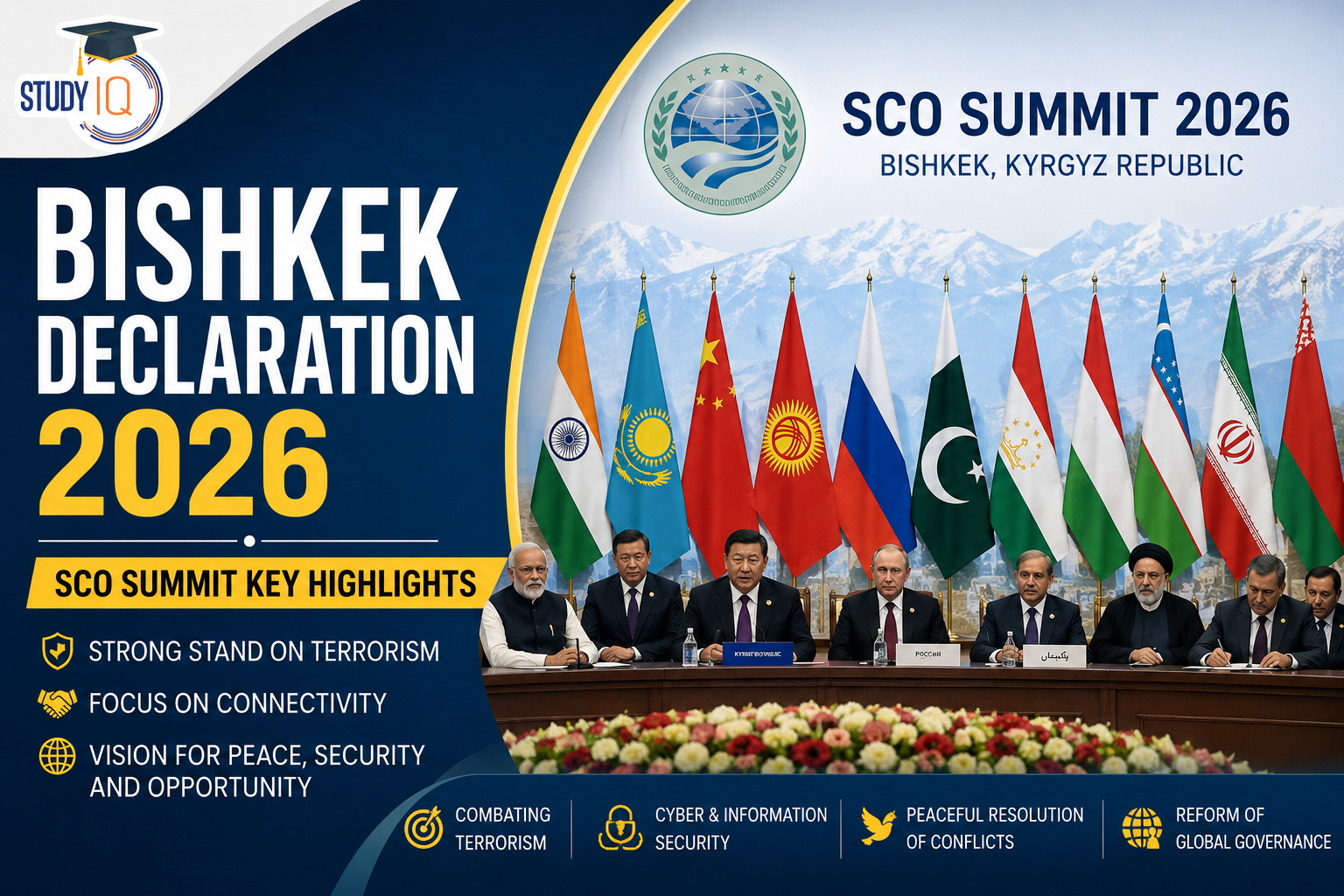
The Shanghai Cooperation Organisation (SCO) adopted the Bishkek Declaration 2026 at its 26th Summit, held in Bishkek, Kyrgyz Republic, from 31 August to 1 September 2026. The summit assumes significance as the SCO completed 25 years, providing an opportunity to assess its achievements and chart a roadmap for the next 25 years.
For India, the summit was particularly important because Prime Minister Narendra Modi used the platform to reiterate India’s concerns over terrorism, regional conflicts and connectivity, while advocating a broader SCO agenda centred on Security, Connectivity and Opportunity.
Read Also: UPSC Daily Current Affairs 2026
What is the Shanghai Cooperation Organisation (SCO)?
The SCO is a Eurasian regional organisation focused on security, political, economic and cultural cooperation. Its current members are India, China, Russia, Pakistan, Iran, Belarus, Kazakhstan, Kyrgyzstan, Tajikistan and Uzbekistan.
India and Pakistan became full members in 2017, while Iran joined as a full member in 2023 and Belarus in 2024. India views the SCO as an important platform for engagement with Central Asia, Russia, China and the wider Eurasian region.
The organisation’s traditional security agenda revolves around combating the “three evils” — terrorism, separatism and extremism.
Major Highlights of the Bishkek Declaration
1. Strong Condemnation of Terrorism
The Bishkek Declaration strongly condemned terrorism in all its forms and manifestations and rejected double standards in combating terrorism.
SCO members called for stronger international cooperation against terrorism, including the cross-border movement of terrorists, while emphasising the central role of the United Nations and implementation of relevant UN Security Council resolutions and the UN Global Counter-Terrorism Strategy.
The declaration also opposed attempts to exploit terrorist, separatist or extremist organisations for political or strategic purposes.
2. Cybersecurity and Information Security
The declaration recognised the growing use of cyberspace for terrorist and extremist activities. Member states called for greater cooperation on:
- International information security
- Protection of information and digital infrastructure
- Countering the misuse of the internet by extremist organisations
- Tackling emerging forms of crime
This is significant because modern terrorism increasingly relies on online radicalisation, encrypted communication, propaganda and terror financing.
3. West Asia Crisis
The SCO expressed deep concern over developments in West Asia and supported a political and diplomatic resolution of conflicts.
The declaration reaffirmed support for Iran’s sovereignty and territorial integrity and called for de-escalation through political and diplomatic means.
For India, instability in West Asia has direct implications for energy security, maritime trade, diaspora welfare and global supply chains.
4. Reform of Global Governance
SCO members advocated reform and improvement of global governance mechanisms. They opposed bloc-based and confrontational approaches and emphasised peaceful resolution of disputes in accordance with international law.
This reflects a broader demand from emerging powers for a more representative and multipolar international order.
India’s Message at the SCO Summit
Prime Minister Narendra Modi’s intervention focused on three interconnected issues: conflict, terrorism and connectivity.
Conflict Has No Borders
PM Modi emphasised that conflicts cannot remain geographically confined. Instability in one region can affect energy markets, maritime routes, trade and supply chains across the world.
India reiterated that lasting solutions to conflicts must come through dialogue and diplomacy rather than warfare. This position reflects India’s broader foreign-policy approach of strategic autonomy and support for peaceful dispute resolution.
Terrorism: Dismantle the Entire Ecosystem
India’s strongest message concerned terrorism.
PM Modi described terrorism as a challenge to humanity and argued that counter-terrorism cannot remain limited to an “action-reaction” approach. Instead, the entire ecosystem supporting terrorism must be dismantled.
This includes:
- Terror financing
- Recruitment networks
- Radicalisation
- Propaganda
- Safe havens
- Cross-border movement of terrorists
- Political and material support
He stressed that countries that use terrorism as an instrument of state policy or provide shelter to terrorists must receive a clear international message that terrorism cannot become a strategic asset.
Connectivity with Sovereignty
India supports connectivity projects that promote trade, investment and regional growth. However, PM Modi underlined that connectivity must respect the sovereignty and territorial integrity of all countries.
This principle is particularly relevant to India’s approach towards transcontinental connectivity initiatives and its engagement with Central Asia.
India’s SCO Vision: Security, Connectivity and Opportunity
India has articulated its SCO vision through three pillars:
- S – Security: Combating terrorism, extremism and emerging security threats.
- C – Connectivity: Improving physical, digital and economic connectivity while respecting sovereignty.
- O – Opportunity: Expanding trade, investment, innovation, entrepreneurship and people-to-people ties.
At the 25th anniversary summit, India argued that the next phase of SCO cooperation should focus on converting dialogue into concrete and measurable outcomes.
India has also promoted initiatives such as the SCO Start-up Forum, Young Authors’ Conclave and Young Scientists’ Forum, while the proposed SCO Civilizational Dialogue Forum is expected to further strengthen cultural and civilisational engagement.
Significance for India
The Bishkek Summit is important for India for several reasons:
- Counter-terrorism: SCO provides a platform to build consensus against terrorism and cross-border extremism.
- Central Asia: It strengthens India’s engagement with strategically important Central Asian states.
- Energy security: Stability in Eurasia and West Asia is crucial for India’s energy interests.
- Connectivity: India can pursue alternative routes and strengthen trade links with Eurasia.
- Strategic autonomy: SCO allows India to engage simultaneously with Russia, China, Central Asia and other regional powers.
- Global South: India can use the platform to advocate reform of global governance institutions.
Challenges Before the SCO
Despite its potential, the SCO faces significant limitations. India-China strategic competition, India-Pakistan tensions and differing approaches towards terrorism can constrain consensus.
The organisation also contains members with divergent geopolitical interests. Therefore, converting declarations into effective collective action remains a major challenge.
For India, the objective should be to ensure that the SCO remains a practical platform for counter-terrorism, economic cooperation, connectivity and regional stability, rather than becoming merely a forum for geopolitical rivalry.
Way Forward
The Bishkek Declaration demonstrates that terrorism, regional instability, cybersecurity and connectivity require collective responses. The SCO should therefore strengthen intelligence-sharing, counter-terror financing mechanisms, cyber cooperation and economic integration.
At the same time, India should continue its policy of strategic autonomy, combining engagement with major powers with deeper ties to Central Asia.
UPSC IAS Live GS P2I Foundation 2027 Pratigya August Evening Batch 2 (Basic)
Conclusion
The Bishkek Declaration 2026 highlights both the opportunities and contradictions within the SCO. Its emphasis on terrorism, sovereignty, peaceful dispute resolution, cybersecurity and global governance broadly aligns with several of India’s priorities.
For India, the central message is clear: the SCO must move from declarations to delivery. Its next 25 years should be defined by practical cooperation in Security, Connectivity and Opportunity, enabling the organisation to contribute meaningfully to peace, stability and prosperity across Eurasia.
 Special Summary Revision (SSR) 2026–27...
 Global Hunger Index 2026: India Ranks 10...
 France Protests 2026: Cost of Living, Sc...













 WhatsApp





