
Table of Contents
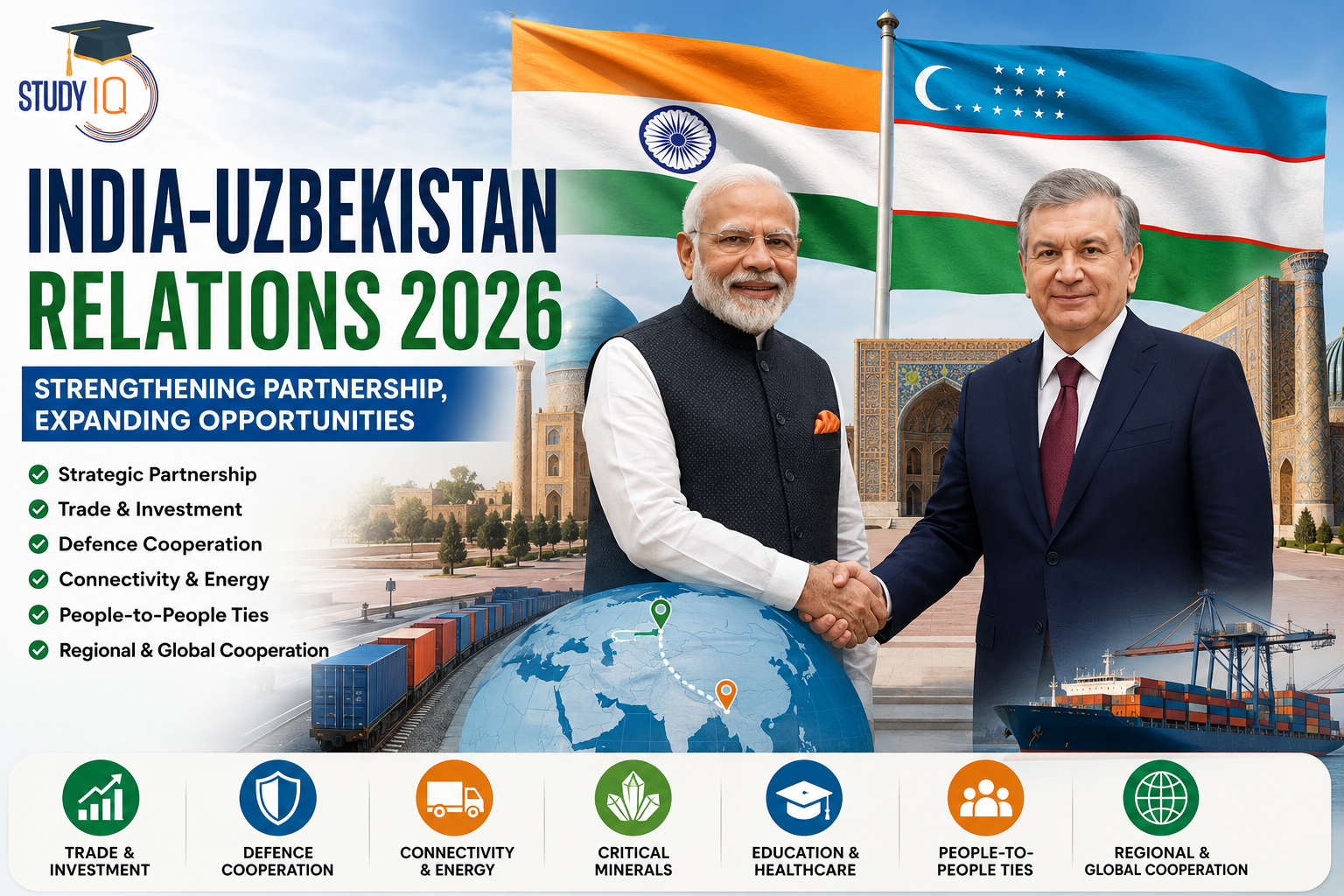
India and Uzbekistan share centuries-old historical and cultural ties. The ancient Silk Route connected the Indian subcontinent with Central Asia through trade, travel and the exchange of ideas. Since Uzbekistan became independent in 1991, India-Uzbekistan relations have gradually expanded from diplomatic engagement to cooperation in trade, defence, healthcare, education, energy, technology and connectivity.
In 2026, the relationship has gained fresh momentum and reflects India’s growing strategic interest in Central Asia.
Read Also: UPSC Daily Current Affairs 2026
Why is Uzbekistan Important for India?
Uzbekistan occupies a central position in Central Asia and has geographical proximity to Afghanistan. Its location makes it important for India’s economic, security and connectivity interests.
For India, stronger relations with Uzbekistan can help in:
- Expanding India’s presence in Central Asia
- Accessing new markets and resources
- Strengthening regional security
- Developing alternative connectivity routes
- Diversifying critical-mineral and energy supplies
- Expanding India’s soft power
Thus, Uzbekistan is an important pillar of India’s “Connect Central Asia” approach.
Trade and Investment
Economic relations are growing steadily. Bilateral trade reached around US$1.3 billion in 2025, recording significant growth over the previous year. Indian investments in Uzbekistan are close to US$1 billion, covering sectors such as pharmaceuticals, healthcare, renewable energy, mining, textiles, agriculture, construction and information technology.
However, the economic relationship still has considerable untapped potential. India needs to focus not only on increasing trade but also on diversifying exports, encouraging joint ventures and promoting local manufacturing.
The aim should be to move from:
Trade → Investment → Joint Production → Regional Value Chains
Critical Minerals: A New Area of Cooperation
The importance of critical minerals is increasing rapidly. Lithium, rare earth elements and other strategic minerals are essential for electric vehicles, renewable energy, semiconductors, electronics and defence technologies.
Cooperation with Uzbekistan can help India diversify its supply chains and strengthen strategic autonomy.
For India, this means:
Critical Minerals → Supply-chain security → Technology security → Strategic autonomy
This could become one of the most important areas of India-Uzbekistan cooperation in the coming years.
Defence and Regional Security
Security cooperation has become increasingly important because of developments in Afghanistan, terrorism, extremism and narcotics trafficking.
India and Uzbekistan cooperate through defence exchanges, military training and counter-terrorism mechanisms. Uzbekistan’s proximity to Afghanistan makes it particularly relevant to India’s regional security interests.
Greater cooperation in intelligence sharing and counter-terrorism can contribute to a stable and secure Central Asia.
Connectivity: The Biggest Challenge
The biggest obstacle to India’s economic engagement with Central Asia is geographical connectivity.
India does not have direct land access to Central Asia. Therefore, projects such as the International North-South Transport Corridor (INSTC) and India’s engagement with Chabahar Port are strategically important.
A stronger connectivity route can link:
India → Chabahar → Iran → Central Asia → Eurasian Markets
Better connectivity can reduce transportation costs, increase trade and provide India with greater access to Central Asian markets.
Therefore, connectivity is not simply an economic issue—it is also a geopolitical tool.
Healthcare and Education: India’s Soft Power
Healthcare is one of India’s strongest areas of cooperation with Uzbekistan. Nearly 14,000 Uzbek nationals have travelled to India for medical treatment, reflecting India’s reputation for affordable and advanced healthcare.
Education and skill development are also strengthening people-to-people relations. Indian universities, scholarships and training programmes provide opportunities for Uzbek students and professionals.
Yoga and cultural exchanges further strengthen India’s soft power.
This creates a virtuous cycle:
Culture → People-to-People Contact → Trust → Strategic Partnership
Technology and Space
The next phase of bilateral relations can increasingly focus on Artificial Intelligence, digital governance, cybersecurity and space technology.
India’s experience with Digital Public Infrastructure, digital payments and space applications can support Uzbekistan’s development goals while opening new opportunities for Indian technology companies.
Multilateral Cooperation
India and Uzbekistan cooperate through platforms such as the Shanghai Cooperation Organisation (SCO), BRICS, United Nations, India-Central Asia Summit and India-Central Asia Dialogue.
These platforms provide opportunities for cooperation on regional security, terrorism, connectivity and economic development.
Challenges
Despite significant progress, some challenges remain:
- First, inadequate connectivity increases the cost of trade.
- Second, bilateral trade remains below its potential.
- Third, China’s strong economic and connectivity presence in Central Asia creates a competitive environment.
- Fourth, instability in Afghanistan continues to pose security challenges.
- Fifth, agreements need to be converted into actual projects and investments through better implementation.
Way Forward
India should adopt a 5C approach:
- Connectivity – Strengthen Chabahar and INSTC-linked routes.
- Commerce – Diversify trade and promote Indian investments.
- Critical Minerals – Develop joint exploration, processing and supply chains.
- Capacity Building – Expand healthcare, education, skills and digital cooperation.
- Counter-Terrorism – Strengthen intelligence sharing and defence cooperation.

UPSC IAS Live GS P2I Foundation 2027 Pratigya August Evening Batch 2 (Basic)
Conclusion
India-Uzbekistan relations have evolved from ancient civilisational links into a modern strategic partnership. Today, the relationship covers almost every major dimension of international cooperation—from trade and defence to healthcare, critical minerals, connectivity and technology.
For India, Uzbekistan is not simply another Central Asian country. Its strategic location, economic potential and proximity to Afghanistan make it an important partner in India’s wider Eurasian vision.
 Special Summary Revision (SSR) 2026–27...
 Global Hunger Index 2026: India Ranks 10...
 France Protests 2026: Cost of Living, Sc...














 WhatsApp





