
Table of Contents
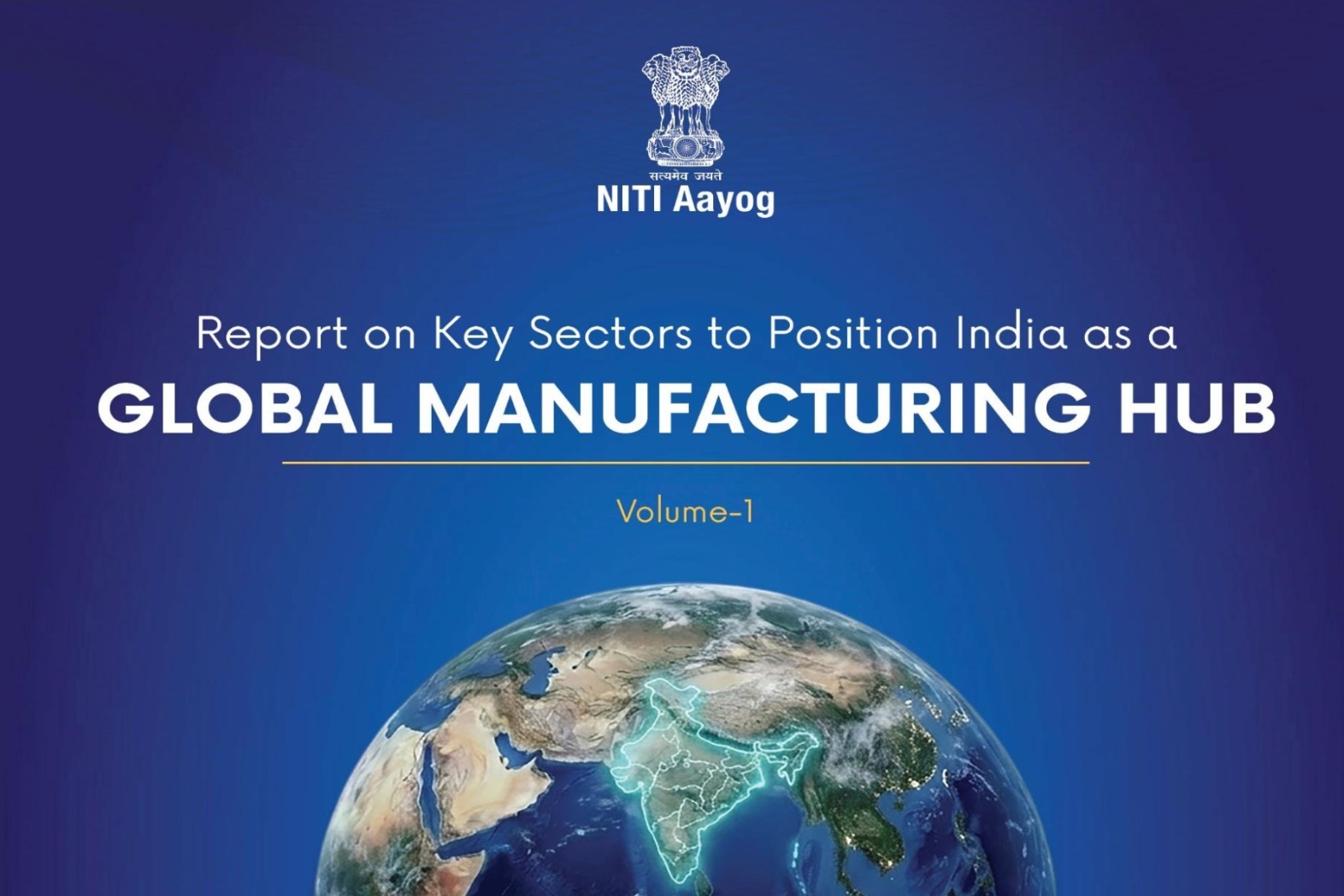
The NITI Aayog Report on Key Sectors to Position India as a Global Manufacturing Hub examines how India can strengthen its manufacturing capabilities, increase exports, generate employment and participate more deeply in global value chains (GVCs).
The report, prepared by NITI Aayog in collaboration with CRISIL Intelligence, initially assessed 62 manufacturing sectors and identified 12 sectors with strong potential for India to develop global leadership.
The report is particularly important because it argues that India’s manufacturing strategy cannot focus merely on increasing production. India needs to move towards higher domestic value addition, advanced manufacturing, technology development and deeper integration with global production networks.
What is the NITI Aayog Manufacturing Hub Report?
The report titled “Key Sectors to Position India as a Global Manufacturing Hub” is designed to identify manufacturing sectors where India has the greatest potential for future growth and global competitiveness.
The assessment considered factors such as:
- Domestic and global market size
- Market growth prospects
- Employment potential
- Strategic importance
- Raw-material availability
- Technology readiness
- Financial viability
- India’s position in global value chains
- Infrastructure requirements
- Policy support
- International best practices
The study used a four-phase methodology, beginning with the screening of 62 sectors and culminating in sector-specific recommendations based on international benchmarking and industry consultations.
12 Key Manufacturing Sectors Identified
The report identifies the following 12 sectors as having significant potential for India:
- Electronics
- Telecom Equipment
- Solar PV
- Pharmaceuticals
- Chemicals
- Automobiles
- Defence and Drones
- Steel
- Capital Goods
- Textiles
- Food Processing
- Leather and Footwear
These sectors were assessed in terms of strategic alignment, financial viability and their potential position within global value chains.
Focus of Volume I
The first volume provides detailed analysis of four sectors:
- Chemicals
- Textiles
- Solar PV Manufacturing
- Telecom and Network Equipment
The remaining eight sectors are to be covered in subsequent volumes.
Why Manufacturing is Important for India
Manufacturing has traditionally been viewed as an important source of employment, investment, productivity growth and exports.
However, India’s manufacturing contribution to GVA has remained relatively stagnant, broadly within the 16–18% range over the past two decades.
The report also highlights India’s comparatively limited share in global manufacturing value added.
India’s share increased from around 1.5% in 1995 to 3.2% in 2023, whereas China’s share increased from approximately 5% to nearly 32% over the same period.
This illustrates the scale of India’s opportunity as well as the competitiveness gap that needs to be addressed.
Major Challenges Facing India’s Manufacturing Sector
1. Infrastructure and Logistics
High logistics costs and inadequate multimodal connectivity continue to affect India’s manufacturing competitiveness.
The report points to weaknesses involving:
- Ports
- Roads
- Railways
- Warehousing
- Multimodal transport
- Power infrastructure
India’s logistics costs are estimated at around 8% of GDP in the report.
Efficient logistics are particularly important for export-oriented manufacturing because delays increase both inventory costs and delivery times.
2. Import Dependence
Several manufacturing sectors remain dependent on imported raw materials, components or intermediate goods.
This creates vulnerability to:
- Global supply-chain disruptions
- Geopolitical tensions
- Exchange-rate movements
- Commodity-price volatility
- External supply shocks
The report therefore emphasises strengthening domestic capabilities while simultaneously integrating Indian firms into international markets.
3. Limited Domestic Value Addition
One of the report’s central messages is that assembly alone is not enough.
India needs to progressively develop capabilities across the entire value chain:
Raw materials → Components → Manufacturing → Design → R&D → Branding → Global distribution
Greater participation in higher-value stages can improve productivity, technological capability and export competitiveness.
4. Technology and Skill Gaps
Advanced manufacturing increasingly depends on:
- Automation
- Artificial intelligence
- Robotics
- Advanced materials
- Semiconductor technologies
- Precision engineering
- Digital manufacturing
The report highlights technology constraints and skill shortages as cross-sectoral challenges that need coordinated intervention.
5. Fragmented MSME Sector
MSMEs are an important part of India’s manufacturing ecosystem but many face difficulties in:
- Accessing finance
- Adopting modern technology
- Scaling operations
- Digitalisation
- Meeting international standards
- Connecting with global value chains
The report notes that MSMEs account for more than 95% of manufacturing units, making their technological and productivity transformation essential.
Sector-Wise Analysis
Chemicals
India’s chemical industry has significant potential because chemicals are essential inputs for pharmaceuticals, agriculture, textiles, automobiles and several other industries.
The report recommends:
- Increasing domestic production
- Reducing import dependence
- Developing integrated manufacturing clusters
- Improving infrastructure
- Encouraging investment
- Increasing downstream value addition
- Promoting sustainable manufacturing
Certain chemicals continue to show substantial import dependence. For example, methanol’s import dependence was estimated at 85–90% in FY2025.
Key issue
India needs to move beyond commodity-oriented chemical production towards higher-value and technology-intensive chemical products.
Textiles
Textiles is particularly important because of its strong employment potential and linkages with MSMEs, rural economies and global trade.
However, the industry faces:
- High logistics costs
- Fragmented supply chains
- Productivity constraints
- Competition from other Asian exporters
- Limited value addition
- Insufficient global branding
The report recommends strengthening man-made fibres, modernising MSMEs, improving productivity and expanding international market access.
Technical Textiles
Technical textiles represent an important opportunity for diversification.
The domestic technical textile market increased from approximately $19 billion in FY2019 to $26.8 billion in FY2024, while exports increased from $1.99 billion to $2.59 billion during the same period.
This can help India move from traditional textile production towards higher-value, technology-oriented manufacturing.
Telecom and Network Equipment
Telecom equipment is strategically important for India’s digital infrastructure and technological self-reliance.
The report estimates India’s telecom and network equipment market at nearly $25 billion in FY2025, with potential to reach approximately $50 billion by 2032.
However, imports remain significantly higher than exports.
The sector therefore requires:
- Greater component localisation
- Domestic R&D
- Technology development
- Skilled workforce
- Export-oriented manufacturing
- Stronger domestic supplier ecosystems
The broader objective is to develop a complete telecom manufacturing ecosystem, rather than concentrating primarily on assembly.
Solar PV Manufacturing
Solar PV manufacturing represents the intersection of:
Energy security + renewable energy + industrial policy + technology + global trade
India has expanded solar manufacturing capacity significantly.
According to the report, solar module capacity listed under ALMM increased from approximately 2.3 GW in 2014 to 100 GW in August 2025. Solar cell manufacturing capacity increased from less than 1.2 GW in 2014 to 25 GW in March 2025.
However, upstream manufacturing remains a major weakness.
India continues to depend on imports for critical inputs such as polysilicon and wafers.
The report therefore recommends strengthening:
- Upstream manufacturing
- R&D
- Manufacturing productivity
- Skilled manpower
- Domestic supply chains
- Technological capabilities
Global Value Chains and India
A major theme of the report is Global Value Chain integration.
A country does not become a manufacturing leader merely by producing large quantities. It must capture value at multiple stages.
For India, this means moving from:
Assembly-led manufacturing
towards:
Design + Components + Technology + Manufacturing + Branding + Exports
The report’s international benchmarking exercise examines leading manufacturing countries to identify lessons related to industrial policy, trade agreements, skills, investment climate, technology and company strategies.
What Can India Learn from Global Manufacturing Leaders?
The report’s assessment of leading manufacturing economies suggests that manufacturing success rarely comes from one policy intervention.
Instead, successful manufacturing ecosystems generally combine:
- Long-term policy consistency
- Industrial clusters
- Infrastructure
- Skilled workforce
- Technology investment
- R&D
- Targeted incentives
- Strong domestic suppliers
- Export orientation
- Global market integration
The report specifically draws lessons from countries including China, Vietnam, South Korea and Singapore.
Way Forward for India’s Manufacturing Sector
India’s manufacturing strategy should focus on five broad priorities.
1. Build Complete Industrial Ecosystems
Instead of isolated factories, India needs integrated clusters containing:
Suppliers + manufacturers + logistics + R&D + skilled workforce + finance
2. Increase Value Addition
India must move from low-value assembly towards components, design, technology, intellectual property and branding.
3. Strengthen R&D
Greater private-sector participation in research and product development is necessary for technological competitiveness.
4. Modernise MSMEs
MSMEs need better access to technology, finance, skills and international markets.
5. Improve Export Competitiveness
Trade agreements, efficient logistics, international standards, quality certification and global branding can help Indian companies expand overseas.
Significance of the NITI Aayog Manufacturing Report
The report is important because it provides a sector-specific roadmap rather than a one-size-fits-all manufacturing strategy.
It recognises that different sectors face different constraints.
For example:
- Chemicals require stronger domestic feedstock and downstream capabilities.
- Textiles need greater productivity, MMF competitiveness and market access.
- Telecom equipment requires component localisation and technology development.
- Solar PV needs stronger upstream manufacturing and R&D.
This sector-specific approach is central to the report’s strategy.
Conclusion
The NITI Aayog Manufacturing Hub Report presents a clear message: India’s manufacturing opportunity is substantial, but achieving global competitiveness will require more than increasing factory output.
India must build globally competitive companies, complete industrial ecosystems, advanced technological capabilities and deeper participation in global value chains.
The identification of 12 priority sectors provides a framework for targeted industrial policy, while the analysis of chemicals, textiles, telecom equipment and solar PV demonstrates the specific reforms required at the sectoral level.
Ultimately, India’s manufacturing transformation will depend on the combination of infrastructure, technology, skills, finance, policy stability, logistics, domestic value addition and global market access.
Read Also: UPSC Daily Current Affairs 2026
 Anti-Goonda Bill 2026 Explained: Why Pre...
 Cool Leaders Award 2026: Winners, Global...
 Black Carbon and Himalayan Glacier Melt:...














 WhatsApp





