
Table of Contents
Context
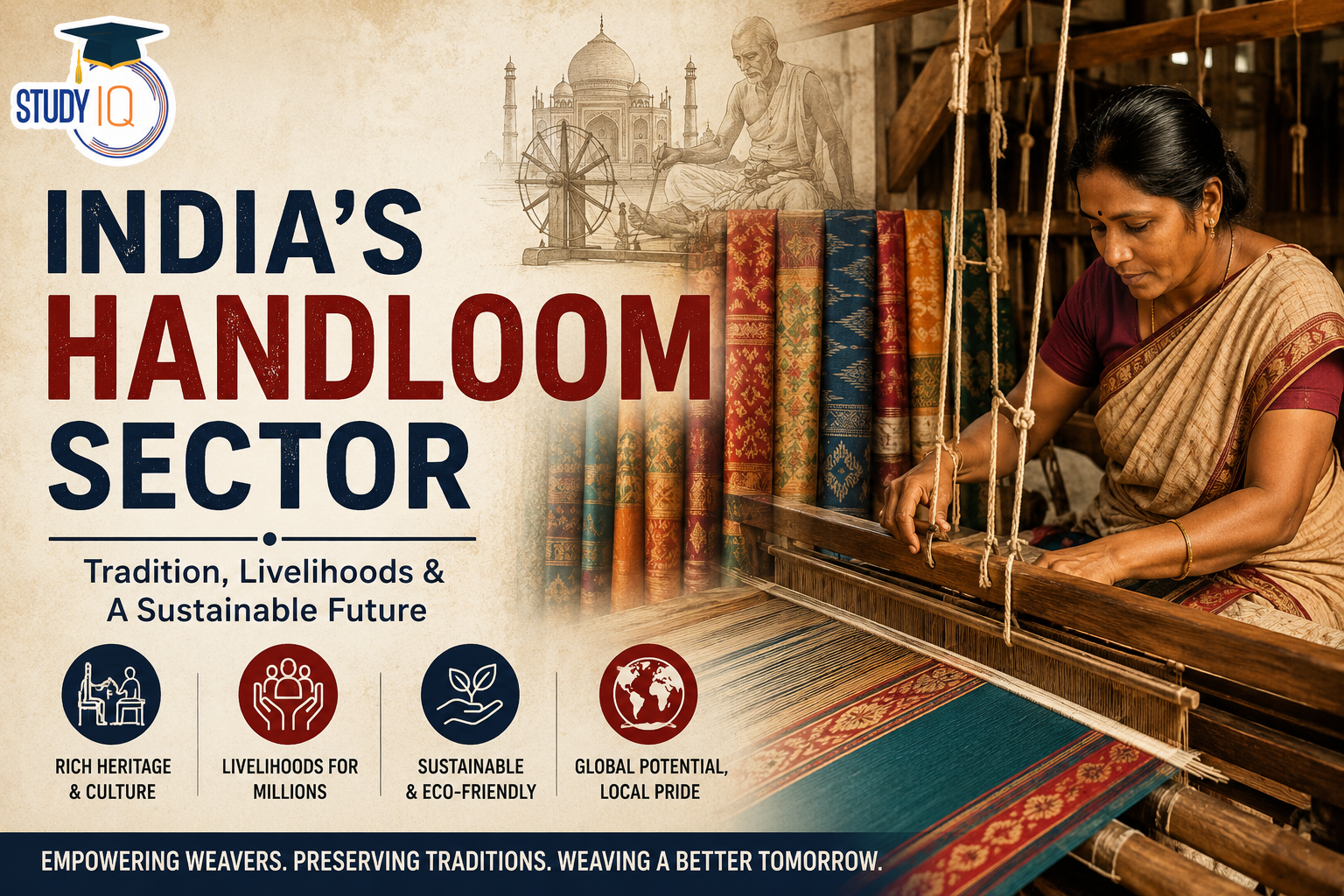
National Handloom Day, observed on August 7, commemorates the launch of the Swadeshi Movement in 1905, when boycotting British textiles and promoting indigenous production made weaving a symbol of economic self-reliance, national identity and resistance. More than a century later, the challenge is to translate this historical and cultural value into sustainable livelihoods, higher weaver incomes and global competitiveness for India’s handloom sector.
Why does a higher retail price for handloom not necessarily translate into higher incomes for weavers?
- Asymmetric Value Retention: A high final retail price does not guarantee high producer realisation because value is distributed across traders, master weavers, brands, designers and retailers before reaching the artisan.
- g., A handwoven product may command a substantial premium in urban retail markets while the weaver continues to receive a labour-based payment primarily.
- Tied Input and Buyer Dependence: Dependence on intermediaries for yarn, orders and working capital can restrict the weaver’s ability to switch buyers and negotiate remuneration.
- g., Dependence on master weavers and traders for yarn and production orders can simultaneously provide market access while constraining producer bargaining power.
- Asymmetric Cash-Flow Imperative: Small weavers with limited working capital may prioritise immediate and predictable payment over potentially higher but delayed returns through formal or direct-market channels.
- g., An intermediary offering advances against ongoing production can remain attractive even when direct-market channels offer higher eventual prices.
- Value-per-Labour-Hour Constraint: Handloom is inherently labour-intensive, making income growth dependent on increasing the value realised per hour of skilled labour rather than simply increasing physical output.
- g., An intricate design may substantially increase weaving time without generating a proportionate increase in the weaver’s effective hourly income.
- Weak Market Intelligence: Limited access to information on consumer preferences, fashion trends, end-market prices and product margins reduces the ability of weavers to capture changing demand.
Why is handloom attracting renewed interest among some younger artisans and entrepreneurs despite historically low economic returns?
- Demand-Side Revaluation: Growing interest in authenticity, cultural identity, slow fashion and sustainable consumption is creating new commercial value around traditional handloom products.
- g., Traditional weaving techniques are increasingly incorporated into contemporary fashion, lifestyle products and designer collections.
- Digital Access with Re-Intermediation Risk: E-commerce and social media expand market reach but do not automatically create direct producer-to-consumer relationships because platforms, aggregators and brands can become new intermediaries.
- g., A digital marketplace may expand sales while retaining control over customer acquisition, commissions and consumer relationships outside the weaving community.
- Occupational Transformation without Craft Decoupling: Youth participation can expand into design, branding and entrepreneurship, but the long-term viability of the ecosystem depends on simultaneously renewing the underlying weaving skill base.
- Product Modernisation: Contemporary designs, colours, apparel formats and lifestyle products can make traditional weaving techniques commercially relevant to changing consumer preferences.
- g., Traditional techniques can be adapted into contemporary apparel, accessories and home furnishings without abandoning the handwoven process.
- Greater Economic Autonomy: Handloom becomes more attractive to younger entrants when new models provide greater control over design, pricing, branding and customer relationships rather than reproducing low-paid contract weaving.
Why has the sustainability advantage of handloom not yet produced proportional export competitiveness?
- Scale-Reliability Gap: Fragmented production makes it difficult to provide the consistent volume and continuity required by large international buyers.
- g., A buyer seeking thousands of units with predictable replenishment may prefer an integrated supplier even when handloom offers greater craft differentiation.
- Consistency-Differentiation Tension: International buyers require predictable quality and specifications, but excessive standardisation can weaken the artisanal variation that creates handloom’s premium value.
- g., The objective should be consistency in quality and compliance, not identical reproduction of every piece; controlled variation can remain part of the product’s artisanal identity.
- Aggregation Infrastructure Deficit: Individual weavers often lack shared facilities for testing, finishing, packaging, warehousing, inventory management and export documentation, preventing dispersed production from functioning as a reliable export supply chain.
- Weak Global Brand Conversion: India’s handloom traditions possess strong cultural identities, but cultural recognition does not automatically become internationally recognised brands capable of sustaining premium prices.
- g., Banarasi, Kanchipuram, Chanderi and Pochampally possess distinctive identities that can be strengthened through provenance, contemporary design and international branding.
- Sustainability-Monetisation Gap: Low power use and low mechanisation provide environmental advantages, but these do not automatically generate export premiums without credible verification, traceability and consumer recognition.
- g., The EU’s forthcoming textile-specific Digital Product Passport framework is intended to improve product information, traceability and sustainability transparency; the textile-specific requirements are planned through a future delegated act, currently indicated for Q4 2027.
Way Forward
- Institutional Liquidity and Risk Absorption: Producer organisations should replicate the economically useful functions of intermediaries-advance payments, input supply, order aggregation and working-capital support-while sharing inventory risk through diversified buyers and confirmed orders.
- g., Order-linked finance, buyer advances, credit guarantees and export receivables financing can reduce the cash-flow gap without requiring producer organisations to absorb unlimited unsold inventory risk.
- Raise Value per Loom-Hour without Diluting Craft: Increase value realisation through design, premiumisation and market positioning while preserving the auxiliary skills and techniques that contribute to fabric texture, drape and artisanal identity.
- g., Technology should primarily reduce drudgery and repetitive work while avoiding excessive mechanisation of processes whose variations contribute to the handloom product’s distinctive character.
- Decentralised Production with Centralised Quality Assurance: Keep weaving dispersed and artisanal while creating shared infrastructure for testing, documentation, finishing, packaging, logistics and export compliance.
- g., Common facilities should establish minimum quality and buyer specifications without forcing every artisan to produce visually identical pieces.
- Enforce Provenance with Proportionate Compliance: Combine Geographical Indications (GIs), Handloom Mark, testing, labelling, traceability, and market surveillance, using shared compliance systems to prevent new regulatory requirements from disproportionately burdening small producers.
- Protect the Craft Base while Building Producer-Centric Markets: Combine craft-skill transmission, youth apprenticeship, digital market access and collective export aggregation so that rising returns accrue to actual weaving labour rather than disproportionately to downstream managers and digital intermediaries.
Read Also: UPSC Daily Current Affairs 2026
 Anti-Goonda Bill 2026 Explained: Why Pre...
 Cool Leaders Award 2026: Winners, Global...
 Black Carbon and Himalayan Glacier Melt:...














 WhatsApp





