Table of Contents
The “Chalo Sansad” protest over alleged examination paper leaks has reignited the debate on the constitutional right to protest and the extent of police powers to regulate public assemblies in India.
The right to protest is a cornerstone of a democratic society, enabling citizens to express dissent and demand accountability peacefully. However, this right is not absolute and is subject to constitutional and legal limitations to maintain public order.
What is the Right to Protest?
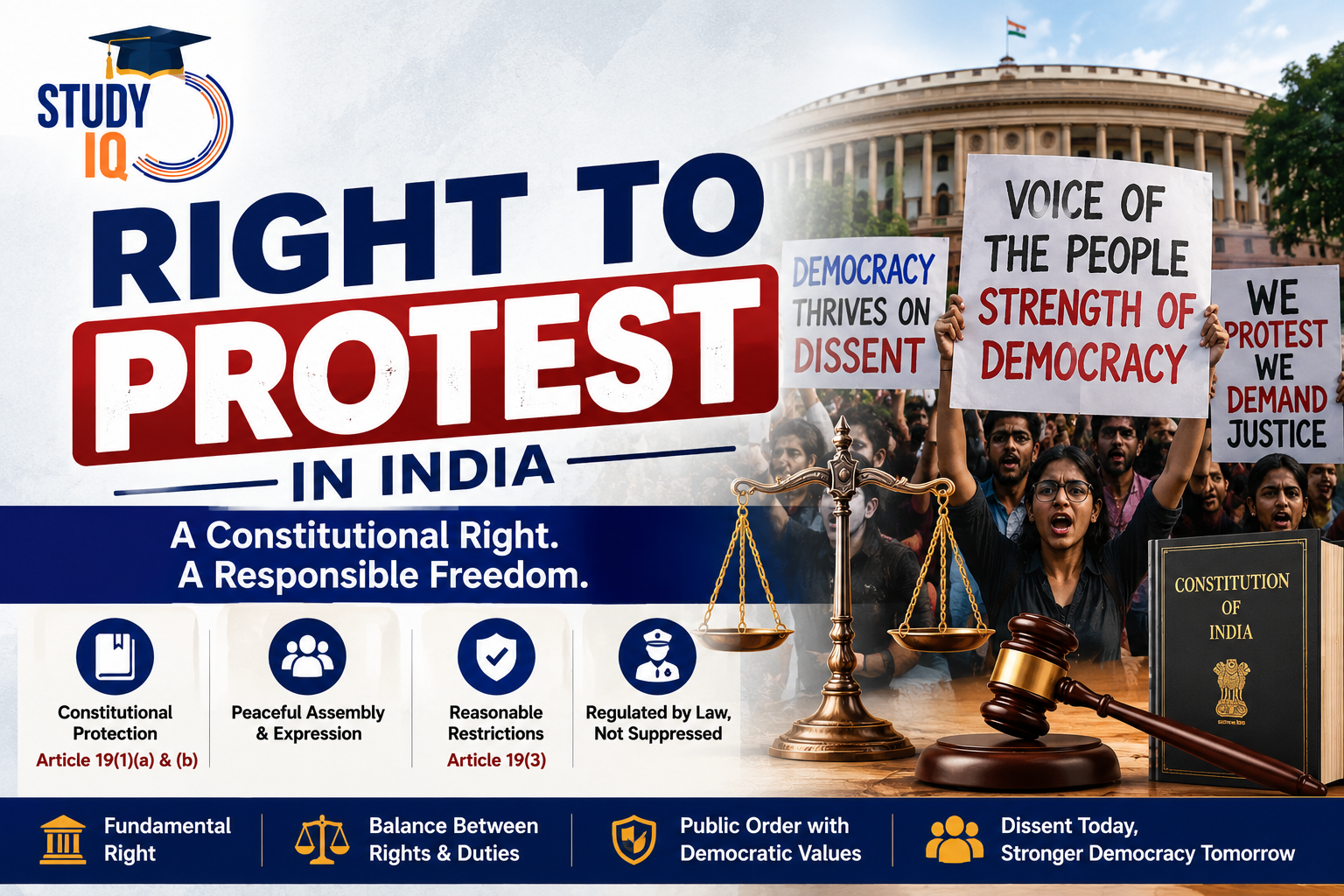
The Right to Protest refers to the constitutional freedom of citizens to assemble peacefully and express their views against government policies, laws, or actions.
It is an essential feature of participatory democracy, allowing people to voice grievances while promoting transparency and accountability in governance.
Constitutional Basis of the Right to Protest
The Constitution of India guarantees the right to peaceful protest through various Fundamental Rights.
Article 19(1)(a)
- Freedom of speech and expression.
Article 19(1)(b)
- Right to assemble peacefully and without arms.
Article 19(1)(c)
- Right to form associations or unions.
Together, these provisions form the constitutional foundation of peaceful protests in India.
Reasonable Restrictions
The Right to Protest is not an absolute right.
Under Article 19(3), the State may impose reasonable restrictions in the interests of:
- Public order
- Sovereignty and integrity of India
- Security of the State
- Other constitutionally permissible grounds
Restrictions must be reasonable, proportionate, and legally justified.
Legal Framework Governing Public Protests
Public protests are regulated through laws dealing with public order, policing, and criminal procedure.
Major laws include:
- Bharatiya Nyaya Sanhita (BNS)
- Bharatiya Nagarik Suraksha Sanhita (BNSS)
- State Police Acts
- Local municipal laws governing public assemblies
These laws empower authorities to regulate the time, place, and manner of public protests while protecting public safety.
What is an Unlawful Assembly?
Under the Bharatiya Nyaya Sanhita (BNS), an assembly of five or more persons becomes an unlawful assembly if its common object includes:
- Using criminal force
- Resisting the execution of law
- Committing an offence
- Compelling any person through criminal force or intimidation
- Disturbing public peace
Once declared unlawful, authorities may take legal action to disperse the gathering.
Police Powers under BNSS
The Bharatiya Nagarik Suraksha Sanhita (BNSS) empowers:
- Executive Magistrates, or
- Authorised police officers
to order the dispersal of:
- An unlawful assembly, or
- An assembly likely to disturb public peace.
If participants refuse to disperse, authorities may use only the minimum force necessary to restore order.
The use of force must always satisfy the principles of necessity, proportionality, and legality.
Landmark Supreme Court Judgments
1. Anita Thakur v. State of Jammu & Kashmir (2016)
The Supreme Court held that:
- Peaceful protesters enjoy constitutional protection.
- Excessive or disproportionate police force violates Fundamental Rights.
- Authorities must exercise restraint while dispersing demonstrations.
Significance: Reinforced protection against arbitrary police action.
2. Mazdoor Kisan Shakti Sangathan (MKSS) v. Union of India (2018)
The Supreme Court observed that:
- The right to protest is a constitutional right.
- Authorities may reasonably regulate protests.
- The State cannot completely prohibit peaceful demonstrations.
Significance: Balanced public order with democratic freedoms.
3. Amit Sahni v. Commissioner of Police (2020) (Shaheen Bagh Case)
The Supreme Court ruled that:
- Public roads and public spaces cannot be occupied indefinitely.
- Protests should take place only at designated places.
- Democratic dissent must not infringe upon the rights of other citizens.
Significance: Clarified that the right to protest cannot override the public’s right to free movement.
Importance of the Right to Protest
The Right to Protest is vital because it:
- Strengthens democratic participation.
- Promotes government accountability.
- Protects civil liberties.
- Enables peaceful expression of dissent.
- Encourages public dialogue on important issues.
- Acts as a constitutional check on arbitrary state action.
Challenges
India continues to face several challenges in balancing protest rights with public order:
- Maintaining law and order during large gatherings.
- Preventing violence and unlawful assemblies.
- Balancing free speech with public convenience.
- Allegations of excessive police force.
- Misuse of restrictions against peaceful protesters.
- Traffic disruptions and prolonged occupation of public spaces.
Way Forward
A balanced approach should include:
- Respecting citizens’ constitutional right to peaceful protest.
- Ensuring restrictions remain reasonable and proportionate.
- Improving coordination between protesters and authorities.
- Designating adequate protest venues.
- Promoting dialogue before enforcement action.
- Ensuring police accountability for excessive use of force.
Read Also: UPSC Daily Current Affairs 2026
 Species in News: Cheetah | Project Cheet...
 Quantum Computing: RRI Scientists Demons...
 Artificial Intelligence in Warfare: How ...












 WhatsApp