
Table of Contents
The Abathsahayeswarar Temple is one of the finest examples of Chola temple architecture in South India. Located in Thukkatchi village of Mayiladuthurai district, Tamil Nadu, this 12th-century Shiva temple has recently gained international recognition after receiving the UNESCO Asia-Pacific Award of Distinction 2024 for its outstanding heritage conservation efforts.
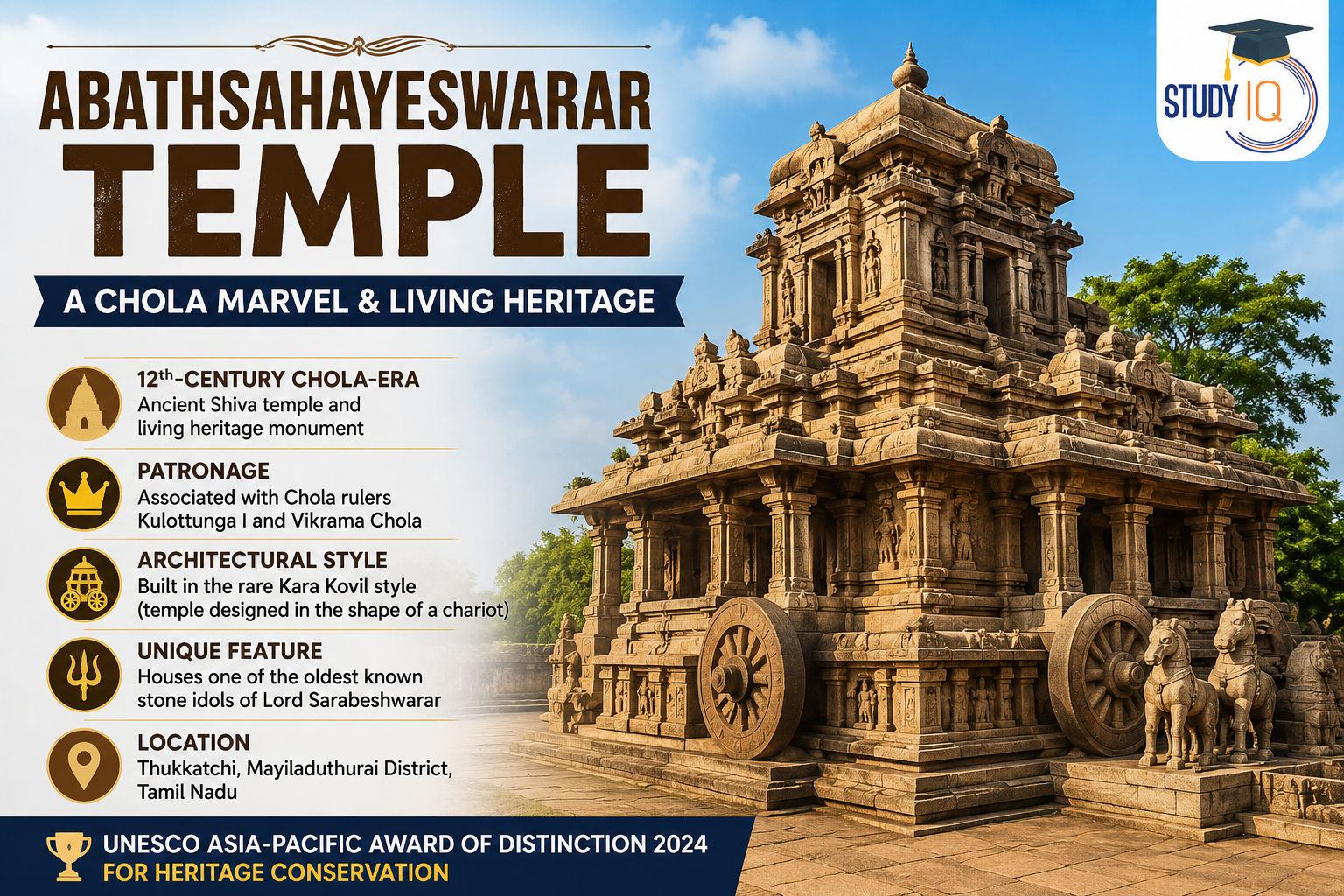
The temple is not only an architectural marvel but also an active place of worship, making it an excellent example of a living heritage monument. Its rare Kara Kovil (chariot-shaped) architectural style and the presence of one of the oldest stone idols of Lord Sarabeshwarar make it an important cultural and religious landmark.

Why is Abathsahayeswarar Temple in the News?
The Abathsahayeswarar Temple was recently highlighted after being conferred the UNESCO Asia-Pacific Award of Distinction 2024, the highest honour under UNESCO’s Asia-Pacific Awards for Cultural Heritage Conservation.
The restoration project was appreciated for:
- Preserving the temple’s original Chola architecture
- Using traditional building materials and indigenous conservation methods
- Combining scientific conservation techniques with traditional sthapathi craftsmanship
- Ensuring the temple continues to function as a living place of worship while preserving its historical integrity
The award recognizes exceptional efforts in protecting and restoring Asia’s cultural heritage.
Overview of Abathsahayeswarar Temple
| Particular | Details |
|---|---|
| Temple Name | Abathsahayeswarar Temple |
| Deity | Lord Shiva (Abathsahayeswarar) |
| Location | Thukkatchi, Mayiladuthurai District, Tamil Nadu |
| Period | 12th Century CE |
| Dynasty | Later Cholas |
| Patrons | Kulottunga I and Vikrama Chola |
| Architectural Style | Kara Kovil (Chariot-shaped Temple) |
| UNESCO Recognition | Asia-Pacific Award of Distinction 2024 |
| Religious Importance | Shaivite Temple |
Location of Abathsahayeswarar Temple
The temple is situated in Thukkatchi village, near Kumbakonam, in Mayiladuthurai district of Tamil Nadu.
The region is famous for its dense concentration of Chola temples and forms part of one of India’s richest cultural landscapes.
Nearby heritage sites include:
- Airavatesvara Temple, Darasuram
- Brihadeeswarar Temple, Thanjavur
- Gangaikonda Cholapuram Temple
These monuments collectively showcase the architectural brilliance of the Chola Empire.
History of Abathsahayeswarar Temple
The temple was constructed during the reign of the Later Cholas in the 12th century.
Historical inscriptions indicate royal patronage from:
- Kulottunga I (1070–1122 CE)
- Vikrama Chola (1118–1135 CE)
The temple served as an important religious centre and reflects the Chola dynasty’s remarkable achievements in architecture, sculpture, engineering, and temple administration.
Over centuries, portions of the temple deteriorated due to weathering, natural disasters, and aging, making conservation essential.
Meaning of Abathsahayeswarar
The name Abathsahayeswarar comes from:
- Abath – danger or distress
- Sahaya – helper or protector
- Eswarar – Lord Shiva
Thus, Lord Shiva is worshipped here as “The Protector in Times of Danger.”
Devotees believe prayers offered at this temple help remove obstacles, hardships, and fears.
Architectural Features of Abathsahayeswarar Temple
The temple is renowned for its unique architectural design.
1. Kara Kovil Style
The temple is built in the rare Kara Kovil architectural style.
Unlike conventional South Indian temples, the sanctum resembles a stone chariot, complete with sculpted wheels and horses, symbolizing divine movement and cosmic energy.
Only a handful of temples in Tamil Nadu follow this distinctive style.
2. Chola Architecture
Typical features of Chola craftsmanship include:
- Intricately carved granite structures
- Elegant vimana (temple tower)
- Finely sculpted pillars
- Detailed stone inscriptions
- Decorative friezes depicting mythological stories
- Highly proportioned sanctum and mandapas
The precision of stone carving demonstrates the engineering excellence of Chola artisans.
3. Stone Idol of Lord Sarabeshwarar
One of the temple’s most significant features is the ancient stone idol of Lord Sarabeshwarar, considered among the oldest known representations of this form.
Who is Lord Sarabeshwarar?
In Shaivite tradition, Lord Sarabeshwarar is a fierce manifestation of Lord Shiva.
According to mythology:
- Lord Vishnu assumed the form of Narasimha after slaying Hiranyakashipu.
- Narasimha’s intense fury threatened cosmic balance.
- Lord Shiva manifested as Sarabha, a powerful composite being, to pacify Narasimha.
- Sarabeshwarar symbolizes the restoration of cosmic order, restraint, and divine harmony.
The iconography of Sarabeshwarar is unique and relatively rare in Indian temples.
UNESCO Asia-Pacific Award of Distinction 2024
The UNESCO Asia-Pacific Awards for Cultural Heritage Conservation honour projects that successfully preserve heritage while maintaining authenticity and community engagement.
The Abathsahayeswarar Temple conservation project received the Award of Distinction, recognizing:
- Authentic restoration practices
- Revival of traditional construction techniques
- Community participation
- Scientific conservation methods
- Preservation of original artistic elements
- Sustainable heritage management
The project serves as a model for conserving India’s living temples without compromising their historical character.
Importance of the Temple
The temple holds significance in multiple dimensions.
Religious Importance
- Ancient Shaivite pilgrimage centre
- Dedicated to Lord Shiva
- Revered by devotees across Tamil Nadu
Historical Importance
- Reflects the cultural achievements of the Chola Empire
- Preserves inscriptions that provide insights into medieval administration, donations, and religious practices
Architectural Importance
- Rare Kara Kovil design
- Exceptional Chola stone craftsmanship
- Unique Sarabeshwarar sculpture
Cultural Importance
- Living heritage monument
- Active rituals continue alongside conservation efforts
- Represents continuity of Tamil temple traditions
Key Facts for UPSC Revision
- Located in Thukkatchi, Mayiladuthurai district, Tamil Nadu
- Dedicated to Lord Shiva (Abathsahayeswarar)
- Built during the 12th century
- Patronised by Kulottunga I and Vikrama Chola
- Built in the rare Kara Kovil (chariot-shaped) architectural style
- Houses one of the oldest stone idols of Lord Sarabeshwarar
- Received the UNESCO Asia-Pacific Award of Distinction 2024
- Considered a living heritage monument
- Conserved using traditional craftsmanship alongside modern conservation science
Latest UPSC Updates
| Resource | Link |
|---|---|
| UPSC Prelims Result 2026 | Check Here |
| UPSC Exam Calendar 2027 | View Calendar |
| UPSC Question Paper 2026 | Download PDF |
| UPSC Prelims Answer Key 2026 | Check Answer Key |
| UPSC Cut Off 2026 | View Cut Off |
| UPSC Syllabus 2026 | Read Syllabus |
| Daily Current Affairs 2026 | Read Updates |
| StudyIQ UPSC IAS Foundation 2027 (English) | Join Course |
| StudyIQ UPSC IAS Foundation 2027 (Hindi) | Join Course |
| StudyIQ UPSC IAS Foundation 2027 (Bilingual) | Join Course |
 World Food Day 2026: Strengthening Nutri...
 International Day for the Eradication of...
 India’s Ramsar Sites Reach 103: Sukhna...














 WhatsApp





