
Table of Contents
Context
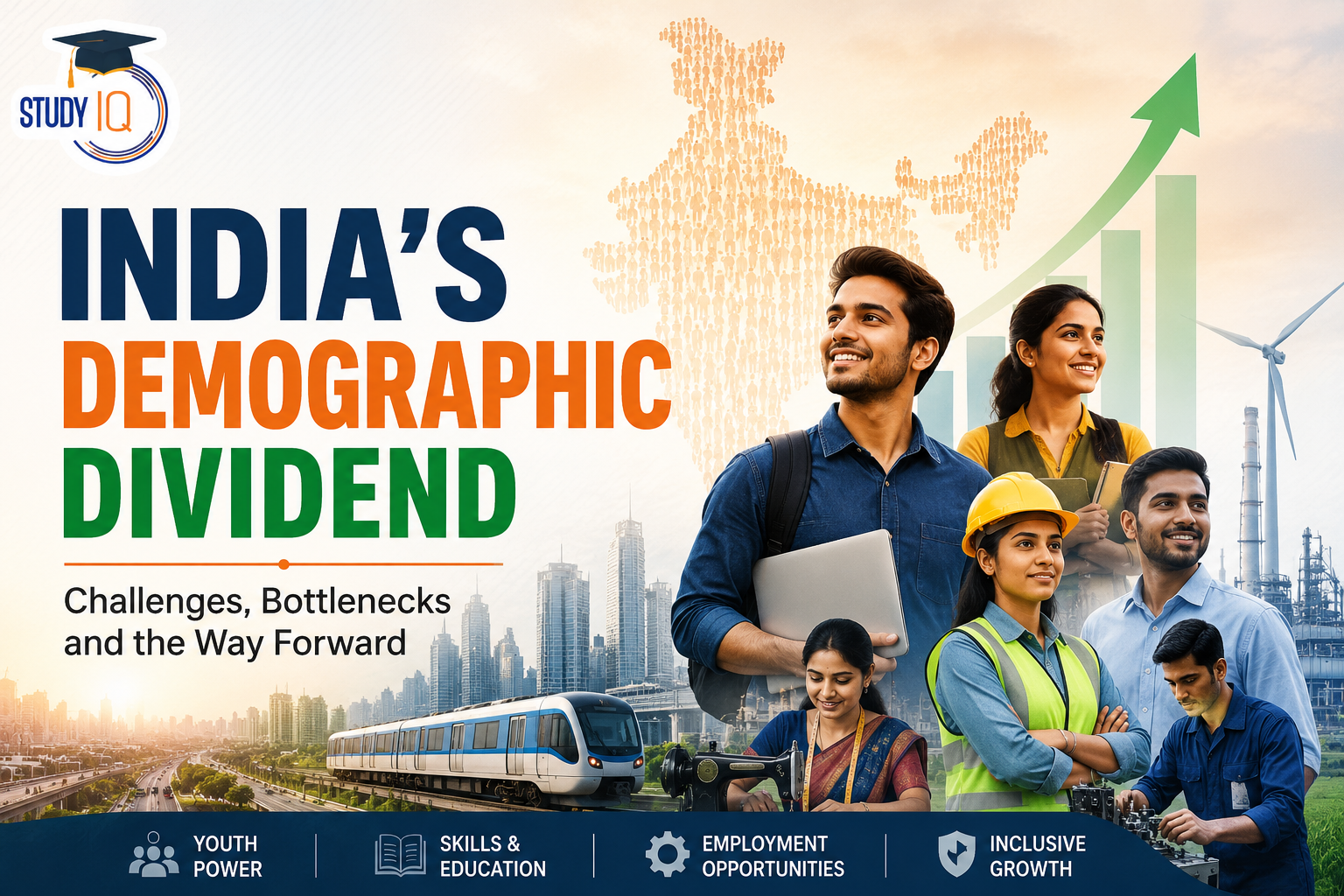
A recent analysis has raised concerns that India’s demographic dividend is being undermined, risking the loss of a once-in-a-generation demographic opportunity.
How is India Failing to Harness its Demographic Dividend?
- Inter-State Demographic Divergence: India’s demographic dividend is increasingly concentrated in northern states with weaker human capital and employment opportunities, while southern states are entering demographic ageing.
- g. Uttar Pradesh and Bihar retain younger populations, whereas Kerala and Tamil Nadu are witnessing rising old-age dependency.
- Persistent Skill Deficit and Industry–Academia Disconnect: Weak alignment between education, vocational training and industry needs has limited workforce employability and productivity.
- g. About 3% of India’s workforce has received formal vocational training.
- Discouraged Worker Effect and Educated Unemployment: Official unemployment rates often mask the true extent of labour market distress by excluding discouraged workers who have stopped looking for jobs. Moreover, the shortage of quality employment opportunities has resulted in rising unemployment even among educated youth, reflecting weak employment elasticity and skill-job mismatch.
- g. The India Employment Report 2024 notes that youth account for nearly 83% of India’s unemployed, with unemployment increasing alongside educational attainment.
- Stalled Structural Transformation: India has not generated sufficient labour-intensive manufacturing employment, resulting in jobless growth, disguised unemployment and expansion of informal work.
- g. Over 30 crore workers are registered on the e-Shram portal, reflecting the predominance of informal employment.
- Underutilisation of Female Workforce: Rising female labour-force participation has not translated into adequate formal and productive employment, limiting the demographic dividend.
- g. Recent PLFS data shows higher female labour-force participation, but much of the increase is concentrated in unpaid family work and self-employment rather than regular wage employment.
What are the Governance and Social Bottlenecks in Harnessing India’s Demographic Dividend?
Governance Bottlenecks
- Public Sector Aspirations and Lost Productive Years: The shortage of quality private-sector jobs, coupled with delayed public recruitment, traps millions of youth in prolonged exam preparation, reducing their productive years.
- g. Recruitment for many Central and State government jobs extends over 3–4 years due to administrative delays and litigation.
- Myopia in Public Expenditure: Short-term political incentives often favour visible announcements over sustained investments in education, healthcare, skilling and employment generation.
- g. Welfare and infrastructure announcements often receive greater political attention than long-term investments in public schools, primary healthcare and vocational institutions.
- Weak Human Capital Formation: Persistent deficits in nutrition, healthcare and foundational learning reduce the cognitive and physical capabilities of the future workforce, limiting productivity and innovation.
- g.NFHS-5 (2019–21) reports 35.5% of children under five are stunted and 67.1% are anaemic.
Social Bottlenecks
- Casualisation and Gigification of Labour: The rapid expansion of gig and contractual work has increased labour market flexibility but weakened job security, employer-sponsored skilling and social protection.
- g.NITI Aayog’s India’s Booming Gig and Platform Economy (2022) projects India’s gig workforce to increase from 7.7 million (2020–21) to 23.5 million by 2029–30.
- Inter-generational Transmission of Poverty: Limited access to quality education and stable employment restricts upward social mobility, particularly for first-generation learners and economically weaker sections.
- g. Financial constraints often force disadvantaged youth to discontinue higher education or abandon competitive examinations.
- Gendered Barriers to Economic Participation: Women continue to face barriers in accessing productive employment due to unpaid care responsibilities, workplace safety concerns and occupational segregation.
Way Forward
- Promote Labour-Intensive Industrialisation: Shift from capital-intensive growth towards employment-intensive manufacturing by incentivising MSMEs and labour-intensive sectors through Employment-Linked Incentives (ELIs).
- g. Promote sectors such as textiles, footwear, food processing and electronics assembly under the Employment Linked Incentive (ELI) Scheme.
- Strengthen Industry-Linked Skill Development: Reform Skill India and PMKVY by integrating vocational education with industry demand, apprenticeships and lifelong learning.
- g. Leverage the National Credit Framework (NCrF) and adopt Germany’s dual apprenticeship model to improve employability.
- Unlock Women’s Economic Participation: Expand investments in childcare, safe transport, flexible work arrangements and women-intensive industries to increase access to quality formal employment.
- g. Strengthen public crèches under Palna, improve workplace safety, and promote women-led employment in textiles and electronics manufacturing.
- Strengthen Social Protection for the New Economy: Extend social security, insurance and skill development to gig and platform workers through a dedicated welfare architecture.
- g. Implement the Code on Social Security, 2020 and draw lessons from the Rajasthan Platform Based Gig Workers (Registration and Welfare) Act, 2023.
- Institutionalise Outcome-Oriented Governance: Improve public service delivery through time-bound recruitment, outcome budgeting, social audits and timely completion of projects to maximise returns on public investment.
- g. Kerala’s People’s Plan Campaign demonstrates how decentralised planning and community oversight can improve accountability.
- Promote Human Capital-Oriented Welfare: Redesign welfare schemes to build long-term human capital by linking benefits with education, health and skill development outcomes.
- g. Brazil’s Bolsa Família uses Conditional Cash Transfers (CCTs) tied to school attendance and health check-ups to break inter-generational poverty.
Latest UPSC Updates
| Resource | Link |
|---|---|
| UPSC Prelims Result 2026 | Check Here |
| UPSC Exam Calendar 2027 | View Calendar |
| UPSC Question Paper 2026 | Download PDF |
| UPSC Prelims Answer Key 2026 | Check Answer Key |
| UPSC Cut Off 2026 | View Cut Off |
| UPSC Syllabus 2026 | Read Syllabus |
| Daily Current Affairs 2026 | Read Updates |
| StudyIQ UPSC IAS Foundation 2027 (English) | Join Course |
| StudyIQ UPSC IAS Foundation 2027 (Hindi) | Join Course |
| StudyIQ UPSC IAS Foundation 2027 (Bilingual) | Join Course |
 World Food Day 2026: Strengthening Nutri...
 International Day for the Eradication of...
 India’s Ramsar Sites Reach 103: Sukhna...













 WhatsApp





