Table of Contents
The Global Liveability Index 2026, released by the Economist Intelligence Unit (EIU), provides a comprehensive assessment of the quality of life in major cities across the world. The annual index evaluates 173 cities based on factors that influence everyday living, including stability, healthcare, education, infrastructure, and culture. The report serves as a benchmark for governments, businesses, urban planners, and expatriates to compare living conditions globally.
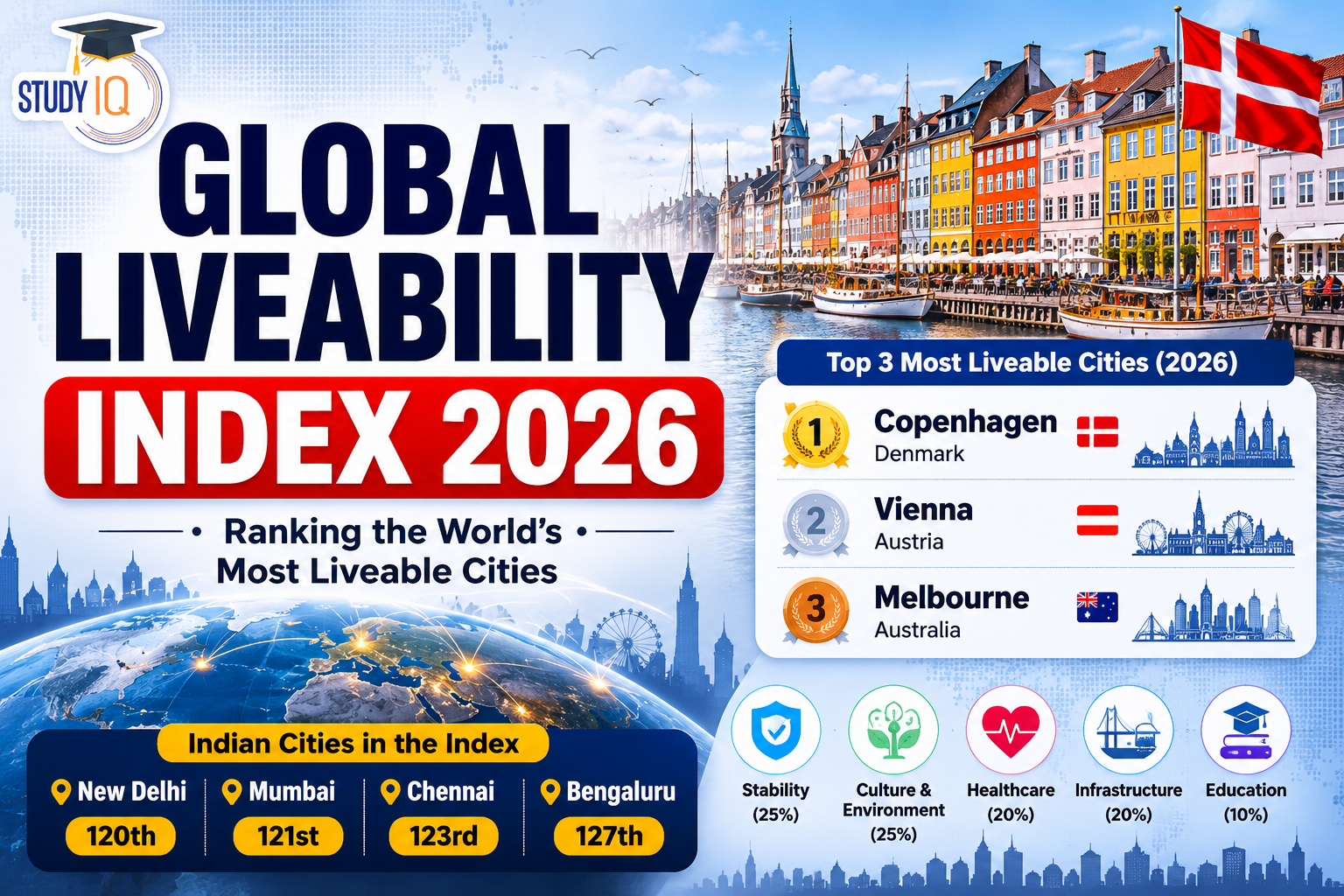
In the 2026 edition, Copenhagen (Denmark) emerged as the world’s most liveable city, followed by Vienna (Austria) and Melbourne (Australia). Among Indian cities, New Delhi ranked 120th, followed by Mumbai (121st), Chennai (123rd), and Bengaluru (127th).
What is the Global Liveability Index?
The Global Liveability Index is an annual report published by the Economist Intelligence Unit (EIU), the research and analysis division of The Economist Group. It measures the quality of urban life by evaluating cities against 30 qualitative and quantitative indicators grouped into five key categories. The index is widely used by multinational companies to determine hardship allowances for expatriates and by policymakers to identify areas requiring urban development.
Global Liveability Index 2026 Evaluation Criteria
Cities are assessed on a 100-point scale based on the following parameters:
| Category | Weightage |
|---|---|
| Stability | 25% |
| Culture & Environment | 25% |
| Healthcare | 20% |
| Infrastructure | 20% |
| Education | 10% |
The assessment considers factors such as crime rates, political stability, healthcare quality, transport networks, educational facilities, housing, climate, and recreational opportunities.
Top 10 Most Liveable Cities in 2026
The world’s highest-ranked cities in the Global Liveability Index 2026 are:
| Rank | City | Country |
|---|---|---|
| 1 | Copenhagen | Denmark |
| 2 | Vienna | Austria |
| 3 | Melbourne | Australia |
| 4 | Sydney | Australia |
| 5 | Zurich | Switzerland |
| 6 | Geneva | Switzerland |
| 7 | Osaka | Japan |
| 8 | Adelaide | Australia |
| 9 | Vancouver | Canada |
| 10 | Tokyo | Japan |
These cities consistently perform well due to their strong public healthcare systems, excellent infrastructure, political stability, high-quality education, and sustainable urban planning.
India’s Performance in Global Liveability Index 2026
India had four cities featured in the rankings:
| Indian City | Global Rank |
|---|---|
| New Delhi | 120 |
| Mumbai | 121 |
| Chennai | 123 |
| Bengaluru | 127 |
Although these cities are among India’s leading economic and technology hubs, they continue to face challenges such as traffic congestion, air pollution, pressure on healthcare services, rapid urbanization, and infrastructure deficits. However, ongoing investments in metro rail networks, digital governance, smart city initiatives, and urban infrastructure have contributed to gradual improvements in living standards.
Key Highlights of the 2026 Report
The 2026 report highlights that Western Europe continues to dominate global liveability rankings due to its stable political environment and high-quality public services. Australian cities also remain among the best performers because of efficient transport systems, environmental sustainability, and robust healthcare infrastructure. The report notes that cities experiencing conflict, political instability, or economic crises continue to rank at the lower end of the index.
Climate resilience, sustainable transport, accessible healthcare, and green urban planning are increasingly influencing city rankings, reflecting the growing importance of sustainability in urban development.
Why the Global Liveability Index Matters
The Global Liveability Index is an important tool for governments and policymakers to evaluate urban performance and identify areas for improvement. It supports evidence-based planning, encourages investment in infrastructure and public services, and helps businesses make informed decisions regarding expansion and employee relocation. For citizens, the index provides valuable insights into the overall quality of life offered by different cities.
UPSC Relevance
The Global Liveability Index 2026 is relevant for UPSC and other competitive examinations.
- Prelims: Economist Intelligence Unit (EIU), Global Liveability Index, ranking methodology, top-ranked cities.
- GS Paper II: Urban governance, Smart Cities Mission, Sustainable Development Goal (SDG) 11.
- GS Paper III: Sustainable urbanization, infrastructure development, environmental sustainability, climate-resilient cities.
Conclusion
The Global Liveability Index 2026 highlights the importance of well-planned urban development in enhancing the quality of life. While cities like Copenhagen, Vienna, and Melbourne continue to set global standards in liveability, Indian cities still face significant challenges related to infrastructure, pollution, and rapid urbanization. Continued investments in sustainable transport, affordable housing, healthcare, and environmental management will be essential for improving India’s position in future global liveability rankings.
Latest UPSC Updates
| Resource | Link |
|---|---|
| UPSC Prelims Result 2026 | Check Here |
| UPSC Exam Calendar 2027 | View Calendar |
| UPSC Question Paper 2026 | Download PDF |
| UPSC Prelims Answer Key 2026 | Check Answer Key |
| UPSC Cut Off 2026 | View Cut Off |
| UPSC Syllabus 2026 | Read Syllabus |
| Daily Current Affairs 2026 | Read Updates |
| StudyIQ UPSC IAS Foundation 2027 (English) | Join Course |
| StudyIQ UPSC IAS Foundation 2027 (Hindi) | Join Course |
| StudyIQ UPSC IAS Foundation 2027 (Bilingual) | Join Course |
 PUFFINS Telescope Mission: NASA’s $20 ...
 World Food Day 2026: Strengthening Nutri...
 International Day for the Eradication of...














 WhatsApp