Table of Contents
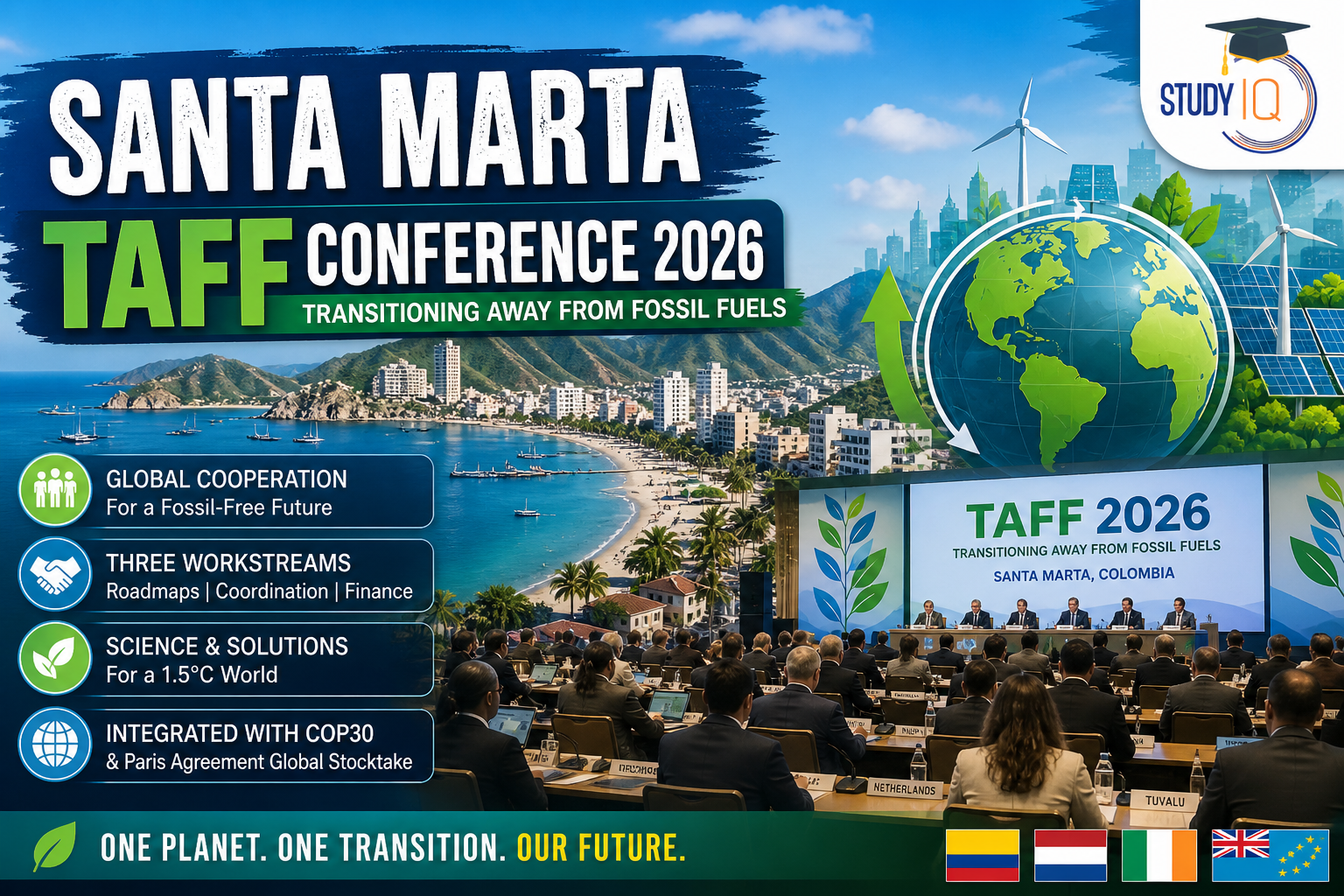
The Santa Marta TAFF Conference 2026 marks a pivotal moment in global climate governance, as nations intensify efforts to shift away from fossil fuels. Co-hosted by Colombia and the Netherlands, the conference took place in Santa Marta, bringing together policymakers, scientists, and financial institutions to operationalize the global commitment to energy transition.
This conference builds directly on the momentum of COP28, where countries formally recognized the need to “transition away from fossil fuels” under the Global Stocktake process.
UPSC Daily Current Affairs 2026
What is TAFF (Transitioning Away from Fossil Fuels)?
TAFF (Transitioning Away from Fossil Fuels) is a global initiative aimed at transforming energy systems by reducing dependence on coal, oil, and gas while accelerating renewable energy adoption.
- It gained international recognition during COP28
- It aligns with the long-term goals of the Paris Agreement
- Focuses on systemic transformation, not just emission reduction
In simple terms: TAFF = Energy Transition Framework for a Net-Zero Future
Key Highlights of Santa Marta TAFF Conference 2026
1. Institutional Continuity: A Long-Term Global Platform
- Countries agreed to hold a second TAFF Conference in 2027
- Next hosts: Ireland and Tuvalu
Significance:
Ensures that TAFF evolves into a permanent global mechanism, rather than a one-time event.
2. New Coordination Architecture
- A new global coordination framework was established
- Integrates efforts of:
- Governments
- Financial institutions
- Energy stakeholders
- Direct linkage with COP30
Why it matters:
Bridges the gap between policy commitments and real-world implementation.
3. Launch of Three Key Workstreams
| Workstream | Objective |
|---|---|
| Transition Roadmaps | Country-specific fossil fuel exit strategies |
| Producer–Consumer Coordination | Align supply (oil/gas) with demand transition |
| Finance Reforms | Mobilize climate finance for clean energy |
Exam Insight:
Important for topics like climate finance, energy security, and sustainable development.
4. Climate Integration with Global Frameworks
- Outcomes to feed into:
- COP30 Presidency Roadmap
- Second Global Stocktake under the Paris Agreement
Significance:
Creates a feedback loop:
Global Targets → National Actions → Review & Accountability
5. Science Panel for Global Energy Transition
- A new Science Panel was launched
- Purpose:
- Provide evidence-based transition pathways
- Support the 1.5°C global warming target
UPSC Angle:
Highlights the science-policy interface in climate governance.
TAFF Activation Group: Role & Functions
- Operates under the COP Action Agenda
- Key responsibilities:
- Facilitate international collaboration
- Assist countries in preparing national transition plans
- Align global efforts with climate goals
Acts as the implementation engine of TAFF.
Global Impact of TAFF Conference 2026
1. Shift from Emission Reduction to System Transformation
TAFF marks a paradigm shift:
- Earlier focus: Reducing emissions
- Now focus: Transforming entire energy systems
2. Strengthening Climate Governance
- Creates structured coordination across stakeholders
- Enhances transparency and accountability
- Integrates climate action with global review mechanisms
3. Climate Finance Reforms
- Push for:
- Increased funding for developing countries
- Just transition mechanisms
- Private sector participation
4. Equity & Just Transition Debate
- Raises critical concerns:
- Impact on fossil fuel-dependent economies
- Job losses in traditional energy sectors
- Need for inclusive and fair transition
5. Acceleration of Renewable Energy Adoption
- Encourages:
- Solar, wind, and green hydrogen expansion
- Technological innovation
- Energy diversification
Conclusion
The Santa Marta TAFF Conference 2026 represents a turning point in global climate action. By moving beyond mere commitments to actionable frameworks, coordinated governance, and science-backed strategies, TAFF is set to play a crucial role in achieving the 1.5°C target.
However, its success will depend on political will, financial commitments, and equitable implementation, especially for developing nations.
 Species in News: Cheetah | Project Cheet...
 Quantum Computing: RRI Scientists Demons...
 Artificial Intelligence in Warfare: How ...











 WhatsApp