

Table of Contents
Context: The recommendations of the 16th Finance Commission, accepted by the Union government, have raised concerns about the direction of fiscal federalism in India. Although the States’ share in central taxes remains at 41%, underlying changes suggest a move towards greater central control and reduced fiscal autonomy for States.
Key Facts about 16th Finance Commission
| Aspect | Details |
|---|---|
| Constitutional Body | Established under Article 280 of the Constitution |
| Commission Name | Sixteenth Finance Commission |
| Constituted By | President of India |
| Year of the Constitution | 2023 |
| Chairman | Arvind Panagariya |
| Tenure | Recommendations for the 2026–2031 period |
| Primary Function | Recommend the distribution of tax revenues between Centre and States |
| Key Role | Strengthen fiscal federalism in India |
| Focus Areas | Tax devolution, grants-in-aid, fiscal consolidation |
| Special Concerns | Regional disparities, population criteria, and state finances |
| Preceded By | 15th Finance Commission |
| Report Submission | Expected by 2025 |
16th Finance Commission and Fiscal Federalism Concerns in India
Key Changes in the Fiscal Framework
- Decline in effective devolution: Even though the official share of States is unchanged, their actual share has reduced due to the growing use of cesses and surcharges, which are not part of the divisible pool. This limits the funds available for distribution among States.
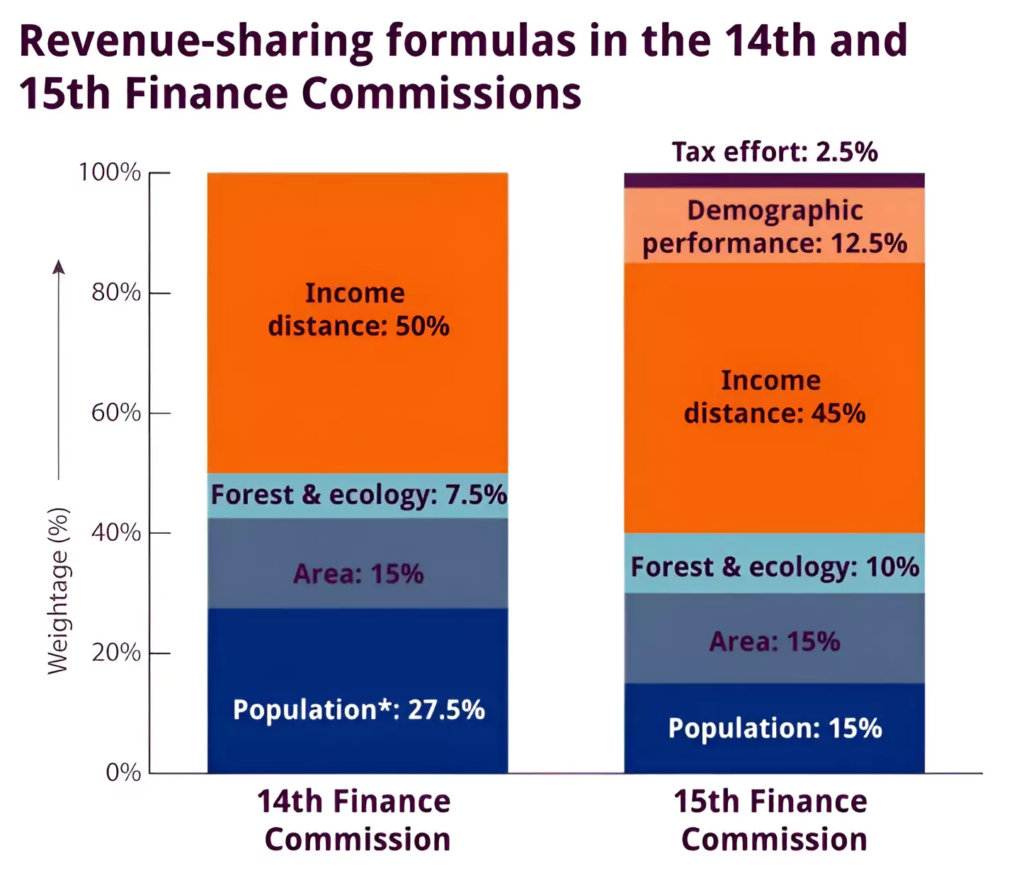
- Changes in inter-state distribution formula: The revised criteria for distributing funds among States have adversely affected several regions, especially economically weaker and northeastern States, as their specific needs are not fully reflected in the formula.
- Discontinuation of statutory grants: Grants earlier provided under Article 275 of the Constitution of India, such as revenue deficit and sector-specific support, have been discontinued, reducing assured financial support for vulnerable regions and tribal areas.
- Rise of discretionary transfers: There is increased reliance on grants under Article 282 of the Constitution of India, which are conditional and less predictable, shifting from a rights-based system to a more controlled and uncertain funding mechanism.
- Greater allocation to local bodies: A significant portion of funds has been earmarked for panchayats and urban local bodies. While this strengthens grassroots governance, it may alter the traditional fiscal balance between the Centre and the States.
Constitutional Concerns
- Blurring of grant mechanisms: Treating statutory grants (Article 275) and discretionary grants (Article 282) as similar weakens the constitutional distinction between mandatory support and optional assistance.
- Impact on federal structure: The shift from equity-based transfers to performance-based allocations may reduce the autonomy of States, which is a key feature of India’s federal system.
- Changing federal balance: Placing local bodies at par with States in fiscal distribution risks disturbing the constitutional hierarchy, where States act as the primary link between the Centre and local governments.
Also Check: 16th Finance Commission on Disaster Funding
Constitution of the Sixteenth Finance Commission
- Under Article 280(1) of the Constitution, the Government of India has instituted the 16th Finance Commission of India, designating Dr. Arvind Panagariya, former Vice-Chairman of NITI Aayog and Professor at Columbia University, as its Chairman.
- The Commission’s specific terms of reference encompass crucial aspects such as the equitable distribution of tax proceeds between the Union and States, guiding principles for grants-in-aid to States, and initiatives to enhance State funds for local bodies, including Panchayats and Municipalities.
- Additionally, the 16th Finance Commission of India has been entrusted with the critical task of reviewing the current arrangements for disaster management financing as outlined in the Disaster Management Act of 2005. The Commission is expected to provide recommendations for improvements in this domain.
- The Government has set a deadline for the 16th Finance Commission to present its comprehensive report by October 31, 2025, reflecting the commitment to timely and informed decision-making in matters of fiscal policy and disaster management financing.
Appointed Members for Sixteenth Finance Commission
| S.No. | Members Name | Term |
| 1. | Shri. Ajay Narayan Jha, former member, 15th Finance Commission and former Secretary, Expenditure | Full-time Member |
| 2. | Smt. Annie George Mathew, former Special Secretary, Expenditure | Full-time Member |
| 3. | Dr. Niranjan Rajadhyaksha, Executive Director, Artha Global | Full-time Member |
| 4. | Dr. Soumya Kanti Ghosh, Group Chief Economic Advisor, State Bank of India | Part-time Member |
15th Finance Commission of India
The 15th Finance Commission of India was established on November 27, 2017. The commission was established by President Ram Nath Kovind. The commission’s purpose is to provide recommendations for fiscal matters and tax devolution for five fiscal years, beginning April 1, 2020.
The 15th Finance Commission, chaired by Mr. N. K. Singh, was tasked with submitting two reports. The initial report, containing recommendations for the financial year 2020-21, was presented to Parliament in February 2020. Subsequently, the final report, encompassing recommendations for the period of 2021-26, was laid before Parliament on February 1, 2021.
The commission’s recommendations include a path for the fiscal deficit that would reduce the centre’s total liabilities from 62.9% of GDP in 2020-21 to 56.6% in 2025-26. The commission also recommends that states’ liabilities be reduced from 33.1% of GDP in 2020-21 to 32.5% by 2025-26.
| Previous Year Question |
Q. With reference to the Finance Commission of India, which of the following statements is correct? (2011)
Answer: (d) |
What is the Finance Commission?
The Finance Commission is a constitutional body in India that recommends how to distribute financial resources between the central and state governments. The President of India establishes the commission every five years under Article 280 of the Constitution.
- Body: It is a statutory, independent, non-political body.
- Composition: It consists of a chairman and four other members.
- First Constituted: The First Finance Commission was constituted on April 6, 1952
- Constitutional Mandate: Article 280(1) of the Constitution mandates the establishment of the Finance Commission every fifth year or sooner.
- Appointed by: The President Of India
- Qualification: As prescribed by the Parliament.
- Chairman: Must have experience in public affairs.
- Other Members (4):
- High Court judge or qualified to become one.
- Specialised knowledge of government finance and accounts.
- Experience in financial matters and administration.
- Special knowledge of economics.
- Purpose: To ensure fair and equitable distribution of tax revenue between the central government (Union) and individual states.
- Functions: Article 280 (3) states that it shall be the duty of the Commission to make recommendations to the President as to:
- Tax Distribution: Recommend a fair division of shared tax revenue between the Union and states, and among states themselves (every 5 years).
- Grants-in-Aid: Establish principles for the Union government to provide financial assistance to states.
- Local Government Support: Advise on strengthening state finances to benefit local bodies like panchayats and municipalities.
- Financial Consultation: Offer expert advice on any financial matters referred by the President, promoting sound fiscal policies.
- Submission: Report -> President -> Parliament
- Quasi-Judicial Powers: Hold powers similar to a civil court(based on the Code of Civil Procedure 1908) for summoning witnesses and accessing documents.
Main Functions of the Finance Commission
- Defining the financial relationship between the central and state governments
- Recommending how to distribute tax revenues between the Union and the states
- Recommending how to distribute tax revenues among the states
- Recommending monitorable performance criteria for important national programs
- Examining the possibility of establishing a permanent funding source for India’s defense needs
Key Challenges for 16th Finance Commission
- Rising regional imbalances: Reduced financial support for weaker States may widen regional disparities, especially in less developed areas.
- Issues linked to the GST regime: The shift to a consumption-based tax system under GST has affected revenue patterns, particularly for manufacturing States, and unresolved issues like IGST settlement continue to create challenges.
- Increasing centralisation: The growing use of cesses and centrally sponsored schemes limits States’ flexibility in spending and increases dependence on the Centre.
- Weakening of equalisation principle: The reduced focus on need-based transfers undermines efforts to ensure balanced development across States, particularly for disadvantaged groups.
Way Forward
- Revive need-based grants: Reintroduce statutory grants to support States based on factors such as poverty levels, population composition, and geographic challenges.
- Expand the divisible pool: Include a portion of cesses and surcharges in the divisible pool to ensure that States receive a fair share of total revenues.
- Address GST-related concerns: Improve coordination with the GST Council and resolve issues related to tax distribution and compensation mechanisms.
- Maintain federal balance: Strengthen local bodies through State governments rather than bypassing them, preserving the constitutional structure.
- Improve transparency: Reduce reliance on discretionary transfers and ensure clear, rule-based allocation of funds to enhance accountability.

 Species in News for UPSC Prelims 2026: C...
 Reassessing Transgender Rights in India:...
 Breaking: US Hits Kharg Island, Will Ira...













 WhatsApp





