
Table of Contents
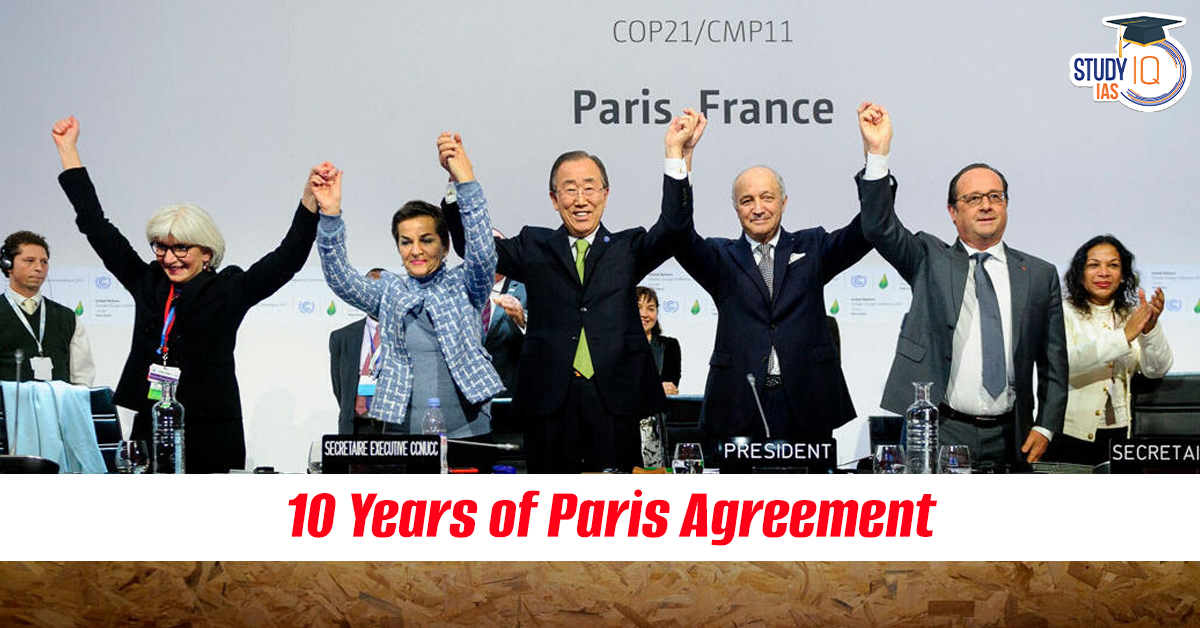
A decade has passed since the adoption of the Paris Agreement in December 2015, a landmark moment in global climate diplomacy. Finalised under the United Nations Framework Convention on Climate Change (UNFCCC) at the Paris Climate Conference, the agreement aimed to unite all countries—developed and developing—under a common framework to combat climate change.
Ten years later, the Paris Agreement stands as both a historic achievement and a sobering reminder of the gap between ambition and action. While it has reshaped global climate governance, the world remains dangerously off-track from its temperature and emission goals.
What Is the Paris Agreement?
The Paris Agreement was adopted at COP21 and entered into force in 2016. It is a legally binding international treaty that seeks to:
-
Limit global temperature rise to well below 2°C, with efforts to restrict it to 1.5°C above pre-industrial levels
-
Enhance climate adaptation and resilience
-
Align global financial flows with low-emission and climate-resilient development
A defining feature of the agreement is its bottom-up approach, where countries submit Nationally Determined Contributions (NDCs) outlining their climate targets and policies, to be reviewed and strengthened every five years.
Key Achievements Over 10 Years
1. Near-Universal Global Participation
The Paris Agreement achieved what earlier treaties could not: almost universal participation. More than 190 countries have ratified it, making climate action a shared global responsibility rather than a divided one.
2. Establishment of the 1.5°C Goal
By formally recognising 1.5°C as a critical threshold, the agreement reshaped climate science, policymaking, and activism. This benchmark now guides IPCC assessments, national climate strategies, and international negotiations.
3. Rise of Net-Zero Commitments
Since 2015, over 140 countries have announced net-zero emission targets. These pledges have accelerated investments in renewable energy, electric mobility, energy efficiency, and green technologies.
4. Climate Finance and Green Investments
The agreement reinforced the commitment of developed nations to mobilise $100 billion annually for climate finance, leading to the growth of green bonds, climate funds, and multilateral financing instruments.
Shortcomings and Persistent Challenges
1. Emissions Continue to Rise
Despite commitments, global greenhouse gas emissions have not declined at the pace required. Current trajectories suggest warming of 2.5–2.8°C by the end of the century—well beyond Paris targets.
2. Weak Compliance Mechanism
The Paris Agreement relies on transparency and peer pressure rather than enforcement. There are no legal penalties for countries that fail to meet their targets, limiting accountability.
3. Climate Finance Deficit
Climate finance remains inadequate and uneven. Many developing countries face high borrowing costs, while grants for adaptation and resilience are insufficient to address escalating climate risks.
4. Lag in Adaptation and Loss & Damage
Mitigation has dominated global efforts, while adaptation and mechanisms for loss and damage—addressing irreversible climate impacts—have progressed slowly despite increasing climate disasters.
Global Stocktake: A Decade-Long Reality Check
The first Global Stocktake (2023–24) under the Paris Agreement concluded that collective action is far from sufficient to achieve the 1.5°C goal. Although renewable energy deployment has expanded rapidly, global dependence on fossil fuels—especially coal, oil, and gas—remains high.
India and the Paris Agreement at 10 Years
India’s engagement with the Paris Agreement has consistently emphasised equity, climate justice, and developmental needs. Key aspects include:
-
Rapid expansion of renewable energy capacity
-
A long-term commitment to net-zero emissions by 2070
-
Leadership in global initiatives such as the International Solar Alliance
-
Promotion of sustainable lifestyles through initiatives like LiFE
At the same time, India continues to stress the responsibility of developed nations to deliver on climate finance, technology transfer, and historical emissions obligations.
The Road Ahead: What the Next Decade Must Deliver
For the Paris Agreement to remain credible and effective, the next ten years must focus on:
-
Stronger and more ambitious NDCs aligned with 1.5°C pathways
-
A clear and just phase-down of fossil fuels, particularly unabated coal
-
Scaled-up adaptation and resilience finance
-
Effective operationalisation of the Loss and Damage Fund
-
Integrating climate action with poverty reduction and sustainable development
Conclusion
Ten years after its adoption, the Paris Agreement remains the cornerstone of global climate governance, but it is not yet a success story. It has transformed global norms and expectations, yet action has lagged behind science and urgency.
The coming decade will determine whether the Paris Agreement becomes a turning point in humanity’s response to climate change—or a missed opportunity in an era of escalating climate risks. Real success will depend on political will, climate finance, and collective action matching the scale of the crisis.
 Illegal Sand Mining in National Chambal ...
 16th Finance Commission: Key Facts, Func...
 Species in News for UPSC Prelims 2026: C...













 WhatsApp





