
Table of Contents
Context
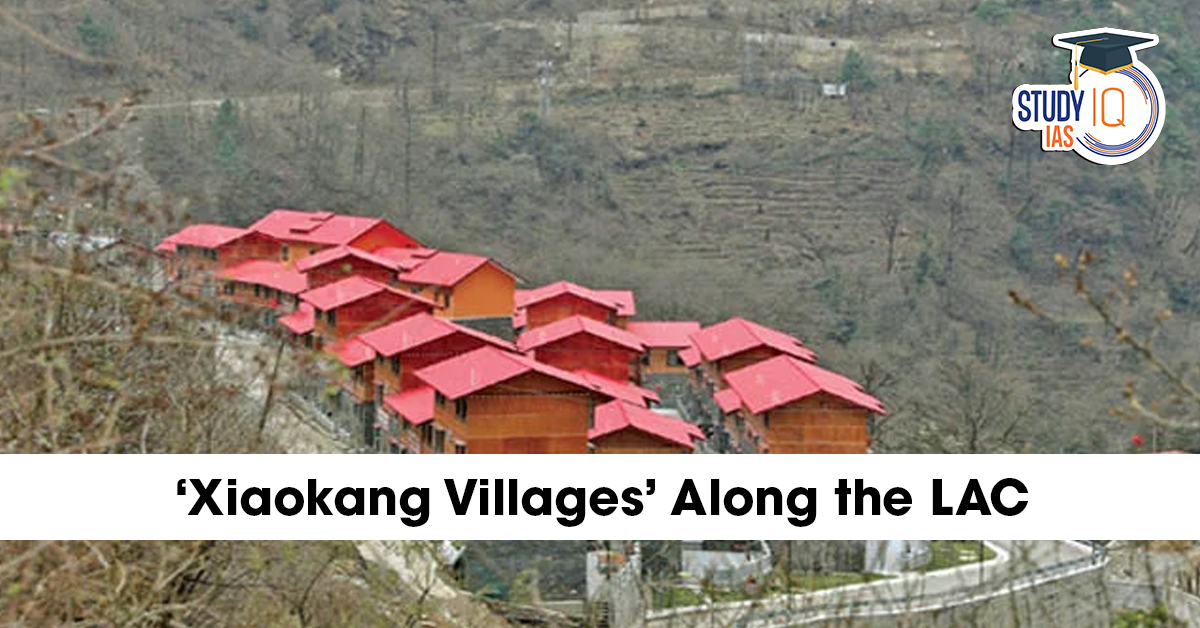
- China has rapidly developed hundreds of “Xiaokang” (well-off) border villages along the Line of Actual Control (LAC), particularly opposite India’s northeastern states.
What Are Xiaokang Border Villages?
- Concept of “Xiaokang”: “Xiaokang” means moderately prosperous or well-off society, a concept promoted by the Xi Jinping government as part of China’s national development strategy.
- Under this programme, China has built modern settlements along its border regions, including:
- housing for civilians
- roads and communication networks
- electricity and internet connectivity
- schools and healthcare facilities
- These villages are meant to promote economic development in remote border regions while strengthening China’s territorial control.
Scale of Construction Along the India Border
Extensive Infrastructure Development: China has reportedly built more than 600 Xiaokang villages along its borders, many in Tibet near India. Key statistics highlighted by Lt Gen Ghai include:
- 628 villages constructed across northern borders
- Around 450 villages (72%) located opposite India’s Northeast
- Nearly 90% of those across Arunachal Pradesh
- Several of these villages are believed to be located in disputed or contested areas along the LAC.
Strategic Purpose of the Villages
- Strengthening Territorial Claims: Civilian settlements can strengthen China’s claims in disputed regions by demonstrating permanent habitation and administrative presence.
- Dual-Use Military Infrastructure: Although officially civilian, many of these villages reportedly have dual-use infrastructure, including:
- all-weather roads
- airstrips or helipads
- communications facilities
- Such infrastructure allows rapid deployment of troops and supplies.
- Border Population Strategy: China aims to increase population density in remote border areas to ensure a permanent human presence along sensitive frontiers.
Key Strategic Areas of Concern for India
- Arunachal Pradesh: China claims Arunachal Pradesh as “South Tibet”, making the region particularly sensitive.
- The concentration of Xiaokang villages opposite Arunachal suggests a deliberate effort to strengthen China’s territorial narrative in this sector.
- Chumbi Valley:Another critical region is the Chumbi Valley, a narrow Tibetan valley located between Sikkim, Bhutan, and Tibet.
- The valley lies close to Doklam, the site of the 2017 India–China military standoff.
- Vulnerability of the Siliguri Corridor: The Siliguri Corridor, often called the “Chicken’s Neck”, is a narrow strip of land about 22 km wide connecting India’s Northeast to the rest of the country.
- Its proximity to the Chumbi Valley makes the corridor vulnerable in the event of military conflict.The situation is further complicated by the uncertain trajectory of India’s relations with Bangladesh, which lies south of the corridor.
- Broader Strategic Context: China’s border village programme reflects a broader strategy of integrating infrastructure development with geopolitical objectives. Similar patterns have been observed along China’s borders with Bhutan, Nepal, Vietnam and Central Asian countries
India’s Response and Infrastructure Development
- Strengthening Military Deployment: India has increased troop deployment and logistics infrastructure near the Siliguri Corridor and the northeastern border.
- Strategic Infrastructure Projects: Several key infrastructure projects have been completed or are under development in the Northeast, including:
- Sela Tunnel in Arunachal Pradesh
- Bogibeel Bridge in Assam
- ]Bridges across the Brahmaputra and Lohit River
- Emergency landing facilities on strategic highways
These projects serve both developmental and military logistics purposes.
- Underground Rail Connectivity: India is also planning a rail tunnel beneath the Siliguri Corridor, with:
- 24 km tunnel in Phase 1
- Possible expansion to 62 km
This would allow secure military and civilian transportation in case of disruptions.
|
Read More Notes |
|
| Environment Notes | Art and Culture Notes |
| Science and Tech | History Notes |
| Geography Notes | Indian Polity Notes |
| General Knowledge | International Relation |
|
Explore StudyIQ Courses |
|
 Removal of the Chief Election Commission...
 Amrit Bharat Station Scheme: Modernising...
 Prioritising Natural Gas Supplies Amid W...











 WhatsApp





