
Table of Contents
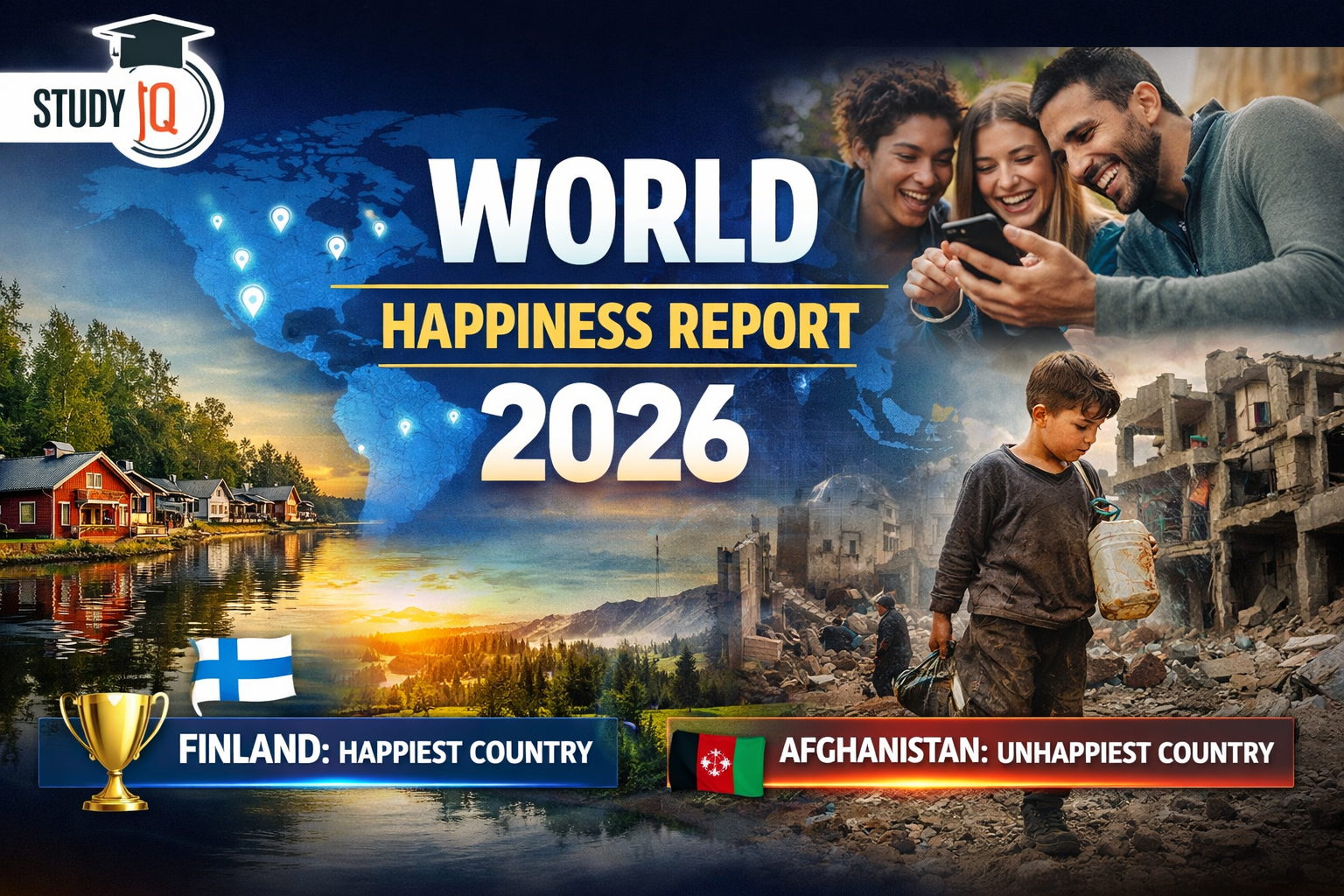
The World Happiness Report 2026 highlights global well-being trends, ranking countries based on life satisfaction. Released by the United Nations, it reveals Finland as the happiest country for the ninth consecutive year, while India ranks 116th.
This year’s report emphasizes a major concern: the impact of social media on youth happiness and declining well-being in developed nations.
Read: United Nations
World Happiness Report 2026 Overview
The World Happiness Report 2026 is a globally recognized annual publication that measures and ranks countries based on people’s self-reported well-being and life satisfaction. It is released around the International Day of Happiness (March 20) and is supported by the United Nations, with data primarily sourced from the Gallup World Poll.
| Aspect | Details |
|---|---|
| Report Name | World Happiness Report 2026 |
| Released By | United Nations (UN) |
| Data Source | Gallup World Poll |
| Total Countries Ranked | 147 |
| Basis of Ranking | Self-reported life evaluation (subjective well-being) |
| Top Country | Finland (9th consecutive year) |
| Lowest Ranked Country | Afghanistan |
| India’s Rank | 116 (Improved from 118 in 2025) |
| Top Region | Nordic Countries (Europe) |
| Major Theme 2026 | Social Media Impact on Youth Happiness |
| Key Concern | Declining well-being among youth in developed countries |
| Notable Trend | No English-speaking country in Top 10 (2nd year) |
Top 10 Happiest Countries in 2026
According to the Happiness Index 2026, the top 10 happiest countries are:
| Rank | Country | Region | Key Strengths | Happiness Drivers (Core Factors) | Special Highlights 2026 |
|---|---|---|---|---|---|
| 1 | Finland 🇫🇮 | Northern Europe | Strong welfare state, high trust, low corruption | Social support, freedom, life satisfaction | 9th consecutive year at No.1 |
| 2 | Iceland 🇮🇸 | Northern Europe | Small population, strong community bonds, gender equality | Social trust, safety, equality | Consistent top performer |
| 3 | Denmark 🇩🇰 | Northern Europe | Work-life balance, universal healthcare, education | Freedom of choice, social support | “Hygge” lifestyle model |
| 4 | Costa Rica 🇨🇷 | Latin America | No army, environmental focus, strong community life | Generosity, social connection | Highest-ever rank (Top Latin country) |
| 5 | Sweden 🇸🇪 | Northern Europe | Social security, innovation, equality | Life expectancy, institutional trust | Stable top 5 presence |
| 6 | Norway 🇳🇴 | Northern Europe | Wealth from natural resources, strong governance | GDP per capita, welfare benefits | High standard of living |
| 7 | Netherlands 🇳🇱 | Western Europe | Inclusive society, strong economy, urban planning | Freedom, social trust | High urban happiness index |
| 8 | Israel 🇮🇱 | Middle East | Strong community bonds, resilience | Social support, life satisfaction | Consistent high ranking despite conflicts |
| 9 | Luxembourg 🇱🇺 | Western Europe | High income levels, financial hub | GDP per capita, quality of life | Small but very wealthy nation |
| 10 | Switzerland 🇨🇭 | Western Europe | Political stability, high-quality healthcare, natural environment | Life expectancy, income, governance | Re-entered Top 10 in 2026 |
India’s Rank in World Happiness Report 2026
India ranks 116th out of 147 countries, showing a slight improvement from its 118th rank in 2025.
Key Takeaways for India:
-
Improvement is marginal but positive
-
Challenges remain in:
-
Social support
-
Income inequality
-
Perception of corruption
-
-
Strength lies in:
-
Family structures
-
Cultural resilience
-
Unhappiest Countries in the World
The World Happiness Report 2026 shows that the lowest-ranked countries are largely affected by conflict, poverty, weak institutions, and humanitarian crises. Afghanistan continues to rank as the least happy country globally, followed by several African and conflict-affected nations.
| Rank (Approx.) | Country | Region | Key Challenges | Impact on Happiness (Core Factors) | Special Notes |
|---|---|---|---|---|---|
| 147 | Afghanistan 🇦🇫 | South Asia | Conflict, political instability, restrictions on women, poverty | Low GDP, weak social support, low freedom | Unhappiest country (repeatedly) |
| 146 | Sierra Leone 🇸🇱 | West Africa | Poverty, poor healthcare, low education access | Low life expectancy, weak institutions | Chronic underdevelopment |
| 145 | Malawi 🇲🇼 | East Africa | Extreme poverty, food insecurity, weak infrastructure | Low income, poor health outcomes | Agriculture-dependent economy |
| 144 | Zimbabwe 🇿🇼 | Southern Africa | Inflation, unemployment, governance issues | Economic instability, corruption perception | Long-term economic crisis |
| 143 | Botswana 🇧🇼 | Southern Africa | Inequality, unemployment, health issues (HIV burden) | Uneven growth, health challenges | Resource-rich but unequal |
| 142 | Yemen 🇾🇪 | Middle East | Civil war, famine, humanitarian crisis | Low life expectancy, no stability | One of worst humanitarian crises |
| 141 | Lebanon 🇱🇧 | Middle East | Economic collapse, political instability | High corruption perception, low income | Severe financial crisis |
| 140 | DR Congo 🇨🇩 | Central Africa | Armed conflict, poverty, displacement | Weak social support, insecurity | Resource curse example |
| 139 | Egypt 🇪🇬 | North Africa | Economic pressure, unemployment, inflation | Limited freedom, economic stress | Transitional economy |
| 138 | Tanzania 🇹🇿 | East Africa | Poverty, low industrialization | Low GDP per capita, limited services | Developing economy |
Social Media and Youth Happiness Crisis (Biggest Theme 2026)
One of the most important findings of the World Happiness Report 2026 is the impact of social media on mental health, especially among young people.
Key Findings:
-
Heavy social media use (5+ hours/day) → lower life satisfaction
-
Moderate use (<1 hour/day) → highest well-being
-
No usage → also misses social benefits
The report calls this a “Global Youth Happiness Divide”
Affected Countries:
-
United States
-
Canada
-
Australia
-
New Zealand
In contrast, youth in many developing regions report increasing happiness levels.
Why Finland is the Happiest Country in the World
Finland’s consistent top ranking is not accidental. It reflects a combination of structural and social factors:
Key Reasons:
-
High GDP per capita
-
Strong welfare state
-
Low corruption levels
-
High social trust
-
Excellent education and healthcare systems
-
Strong work-life balance
Finnish citizens reported an average life evaluation score of 7.764/10, significantly higher than most countries.
Six Key Factors of Happiness Ranking
The Happiness Index 2026 is based on six core indicators:
-
GDP per capita
-
Healthy life expectancy
-
Social support
-
Freedom to make life choices
-
Generosity
-
Perception of corruption
These indicators reflect a holistic view of development, beyond traditional economic metrics.
Decline of Developed Nations in Happiness Rankings
A surprising trend in recent years is the decline of English-speaking developed countries:
-
USA – Rank 23
-
Canada – Rank 25
-
UK – Rank 29
For the second consecutive year, no English-speaking country appears in the top 10.
Reasons:
-
Rising mental health issues
-
Increasing social isolation
-
Impact of digital lifestyles
Emerging Trends in Global Happiness
Rise of Alternative Models
Countries like Costa Rica prove that high GDP is not mandatory for happiness.
European Convergence
Eastern European countries like:
-
Kosovo
-
Slovenia
-
Czechia
are catching up with Western Europe.
Social Connection Matters More Than Technology
The report emphasizes that:
Strong relationships and community bonds are more important than reducing screen time alone
What This Means for the World
The World Happiness Report 2026 shifts the global conversation:
-
From economic growth → human well-being
-
From digital connection → real social connection
-
From wealth → trust and equality
Governments are increasingly recognizing that policy-making must include mental health, social cohesion, and digital regulation.
Conclusion
The World Happiness Report 2026 offers a deep insight into what truly makes societies thrive. While Finland continues to lead as the happiest country, the report highlights deeper structural issues, including the youth mental health crisis, the role of social media, and the limitations of GDP as a measure of progress.
Read: Daily Current Affairs
 Electric Cooking Solutions in India: Fut...
 AI-Based Speech Restoration App: How It ...
 24 Speed Post: Delivery Time, Charges an...











 WhatsApp





