
Table of Contents
Context
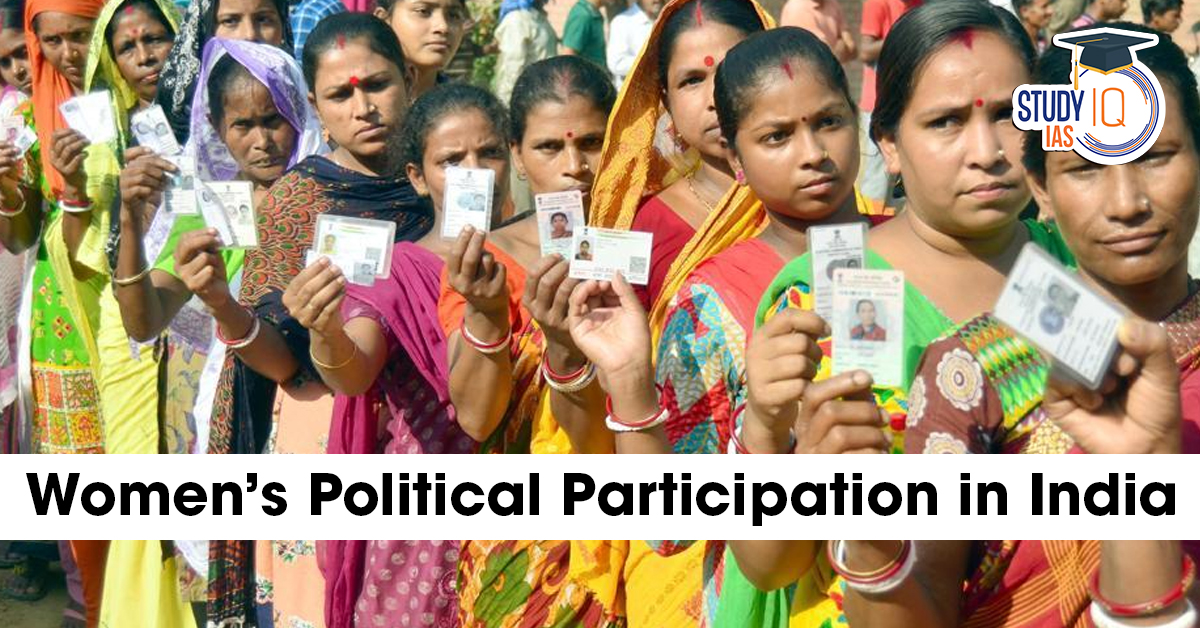
- Women’s participation in India’s electoral process has increased substantially, with female voter turnout almost equal to that of men in the 2019 Indian General Election and the 2024 Indian General Election. However, a clear gap remains between participation at the ballot box and representation in political offices, highlighting structural barriers in Indian politics.
Key Data and Trends
| Key Data and Trends |
| ● Near parity in voter turnout:The gender gap in voter turnout has declined sharply—from about 11.2% in 1967 to almost zero in 2019 and 2024, reflecting rising political engagement among women.
● Representation in Parliament: Despite improved participation, women remain underrepresented. In the 2024 Lok Sabha, women hold 74 seats (around 13.6%), slightly lower than the record 78 seats in 2019. ● Limited candidature: Although nearly 800 women contested the 2024 elections, they still constitute a small share compared with the much larger number of male candidates. ● Higher electoral success rate: Available data suggests women candidates often perform better electorally. In 2024, about 9% of women candidates won, compared to roughly 6% of men. ● State election trends: Since around 2011, several state elections have recorded higher female turnout than male turnout, with women voters exceeding men by an average of nearly 2%. |
Key Dimensions of Women’s Political Participation
- Silent revolution: Women have moved from limited engagement to active electoral participation.
- Eg: In the 2024 general elections, female voter turnout nearly matched that of men, indicating greater political awareness across both rural and urban areas.
- Campaign participation: Women are increasingly visible in campaign activities such as rallies and door-to-door outreach, though their presence remains lower than that of men
- Eg: Participation in election meetings has grown to about 16%, reflecting gradual movement of women into public political spaces.
- Grassroots leadership: Reservations in local governance have enabled large-scale female participation in grassroots politics
- Eg: Due to provisions under the 73rd Constitutional Amendment Act and the 74th Constitutional Amendment Act, more than 1.4 million women serve as elected representatives in local bodies, creating a pipeline for future leaders.
- Independent voting behaviour: Women are increasingly exercising autonomous political choices rather than following family voting patterns
- Eg: Surveys during the 2024 elections showed that about half of female voters made their voting decisions independently.
- Issue-based voting: Women voters are increasingly influenced by policy measures that directly affect their welfare rather than solely by caste or party loyalties.
- Eg: Welfare initiatives like the Mukhyamantri Ladli Behna Yojana in Madhya Pradesh played a major role in mobilising women voters.
Major Initiatives to Promote Women’s Political Participation
- Women’s Reservation in Legislatures: The Nari Shakti Vandan Adhiniyam provides for one-third reservation for women in the Lok Sabha and State Assemblies.
- Reservation in Local Governance: The 73rd and 74th Constitutional Amendments mandated 33% reservation for women in Panchayats and Urban Local Bodies, with some states increasing it to 50%.
- SVEEP Programme: The Systematic Voters’ Education and Electoral Participation (SVEEP) initiative of the Election Commission of India works to reduce gender disparities in voter registration and turnout through awareness campaigns.
- Political Literacy Initiatives: Political education programmes in schools and colleges aim to encourage young women to engage with the democratic process at an early stage.
Challenges Limiting Women’s Representation
- Perception of Lower Electability: Political parties often hesitate to field women candidates, assuming they are less likely to win. As a result, women accounted for only around 10% of total candidates in the 2024 elections.
- Patriarchal Social Norms: Traditional gender roles and societal expectations often discourage women from active political involvement or require family approval for participation.
- Domestic Responsibilities: The disproportionate burden of household work and caregiving reduces the time women can dedicate to campaigning and political engagement.
- Money and Muscle Power in Politics: High campaign costs and the presence of criminal elements in politics discourage many qualified women from entering electoral contests.
- Information and Digital Divide: In some regions, lower literacy levels and limited access to digital information restrict women’s ability to engage with political discourse.
Way Forward
- Early Implementation of Legislative Reservation: The provisions of the Nari Shakti Vandan Adhiniyam should be implemented swiftly after the delimitation process to increase women’s presence in legislatures.
- Internal Party Reforms: Political parties should voluntarily introduce quotas for women candidates and leadership positions within party structures.
- Capacity Building at the Grassroots Level: Training and mentorship programmes should help women leaders in Panchayats transition to state and national politics.
- Ensuring a Safer Political Environment: Stronger measures are required to address online harassment, defamation, and gender-based intimidation faced by women politicians.
- Strengthening Economic Independence: Greater economic empowerment will enable women to mobilise resources necessary to contest elections and sustain political careers.
Conclusion
India has made remarkable progress in closing the gender gap in voter turnout, demonstrating the growing political agency of women. However, meaningful gender equality in politics will be achieved only when women are equally represented in decision-making institutions. Legislative reforms such as the Nari Shakti Vandan Adhiniyam provide a structural foundation, but sustained changes in political party practices and societal attitudes remain crucial for true democratic inclusion.
|
Read More Notes |
|
| Environment Notes | Art and Culture Notes |
| Science and Tech | History Notes |
| Geography Notes | Indian Polity Notes |
| General Knowledge | International Relation |
|
Explore StudyIQ Courses |
|
 The Transgender Persons (Protection of R...
 WASH (Water, Sanitation, and Hygiene) Se...
 Vairamuthu Wins Jnanpith Award 2026: Tam...







 WhatsApp





