
Table of Contents
The concept of streedhan has long occupied a significant place in Indian personal law, symbolising a woman’s exclusive proprietary rights over property received during various stages of her life. In a progressive and reaffirmative ruling, the Allahabad High Court in Anamika Tiwari and Others v. State of U.P. (2026) has once again emphasised that a married woman is the absolute owner of her streedhan. The Court categorically held that she cannot be prosecuted for criminal breach of trust for taking her own property.
Background of the Anamika Tiwari v. State of U.P Case
The case arose out of matrimonial discord between the wife, Anamika Tiwari, and her husband. Following allegations of dowry harassment, the wife had earlier initiated criminal proceedings under Section 498-A of the Indian Penal Code (IPC) and the Dowry Prohibition Act. Subsequently, the husband filed a counter-complaint alleging that the wife and her relatives unlawfully took cash, jewellery, and household articles from his residence.
Based on this complaint, a Magistrate issued a summoning order under Sections 323, 504, and 406 IPC. Aggrieved, the wife approached the High Court seeking the quashing of the proceedings.
Legal Issues Involved in Wife’s Streedhan
The central legal issue before the Court was whether a wife could be held liable for criminal breach of trust under Sections 405 and 406 IPC for taking away property claimed by the husband, particularly when such property constituted her streedhan.
Additionally, the Court examined whether the Magistrate had properly applied legal principles before issuing the summoning order.
Court’s Observations and Ruling
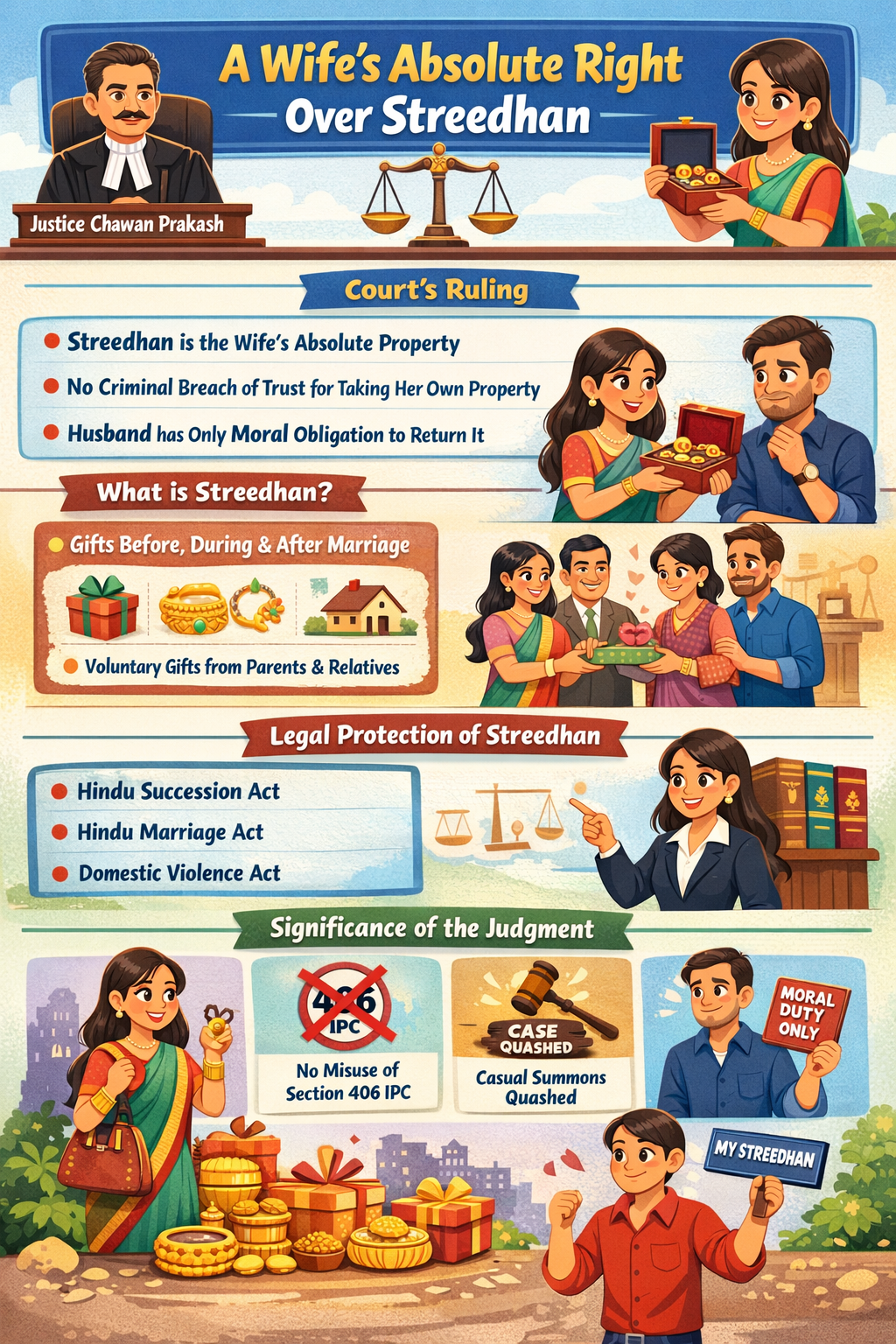
Justice Chawan Prakash undertook a detailed examination of the law relating to criminal breach of trust. The Court observed that an essential ingredient of Section 405 IPC is entrustment of property. Without such entrustment, the offence under Section 406 IPC cannot be established.
The Court held that:
- Streedhan is the absolute property of the wife, and no entrustment from the husband or his family arises in such cases.
- Consequently, a wife cannot be accused of misappropriating her own property.
- Marriage does not convert streedhan into joint property of the spouses.
- Even if the husband uses streedhan in times of necessity, he is merely under a moral obligation to restore it, not vested with any legal ownership rights.
The Court further criticised the Magistrate for casually passing the summoning order without properly analysing the legal requirements of Section 405 IPC.
With respect to allegations under Sections 323 and 504 IPC, the Court found them vague and lacking specific evidence. Accordingly, the High Court quashed the entire criminal proceedings against the wife and her relatives.
Understanding the Concept of Streedhan
The term streedhan is derived from the Sanskrit words “stri” (woman) and “dhana” (property). It refers to all property that a woman acquires during her lifetime, including:
- Gifts received before, at, or after marriage
- Property received during childbirth or widowhood
- Voluntary presents from family members and relatives
Importantly, streedhan is distinct from dowry. While dowry often involves coercion or demand, streedhan consists of voluntary gifts made out of love and affection.
A woman enjoys absolute ownership rights over her streedhan and is free to use, dispose of, or alienate it at her discretion.
Statutory Protection of Streedhan
Indian law robustly safeguards a woman’s rights over her streedhan:
- Under the Hindu Succession Act, 1956 (Section 14), a woman has full ownership over her property.
- Hindu Marriage Act, 1955 (Section 27) recognises her entitlement to property presented at or about the time of marriage.
- The Protection of Women from Domestic Violence Act, 2005, empowers courts to order the return of streedhan to the aggrieved woman.
Courts have consistently held that if streedhan is placed in the custody of the husband or in-laws, they act merely as trustees, obligated to return it upon demand.
Significance of the Judgment
This ruling is significant for several reasons:
- Reaffirmation of Women’s Property Rights
It strengthens the legal recognition of women’s independent ownership rights within marriage. - Clarification of Criminal Liability
It prevents the misuse of criminal provisions like Section 406 IPC in matrimonial disputes. - Judicial Accountability
The Court’s criticism of the Magistrate underscores the importance of careful judicial application of law before issuing a process. - Distinction Between Moral and Legal Rights
The judgment clearly distinguishes between a husband’s moral duty and the absence of legal entitlement over streedhan.
Conclusion
The decision in Anamika Tiwari v. State of U.P. is a progressive reaffirmation of a woman’s autonomy over her property. By holding that a wife cannot be prosecuted for reclaiming her own streedhan, the Allahabad High Court has reinforced the foundational principle that marriage does not extinguish a woman’s legal identity or proprietary rights.
In an era where matrimonial disputes often give rise to retaliatory litigation, this judgment serves as an important safeguard against the misuse of criminal law, while simultaneously advancing gender justice and legal clarity.










 WhatsApp





