
Table of Contents
Context
- Rising Iran-US conflict matters more for the world economy and geopolitics than similar tensions elsewhere, such as in Venezuela, and energy security lies at the heart of these concerns
|
Iran’s Strategic Importance in Global Energy |
Major Oil & Gas Reserves
Export Significance
|
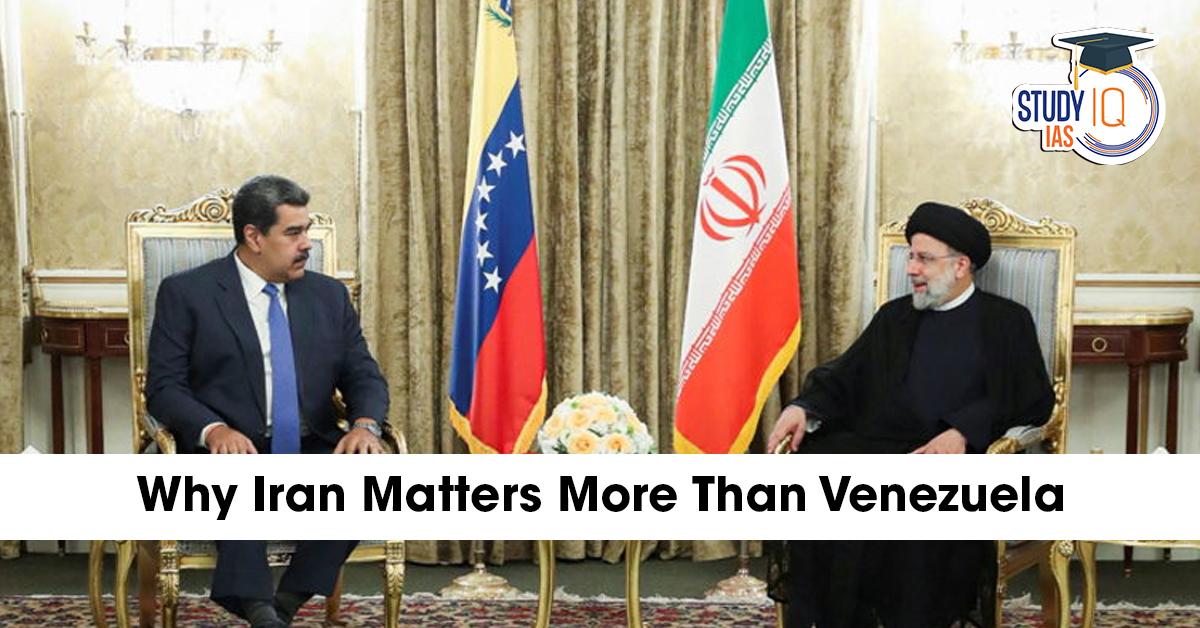
Geopolitics: Why Iran Matters More Than Venezuela
A conflict involving Iran has far greater potential global impact than one in Venezuela due to Iran’s share of energy exports and control of a key shipping chokepoint.
Oil Quality and Location
- Iranian oil is high-quality crude that is cheaper to produce than Venezuela’s heavier, harder-to-refine oil.
- Its geographic position near Asia and Europe enhances its strategic export value.
- Venezuela’s oil sector is less integrated into global supply networks, so disruption there causes comparatively smaller global price effects.
Regional Power Projection
- Iran’s military reach spans the Persian Gulf, and it can threaten key maritime routes, including the Strait of Hormuz.
- Venezuelan interventions primarily affect Western Hemisphere dynamics; Iran’s conflict could destabilise Middle East security and involve multiple regional actors.
The Strait of Hormuz
- Energy Trade Lifeline: About 18–20 million barrels per day of oil and petroleum products — roughly 20–27% of global maritime oil trade — passes through the Strait. Nearly 20% of global LNG trade also transits this narrow channel.
- Risk of Disruption: If Iran or conflict parties interfere with shipping in the Strait, oil and gas supply to global markets could be severely disrupted.
- Analysts warn that even threats to close the Strait push energy prices sharply higher due to fear premiums.
US Objectives in the Region
- Preventing Nuclear Proliferation: A key US goal is to stop Iran from developing nuclear weapons capability and to secure a deal that limits Iran’s nuclear program through negotiations or pressure.
- Containment Strategy: The US aims to restrain Iran’s ballistic missile program and its support for proxy groups in the region.
- Energy Market Stability: Despite security goals, the US is also highly sensitive to energy price spikes that could harm its own economy, influencing its reluctance to pursue full-scale military action.
- Diplomacy and Pressure: Recent diplomatic engagement (e.g., talks in Oman) reflects an attempt to balance pressure with dialogue to manage tensions without large-scale conflict.
|
Reasons for Iran’s pursuance of nuclear weapons |
|
Global Implication of US-Iran conflict
- Regional Destabilization: Intensified conflict risks dragging other Gulf states into war, undermining regional security architecture.
- Threat to Multilateralism: Unilateral action of US against Iran sidelining the UN, UNSC weakens multilateralism.
- It gives authoritarian states justification to do the same—bypassing international law (e.g., Russia in Ukraine, China in Taiwan Strait).
- Push back diplomatic efforts: Nuclear talk will take back stage between Iran and USA as Iran refused to talk on table due to its disrespect to sovereignty.
- Nuclear Proliferation Threat: Incomplete destruction of Iran’s nuclear sites may push Tehran to accelerate weaponization clandestinely.
- E.g. Intelligence suggest that despite the directly intervention of US in the conflict (“Operation Midnight Hammer”) with bunker-buster bombs, the bomb making capability is not diminished
- Global Polarisation: The conflict may widen rifts between Western powers and nations backing diplomatic restraint like China and Russia.
|
Impact on India |
|
 India-China Trade Relations, Border Disp...
 Digital Arrest Scams, Key Measures and I...
 World Meteorological Day 2026: Theme, Hi...











 WhatsApp





