
Table of Contents
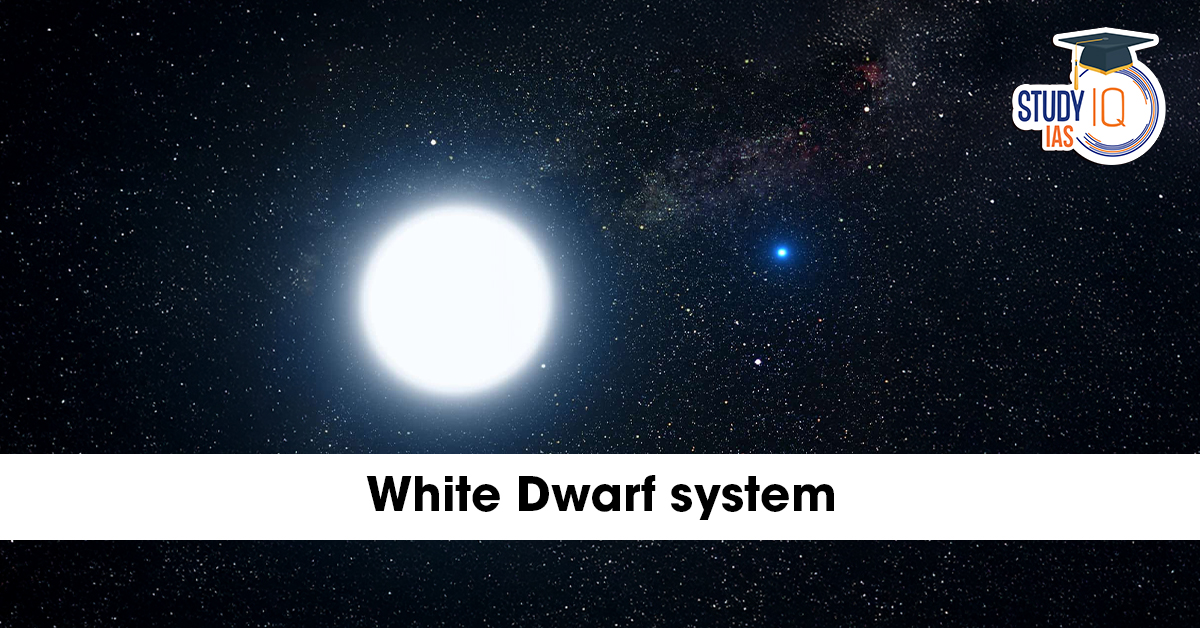
White dwarf systems represent one of the final evolutionary stages of stars like our Sun. Though small in size, they play a massive role in astrophysics by helping scientists understand stellar evolution, binary interactions, and extreme states of matter. Recent discoveries, including NASA’s observation of the white dwarf system EX Hydrae using X-ray polarisation, have opened a new chapter in exploring these compact cosmic objects.
What is a White Dwarf?
A white dwarf is the dense core left behind after a medium-sized star (like the Sun) has exhausted its nuclear fuel.
Key characteristics:
-
Size: Comparable to Earth
-
Mass: Similar to the Sun
-
Density: Extremely high (1 teaspoon weighs several tons)
-
Energy source: No fusion, only residual heat
After shedding its outer layers as a planetary nebula, the remaining core collapses into a white dwarf and cools slowly over billions of years.
What is a White Dwarf System?
A white dwarf system usually refers to a binary star system where a white dwarf is paired with a companion star. The intense gravity of the white dwarf can pull matter from its partner, leading to energetic emissions and dramatic astrophysical phenomena.
Such systems are among the brightest X-ray sources in the sky.
Types of White Dwarf Systems
1. Cataclysmic Variables (CVs)
-
Companion star transfers mass to white dwarf.
-
Produces outbursts and X-ray emissions.
Subtypes:
-
Intermediate Polars: Moderate magnetic field (e.g., EX Hydrae)
-
Polars: Strong magnetic field, no accretion disk
2. Type Ia Supernova Progenitors
-
When white dwarf mass exceeds 1.4 solar masses (Chandrasekhar limit), it explodes.
-
Used as “standard candles” in cosmology.
3. Detached White Dwarf Binaries
-
No mass transfer.
-
Used to study gravitational waves.
Role of Magnetism in White Dwarf Systems
Magnetic fields control how matter falls:
| Magnetic Field Strength | Matter Behavior |
|---|---|
| Weak | Accretion disk forms |
| Strong | Matter flows directly to poles |
| Moderate | Disc + magnetic funnel (Intermediate Polars) |
These processes heat gas to millions of degrees, producing X-rays.
Why Are White Dwarf Systems Important?
-
Reveal physics of extreme gravity and magnetism
-
Help in understanding stellar death
-
Act as laboratories for accretion processes
-
Explain cosmic distance measurements (Type Ia Supernovae)
-
Help test Einstein’s theories of gravity
NASA and White Dwarf Exploration
Recent missions:
-
IXPE (Imaging X-ray Polarisation Explorer)
-
Measures how X-rays are polarised.
-
Revealed the internal structure of EX Hydrae.
-
Estimated gas columns rising nearly 2,000 miles above surface.
-
This was the first time scientists studied a white dwarf system in 3D structure rather than as a point source.
Formation Process of a White Dwarf
-
Star burns hydrogen → helium.
-
Core collapses → red giant phase.
-
Outer layers expelled → planetary nebula.
-
Core becomes a white dwarf.
White Dwarf vs Neutron Star vs Black Hole
| Feature | White Dwarf | Neutron Star | Black Hole |
|---|---|---|---|
| Size | Earth-sized | City-sized | Point-like |
| Density | High | Extreme | Infinite |
| Gravity | Strong | Stronger | Strongest |
| Formation | Sun-like stars | Massive stars | Very massive stars |
Future Research on White Dwarf Systems
-
X-ray polarimetry missions
-
Gravitational wave observatories
-
AI-driven modeling
-
Study of accretion geometry
-
Deeper understanding of cosmic explosions
Conclusion
White dwarf systems are among the most fascinating structures in the universe. They represent the final fate of most stars and serve as cosmic laboratories for extreme physics. With advanced missions like NASA’s IXPE, astronomers are now able to study not just how bright these systems are, but how their light behaves—allowing them to map their hidden structures.
As technology evolves, white dwarf systems will continue to illuminate our understanding of the universe’s life cycle.
 Species in News for UPSC Prelims 2026: C...
 Central India’s Jumbo Crisis: Human-El...
 UN Road Safety Project: Objectives, Impl...











 WhatsApp





