
Table of Contents
A recent scientific study has highlighted an important fact about Earth’s climate system: water vapour contributes more to atmospheric heating than aerosols. This finding is crucial for understanding global warming, climate feedback mechanisms, and the role of different atmospheric components in regulating Earth’s temperature. For students preparing for UPSC and other competitive exams, this topic holds strong relevance in Geography, Environment, and Climate Change sections.
Understanding Water Vapour and Aerosols
-
Water vapour is the gaseous form of water and the most abundant natural greenhouse gas in the atmosphere.
-
Aerosols are tiny solid or liquid particles suspended in the air, such as dust, sulphates, sea salt, smoke, and black carbon.
Both influence Earth’s energy balance, but their mechanisms and impact on atmospheric heating differ significantly.
How Water Vapour Heats the Land More Than Aerosols
1. Strong Greenhouse Behaviour
Water vapour is a highly efficient greenhouse gas. It absorbs the longwave (infrared) radiation emitted by the Earth’s surface and re-emits part of it back toward the ground. This process traps heat in the lower atmosphere, leading to:
-
Higher surface temperatures
-
Enhanced warming of the troposphere
-
Intensification of the greenhouse effect
Aerosols, on the other hand, are not primarily greenhouse agents and do not trap infrared radiation in the same systematic way.
2. Continuous Radiative Absorption
Water vapour absorbs radiation across a broad spectrum of infrared wavelengths. This makes its heating effect:
-
Consistent
-
Uniform
-
Persistent throughout the atmosphere
Aerosols show highly variable behaviour:
-
Some scatter sunlight (cooling effect)
-
Some absorb sunlight (warming effect)
-
Their overall impact depends on type, size, and composition
Thus, water vapour has a more reliable warming influence than aerosols.
3. Vertical Distribution Advantage
Water vapour is concentrated mainly in the lower troposphere, very close to Earth’s surface. This allows it to:
-
Directly affect land temperatures
-
Warm the air humans live in
-
Intensify surface heat retention
Aerosols may be present at different altitudes:
-
Some remain near the surface
-
Others rise into the upper atmosphere
This irregular vertical placement reduces their uniform heating influence.
4. Powerful Feedback Amplification
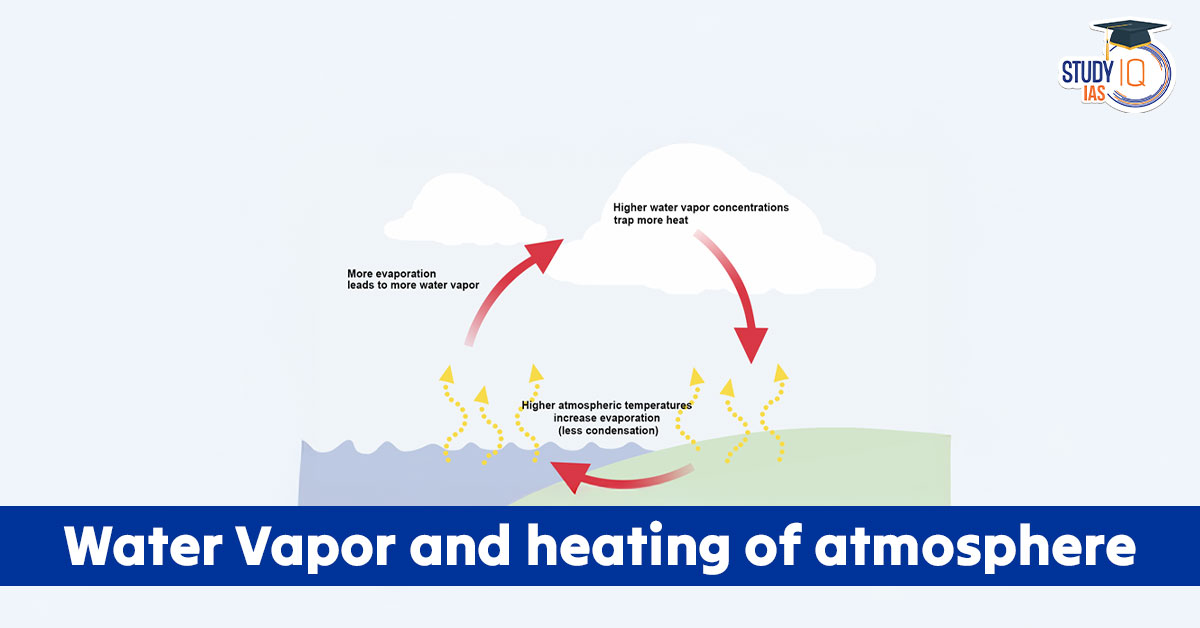
Water vapour creates a positive feedback loop:
-
Rising temperature →
-
Increased evaporation →
-
Higher water vapour concentration →
-
Stronger greenhouse effect →
-
Further warming
This feedback is one of the most powerful amplifiers of global warming. Aerosols do not show such a self-reinforcing mechanism on a comparable global scale.
5. Aerosol Limitation
Most aerosols, such as sulphates and dust:
-
Scatter incoming solar radiation
-
Reduce surface heating
-
Produce a cooling effect
Only a few aerosols like black carbon absorb sunlight and contribute to warming, but:
-
Their effect is localized
-
Their lifespan is short
-
Their heating potential is weaker compared to water vapour
Hence, aerosols can both cool and warm, whereas water vapour consistently warms.
Water Vapour vs Aerosols: A Quick Comparison
| Aspect | Water Vapour | Aerosols |
|---|---|---|
| Nature | Greenhouse gas | Suspended particles |
| Primary effect | Strong warming | Cooling or warming |
| Radiation interaction | Absorbs infrared | Mostly scatters solar |
| Feedback mechanism | Strong positive feedback | Weak or absent |
| Vertical influence | Concentrated near surface | Irregular distribution |
| Impact consistency | Uniform and persistent | Highly variable |
Significance for Climate Change
-
Water vapour does not initiate climate change but amplifies it.
-
Carbon dioxide starts the warming, and water vapour intensifies it.
-
Understanding this interaction is critical for climate modeling and prediction.
This explains why small temperature increases can lead to large climate impacts.
Conclusion
Water vapour heats the land more effectively than aerosols because it:
-
Acts as a powerful greenhouse gas
-
Absorbs infrared radiation continuously
-
Exists close to the Earth’s surface
-
Creates a strong positive feedback loop
-
Has a uniform and persistent warming effect
Aerosols, by contrast, often scatter sunlight and cool the atmosphere, with only a limited warming role in specific cases. Thus, in the hierarchy of atmospheric heating agents, water vapour stands above aerosols as the dominant amplifier of Earth’s warming system.
 Navigating Uncharted Waters: What Next f...
 Astronaut Reentry Explained: How Spacecr...
 Missile Interceptors Explained: Role in ...











 WhatsApp





