
Table of Contents
Context
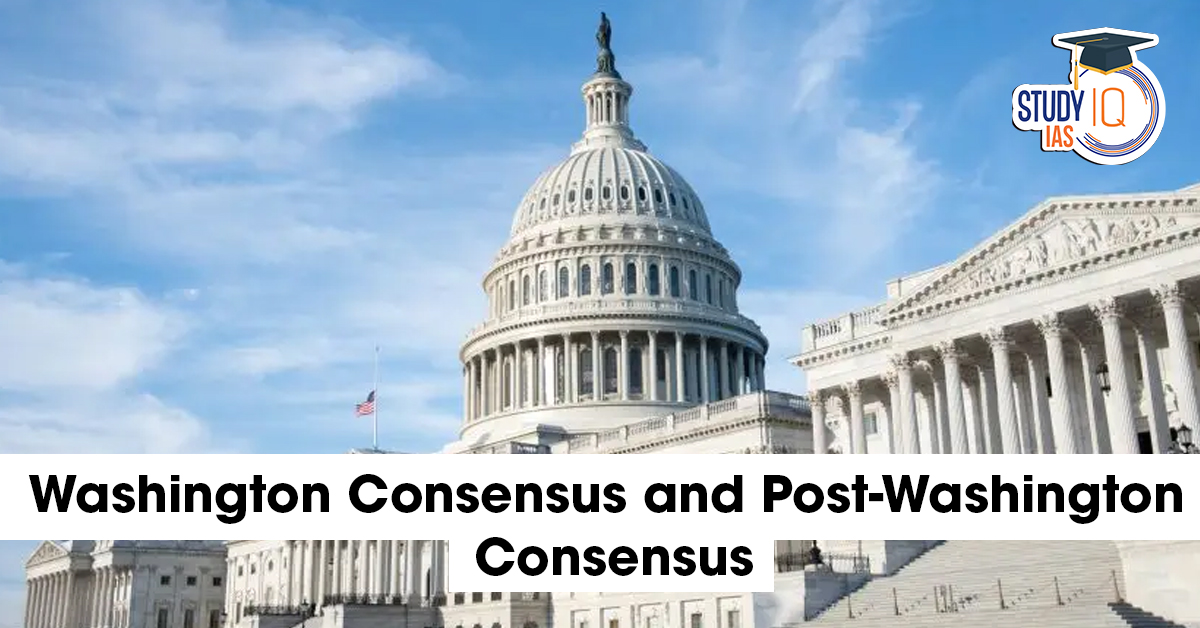
Shashi Tharoor’s op-ed traces the birth, legacy, and collapse of the Washington Consensus (WC) — the 10-point neoliberal policy framework coined by John Williamson in 1989. The WC advocated fiscal discipline, privatisation, deregulation, and trade liberalisation. However, decades of implementation reveal systemic failures — from the 1997 Asian Financial Crisis to the 2008 meltdown, rising inequality, and the current Trump tariff era. The world is now navigating a post-Washington Consensus multipolar order requiring context-sensitive, pragmatic policy eclecticism.
|
Background |
| ● In the late twentieth century, the Washington Consensus emerged as a dominant framework guiding economic reform in developing countries.
● Coined by John Williamson in 1989, the term described ten policy prescriptions widely supported by institutions in Washington as remedies for economic crises. ● These reforms emphasised fiscal discipline, market liberalisation, privatisation, and deregulation, aiming to stabilise economies and stimulate growth. ● The Washington Consensus emerged during severe debt crises in Latin America and other developing regions. ● International institutions such as the International Monetary Fund and the World Bank promoted reforms intended to restore macroeconomic stability and encourage market-driven growth. ● The ten policy prescriptions included: ○ Fiscal discipline ○ Reordering public expenditure, ○ Tax reform, interest rate liberalisation, ○ Competitive exchange rates, ○ Trade liberalisation, ○ Foreign direct investment liberalisation, ○ Privatisation of state enterprises. |
Challenges and Structural Limitations
- A major criticism of the Washington Consensus was its rejection of industrial policy, which involves state support for strategic domestic industries.
- Trade rules under the World Trade Organization restricted policy tools such as subsidies and investment regulations, limiting the ability of developing countries to nurture emerging sectors.
- This restriction contrasted sharply with the historical experience of successful industrial economies.
- Countries such as South Korea, Taiwan, and Japan relied heavily on state-led development, strategic protection, and targeted industrialisation during their formative years.
- Structural adjustment policies also produced significant social consequences. Cuts in public spending weakened public services, increased economic inequality, and intensified poverty in several regions.
Political Backlash and the Decline of the Consensus
- By the late 1990s, dissatisfaction with the Washington Consensus had grown widespread.
- Protests against globalisation and international financial institutions spread across many parts of the Global South.
- The divisions were also visible in global trade negotiations, including the 1999 Seattle WTO protests and the 2003 Cancún WTO Ministerial Conference.
- These confrontations highlighted tensions between developed and developing nations over trade rules and development priorities.
- After the 2008 financial crisis, scepticism toward liberalisation expanded within advanced economies as well.
- Political movements expressing frustration with globalisation emerged in the West, including the Make America Great Again movement and the referendum leading to Brexit.
- These developments revealed widespread disillusionment with economic globalisation and its perceived social costs.
Emergence of a Post-Washington Consensus
- The twenty-first century has witnessed the gradual emergence of a post-Washington consensus, which recognises that markets alone cannot ensure inclusive development.
- Contemporary economic thinking emphasises institutional strength, public investment, social safety nets, and redistributive policies.
- Governments increasingly focus on education, healthcare, infrastructure, and innovation systems to support long-term development.
- Strategic industrial policy, once dismissed, has regained importance in fostering technological capabilities and competitive industries.
- Alternative models have also gained prominence. The state-led development strategy associated with China demonstrates how state intervention, industrial strategy, and controlled liberalisation can drive rapid economic transformation.
Way Forward
- A New Development Consensus must be inclusive, bottom-up, and context-sensitive — drawing from South Korea (industrial policy), Nordic states (social protection), and China (infrastructure-led growth) selectively.
- India should advocate in G20, BRICS, and WTO for flexibilities that allow developing nations to pursue strategic industrial policies.
- Digital trade governance, climate finance, and AI regulation are new frontiers where a post-WC consensus must be built.
Conclusion
- The Washington Consensus once offered a seemingly universal formula for development based on liberalisation, privatisation, and deregulation.
- Over time, however, financial crises, inequality, and political resistance revealed the limitations of a single policy template. Contemporary economic governance reflects a more pragmatic, context-sensitive, and policy-diverse.
- The decline of the Washington Consensus therefore marks not the end of globalisation, but the end of the belief in a single universal model of development.
|
Read More Notes |
|
| Environment Notes | Art and Culture Notes |
| Science and Tech | History Notes |
| Geography Notes | Indian Polity Notes |
| General Knowledge | International Relation |
|
Explore StudyIQ Courses |
|
 The Transgender Persons (Protection of R...
 WASH (Water, Sanitation, and Hygiene) Se...
 Vairamuthu Wins Jnanpith Award 2026: Tam...











 WhatsApp





