
Table of Contents
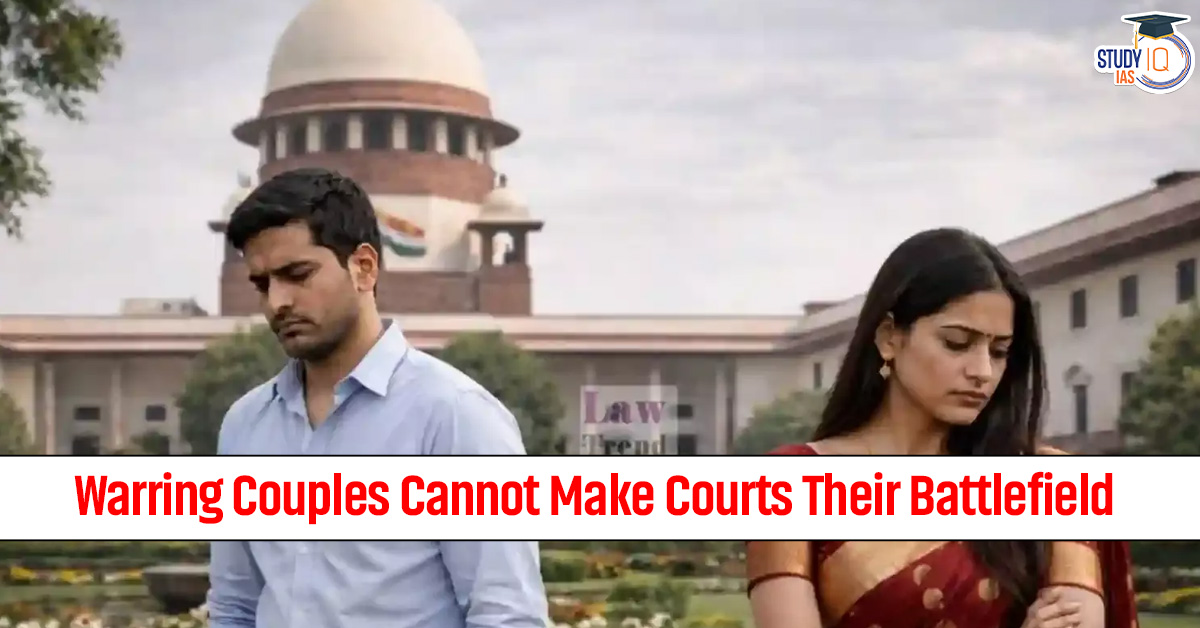
Matrimonial disputes maintain a contradictory position under contemporary legal frameworks. Although the law should offer remedies for genuine instances of cruelty, desertion, and economic deprivation, the escalating weaponisation of matrimonial litigation has become a significant institutional and cultural issue. In Neha Lal v. Abhishek Kumar (2026 LiveLaw (SC) 73), the Supreme Court of India issued an important ruling cautioning against the exploitation of courts for personal vendettas, ego conflicts, and protracted disputes between estranged spouses. The Court’s remarks underscore the significant increase in divorce litigation, the diminishing chances for reconciliation upon the invocation of criminal law, and the pressing necessity to prioritise mediation as a primary reaction instead of a final option.
This ruling transcends the individual case, reflecting a comprehensive judicial examination of the litigation of marriage disputes, the strain on legal systems, and the fragmentation of societal connections due to aggressive escalation.
Case Factual Background
The case originated from an exceptionally lengthy marital dispute between Neha Lal and Abhishek Kumar, whose marriage, formalised in 2012, endured merely 65 days of cohabitation. Notwithstanding their short marriage, the parties were embroiled in litigation for nearly 13 years, during which they commenced more than 40 court actions against one another.
The duration of these proceedings encompassed:
- Petitions for divorce
- Maintenance claims pursuant to Section 125 of the CrPC (now Section 144 of the BNSS, 2023)
- Proceedings pursuant to the Protection of Women from Domestic Violence Act, 2005
- Criminal allegations encompassing Section 498A of the Indian Penal Code
- Petitions for execution, motions for perjury, writ petitions
Numerous transfer petitions spanning various jurisdictions
The Supreme Court was presented with a transfer petition submitted by the wife, requesting the relocation of proceedings initiated by the husband. Throughout the duration, mediation was considered but could not be effectively pursued. The wife subsequently used Article 142 of the Constitution, requesting the dissolution of the marriage on the basis of irretrievable breakdown.
Supreme Court’s Remarks and Rationale Matrimonial Litigation as a Systemic Encumbrance
A Bench consisting of Justices Rajesh Bindal and Manmohan articulated significant apprehension regarding the escalating trend of matrimonial litigation inundating all tiers of the system, including the Supreme Court. The Court observed that it is being overwhelmed with transfer requests, primarily submitted by wives, either at the outset or as acts of retaliation.
The Court noted:
“Conflicted couples must not be permitted to resolve their disputes by utilizing the courts as a battleground, thereby obstructing the judicial system.”
This statement highlights the judiciary’s exasperation with litigants who manipulate legal proceedings into tools of harassment, therefore compromising court efficiency and reallocating resources from legitimate conflicts.
Mediation as the Primary Institutional Response
The ruling emphatically promotes pre-litigation mediation as the primary remedy to marital conflict. The Court underscored that:
- Family members and advocates are obligated to promote reconciliation prior to engaging in litigation.
- Counselling and mediation should be considered prior to initiating civil or criminal proceedings.
- Courts, upon hearing petitions, whether for maintenance or domestic violence, should prioritise mediation prior to soliciting responses that may intensify animosity.
- Law enforcement agencies should pursue reconciliation, ideally via court-affiliated mediation centres, instead of resorting to quick criminal proceedings.
The Court cautioned that arrests, even for a single day, frequently represent a “point of no return,” eliminating all chance of reconciliation.
Expressing anguish over such entangled litigation wasting the Court’s time, the Court suggested exploring the possibility of pre-litigation mediation to resolve such disputes without coming to Courts.
“They have indulged into filing more than 40 cases against each other. Warring couples cannot be allowed to settle their scores by treating Courts as their battlefield and choke the system. If there is no compatibility, there are modes available for early resolution of disputes. Process of mediation is the mode which can be explored at the stage of pre-litigation and even after litigation starts. When the parties start litigating against each other, especially on criminal side, the chances of reunion are remote but should not be ruled out.”, the court said.
“Practice of law is said to be noble profession. Whenever the parties in matrimonial dispute have differences, the preparation starts as to how to teach lesson to the other side. Evidence is collected and, in some cases, even created, which is more often in the era of artificial intelligence. False allegations are rampant. As any matrimonial dispute has immediate effect on the fabric of the society, it is the duty of all concerned to make earnest effort to resolve the same at the earliest before the parties take strong and rigid stand. There are mediation centres in all districts where pre-litigation mediation is also possible. In fact, it is being explored in number of cases and the success rate is also encouraging.
In many cases, the parties, after resolution of their disputes, has also started living together.”, the court added. “we find this to be a case of irretrievable breakdown of marriage, where the parties stayed together only for 65 days, are separated for the last more than a decade and have been indulging into litigation one after another. We find this to be a fit case for exercise of our discretion under Article 142 of the Constitution of India to dissolve the marriage between the parties. As a result, by passing the decree, we dissolve the marriage between the parties. No alimony has been claimed by the petitioner-wife and all her previous claims stand settled.”, the court ordered.
Increase in Matrimonial Conflicts as Instruments of Retribution and Ego Fulfilment
India has experienced a significant rise in matrimonial disputes attributable to various converging factors:
- Transformations in gender roles and societal expectations
- Analysis of conventional joint family mediation methods
- Heightened legal consciousness coupled with confrontational framing
- Social stigma associated with compromise
- Ascendancy of social media and the fabrication of digital evidence
- What was once seen as a private or familial matter is now often exacerbated into multi-forum litigation.
Utilization of Criminal Law as a Weapon
Although provisions like Section 498A IPC and the Domestic Violence Act were established to safeguard women against genuine abuse, courts have consistently recognized their exploitation in specific instances. The Supreme Court observed in the current case that:
- Evidence is frequently “gathered or even fabricated.”
- False accusations are prevalent.
- Litigation transforms into an endeavour of “teaching a lesson” rather than pursuing justice.
The Court’s mention of artificial intelligence and falsified evidence underscores the burgeoning technical concerns that complicate matrimonial adjudication.
The Function of the Judiciary in Matrimonial Disputes
The judiciary holds a precarious role, safeguarding vulnerable couples while averting the misuse of legal procedures. Throughout the years, the Supreme Court has endeavoured to achieve this equilibrium through:
- Protocols advising against automatic arrests in matrimonial offences
- Promoting mediation and resolution
- Acknowledging the irretrievable breakdown of marriage as a basis for divorce under Article 142
The Court utilised its extraordinary constitutional authority under Article 142 to annul the marriage, recognising that the relationship was irreparable.
Irretrievable Breakdown of Marriage
Despite irretrievable breakdown not being a legislative basis under the Hindu Marriage Act, the Supreme Court has consistently applied Article 142 to annul marriages in instances where:
- Cohabitation was minimal
- Separation was prolonged
- Litigation was excessive and acrimonious
The Court determined:
“We determine this to be a situation of irreparable dissolution of marriage.”
The judgment demonstrates judicial pragmatism by prioritising human dignity and finality over strict legal formalism.
Judicial Discipline and Institutional Accountability
The Court emphasised the nobility of the legal profession, reminding advocates of their ethical duty to mitigate conflict rather than exacerbate it. The Court noted that lawyers frequently engage in adversarial escalation by prioritising revenge over resolution.
This underscores that divorce justice is not exclusively the duty of courts, but rather a collaborative responsibility shared by lawyers, families, mediators, and institutions.
Consequences of the Judgment
Regarding Litigants
- Conveys a definitive message against extended, retaliatory legal actions
- Affirms mediation as a valid and efficacious method for resolving disputes
- Deters the exploitation of criminal law as a tool for coercion
Regarding the Judicial System
- Recognizes the systemic stress induced by matrimonial disputes
- Promotes court efficiency and case management
- Fortifies the legal principles of irretrievable breakdown
Regarding Society
- Advocates for reconciliation and communication rather than confrontation
- Confronts the ethos of ego-centric legal disputes
- Affirms that courts are institutions of justice, not battlegrounds for personal conflict.
Comparative Analysis
Family law systems in nations like the UK, Australia, and Canada mandate mediation or cooling-off periods prior to litigation. Numerous methods dissuade combative processes in familial conflicts, acknowledging their psychological and societal repercussions.
The Supreme Court’s focus on mediation harmonises Indian jurisprudence with international best practices, while being attuned to India’s socio-cultural context.
Conclusion
The Supreme Court’s ruling in Neha Lal v. Abhishek Kumar serves as a significant judicial critique of the exploitation of divorce litigation in modern India. By advising against the perception of courts as battlefields for conflict, emphasising mediation, and applying Article 142 to achieve resolution in an irreparably broken marriage, the Court reinforced its function as a protector of justice and institutional integrity.
In a time characterised by more litigation, emotional division, and technology abuse, the ruling underscores that law is a tool for conflict resolution, not for its continuation. The genuine efficacy of matrimonial justice is measured not by the volume of cases initiated or adjudicated but by the reinstatement of dignity, resolution, and societal cohesion.
|
Read More Notes |
|
| Environment Notes | Art and Culture Notes |
| Science and Tech | History Notes |
| Geography Notes | Indian Polity Notes |
| General Knowledge | International Relation |
|
Explore StudyIQ Courses |
|
 Tackling Child Trafficking in India: Leg...
 In Overcrowded Prisons, Justice Has Lost...
 Karnataka Freedom of Choice in Marriage ...





 WhatsApp





