
Table of Contents
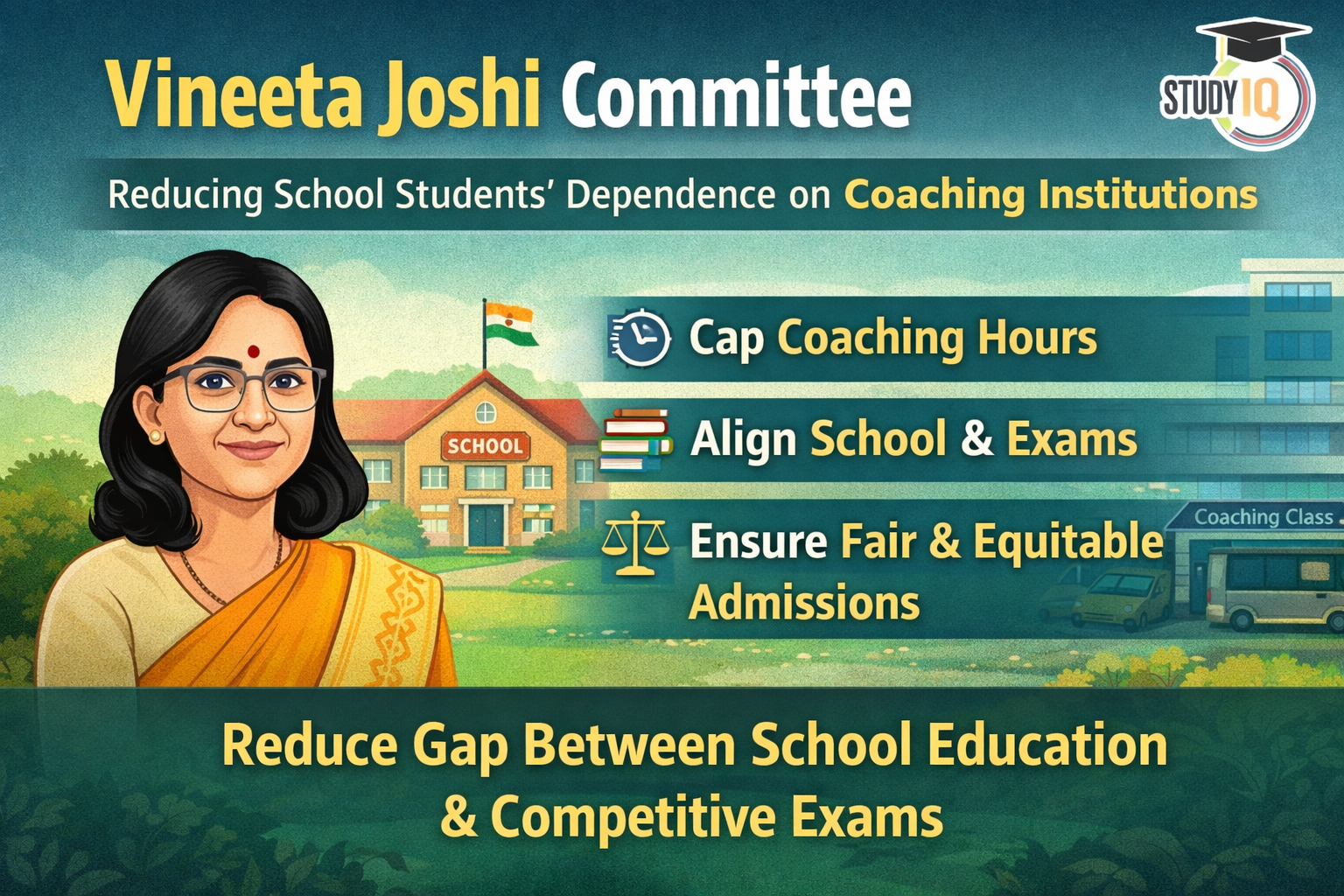
The Vineeta Joshi Committee, constituted by the Ministry of Education and headed by Vineeta Joshi, Secretary, Department of Higher Education, has proposed a transformative roadmap to reduce the growing dependence of Indian school students on private coaching institutions. The committee examined the gaps between school education and competitive entrance examinations, the effectiveness and fairness of these exams, and the increasing influence of coaching centres on students’ academic journeys.
Its recommendations aim to restore the central role of schools, ensure equity, reduce psychological stress, and make competitive exam preparation an integral part of formal education.
Why Did the Government Set Up the Vineeta Joshi Committee?
The explosive growth of coaching institutions for exams like JEE, NEET, CUET and JEE Advanced has created a parallel education system. This has raised serious concerns regarding:
-
Academic imbalance
-
Mental health of students
-
Social inequality
-
Marginalisation of school education
The committee was tasked with identifying structural problems and suggesting reforms that make schools sufficient and effective for competitive success.
Reasons Behind the Rise of Coaching Institutions
1. Misalignment Between School Education and Entrance Exams
School boards like CBSE focus on conceptual and analytical learning, while competitive exams emphasize:
-
Objective questions
-
MCQ format
-
Speed and accuracy
This mismatch pushes students towards coaching centres.
2. Inadequate Teacher Training
-
Many school teachers are trained only to meet board exam standards.
-
Coaching institutes hire:
-
Engineers
-
Doctors
-
Subject specialists
who are better equipped to handle competitive exam-oriented teaching.
-
3. Coaching Ecosystem Advantage
Coaching institutes provide:
-
Regular mock tests
-
Performance analytics
-
Targeted study material
-
Exam strategies
Schools lack such structured competitive preparation systems.
4. Rise of Dummy Schools
Students enrol in “dummy schools” only for formal attendance while spending their entire time in coaching institutes.
This sidelines:
-
Classroom learning
-
Holistic development
-
School engagement
5. Psychological Stress on Students
-
Single-attempt, high-stakes exams create:
-
Anxiety
-
Burnout
-
Narrow definitions of success
-
-
Students begin coaching from early ages under immense pressure.
6. Absence of Career Guidance in Schools
Without proper counselling, students:
-
Follow herd mentality
-
Believe competitive exams are the only path to success
-
Ignore alternative careers and personal aptitudes
7. Equity and Social Justice Concerns
Coaching is expensive and urban-centric.
This disadvantages:
-
Poor students
-
Rural learners
-
Marginalised communities
It creates an unfair advantage for the privileged.
Key Recommendations of the Vineeta Joshi Committee
1. Capping Coaching Hours
-
Limit coaching classes to 2–3 hours per day
-
Prevent physical and mental exhaustion
-
Restore importance of school learning
2. Redesigning School Curriculum
-
School syllabus should mirror competitive exams
-
Reduce dependency on external coaching
3. Greater Weightage to Board Exams
-
Increase the role of board examination results in college admissions
-
Reduce monopoly of entrance exams
4. Introducing Competitive Tests in Class XI
-
Early exposure to competitive exam patterns
-
Gradual preparation instead of last-minute pressure
5. Syllabus Alignment (NCERT as Nodal Agency)
NCERT to:
-
Align school curriculum with competitive exams
-
Coordinate with:
-
NTA
-
CBSE
-
Other boards
-
6. Data Transparency by NTA
NTA to share with IIT Kanpur:
-
Candidate-level responses
-
Question-wise performance
-
Shift-wise papers
-
Answer keys
for assessing: -
Fairness
-
Reliability
-
Discriminatory power of exams
7. Psychometric Analysis of Question Papers
-
A psychometric expert will assess:
-
Difficulty levels
-
Student differentiation capability
across: -
JEE Main
-
NEET
-
CUET
-
JEE Advanced
-
8. Survey on Student Engagement with Coaching
-
CBSE and Department of School Education will:
-
Conduct surveys
-
Assess extent of coaching dependence
-
9. Remedial and Mentorship in Schools
-
CBSE to develop:
-
Remedial classes
-
Mentorship programmes
within schools to replace private coaching support.
-
Why These Reforms Matter
| Aspect | Impact |
|---|---|
| Equity | Reduces advantage of wealthy students |
| Mental Health | Lowers stress and burnout |
| School Strengthening | Makes schools academically sufficient |
| Fair Competition | Improves exam credibility |
| Holistic Development | Restores importance of formal schooling |
Conclusion
The Vineeta Joshi Committee represents a decisive shift towards school-centric competitive preparation. Its vision is to:
“Make schools sufficient, fair, and psychologically healthy spaces for academic success, rather than forcing students into expensive and stressful parallel coaching systems.”
If implemented effectively, these reforms could reshape India’s education ecosystem by:
-
Reducing inequality
-
Restoring trust in schools
-
Humanising competitive examinations
-
Protecting students’ mental well-being
 Navigating Uncharted Waters: What Next f...
 Astronaut Reentry Explained: How Spacecr...
 Missile Interceptors Explained: Role in ...











 WhatsApp





