
Table of Contents
Village Defence Guards (VDGs) are community-based security volunteers in Jammu and Kashmir, created to strengthen grassroots defence and support security forces in maintaining internal security. In the context of persistent cross-border terrorism, infiltration attempts and asymmetric warfare, VDGs act as a force multiplier, especially in remote border villages and rural areas.
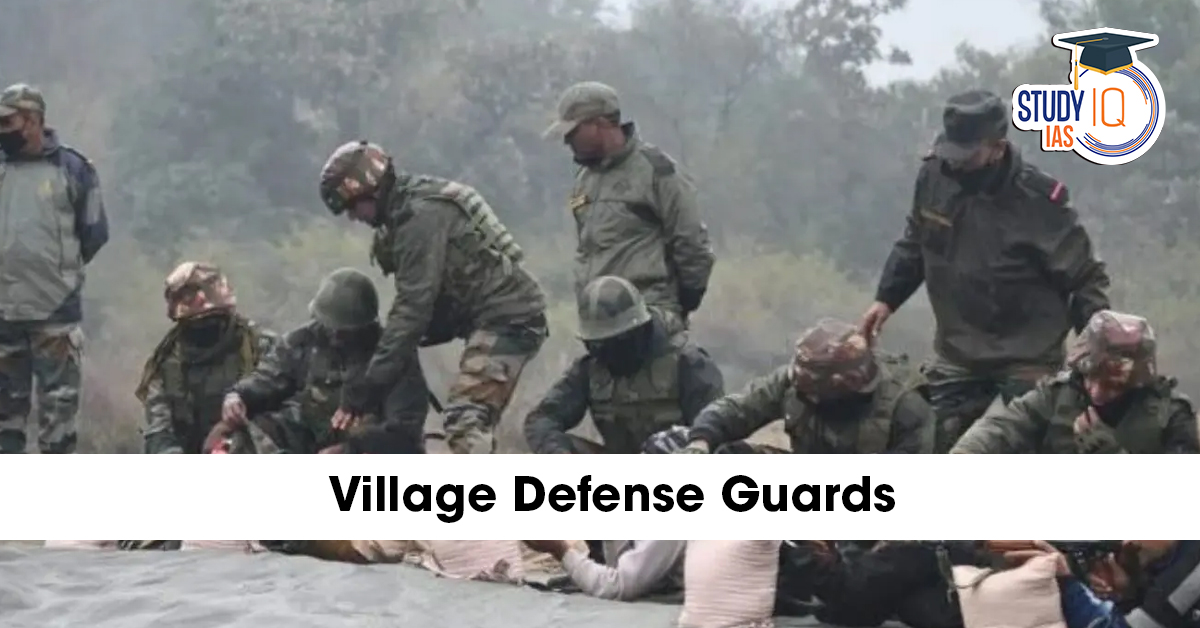
Recent training initiatives by the Indian Army, such as the programme conducted by the Sabre Brigade in Jammu, highlight the growing emphasis on improving the operational readiness of VDGs and integrating them more closely with formal security structures.
What are Village Defence Guards (VDGs)?
Village Defence Guards are armed civilian volunteers drawn from local communities, authorised by the government to assist security forces in defending villages against terrorist attacks, infiltration and criminal activities.
They function as the first line of local defence, particularly in areas where terrain, distance and sparse population limit the continuous presence of security forces.
Evolution of Village Defence Guards
-
Origin: VDGs trace their roots to the Village Defence Committees (VDCs) established in the mid-1990s during peak militancy in Jammu and Kashmir.
-
Renaming & restructuring: In 2022, VDCs were reorganised and renamed as Village Defence Guards to:
-
Improve accountability
-
Streamline command and control
-
Enhance training and coordination with security forces
-
Composition and Structure
-
Members:
-
Primarily local residents familiar with terrain and social dynamics
-
Ex-servicemen, able-bodied youth, and responsible villagers
-
-
Supervision:
-
Operate under the district administration
-
Coordinated with police and the Indian Army
-
-
Arms:
-
Licensed weapons provided by the government
-
Issued strictly for village defence purposes
-
Roles and Responsibilities of VDGs
1. Village Protection
-
Guard villages against terrorist raids and infiltration
-
Protect civilians during security emergencies
2. Intelligence Support
-
Act as local eyes and ears of security forces
-
Report suspicious movements, strangers and activities
3. Area Familiarisation
-
Assist forces with:
-
Terrain navigation
-
Local routes and hideouts
-
Cultural and social insights
-
4. Confidence Building
-
Strengthen trust between local communities and the State
-
Reduce fear and psychological impact of terrorism
Training of Village Defence Guards
Recent Army Training Initiatives
The Indian Army regularly conducts capacity-building programmes for VDGs, such as the training held at Purmandal, Jammu, focusing on:
-
Weapon handling and safety
-
Firing practice
-
Basic battle drills
-
Coordination during counter-terror operations
Objectives of Training
-
Improve operational efficiency
-
Reduce accidental misuse of weapons
-
Enhance coordination with police and Army units
-
Prepare VDGs for emergency response situations
Significance of Village Defence Guards
1. Grassroots Security
VDGs ensure round-the-clock vigilance in vulnerable villages where permanent deployment of forces is difficult.
2. Force Multiplier
They supplement the limited manpower of security forces, especially in counter-insurgency environments.
3. Community Resilience
By involving locals, VDGs strengthen collective responsibility for security, reducing reliance solely on external forces.
4. Counter-Terror Strategy
VDGs play a crucial role in area domination, early warning and deterrence against surprise attacks.
Challenges Associated with VDGs
1. Training Gaps
-
Uneven training standards across districts
-
Need for regular refresher courses
2. Weapon Safety and Accountability
-
Risk of accidental firing
-
Potential misuse if oversight is weak
3. Psychological Stress
-
Continuous exposure to threat environments
-
Limited access to counselling and support
4. Legal and Ethical Concerns
-
Ensuring actions remain within the framework of law
-
Avoiding vigilantism or communal misuse
Government Measures and Safeguards
-
Structured training by Army and police
-
Clear rules of engagement
-
Licensing and periodic verification of weapons
-
Increased monitoring by district authorities
Way Forward
-
Institutionalise standardised training modules
-
Integrate VDGs into local disaster and emergency response
-
Provide insurance, honorarium and welfare support
-
Use technology for communication and real-time alerts
-
Ensure strong accountability mechanisms
Conclusion
Village Defence Guards represent a community-centric internal security model, particularly suited to the unique socio-geographical conditions of Jammu and Kashmir. When properly trained, supervised and supported, VDGs can significantly enhance local security, intelligence gathering and public confidence, while complementing the efforts of the Indian Army and police forces.
 FATF Report on India’s Action on Virtu...
 India Pharma Expo 2026: Key Highlights, ...
 India–Arab League Relations: Cooperati...













 WhatsApp





