
Table of Contents
With the rapid growth of automobiles and increasing traffic density, road safety has become a major concern in India. In this context, Union Road Transport and Highways Minister Nitin Gadkari’s announcement about the rollout of Vehicle-to-Vehicle (V2V) communication technology marks a transformative step toward smarter and safer mobility. This technology has the potential to drastically reduce road accidents and revolutionize the way vehicles interact on Indian roads.
What is Vehicle-to-Vehicle (V2V) Communication Technology?
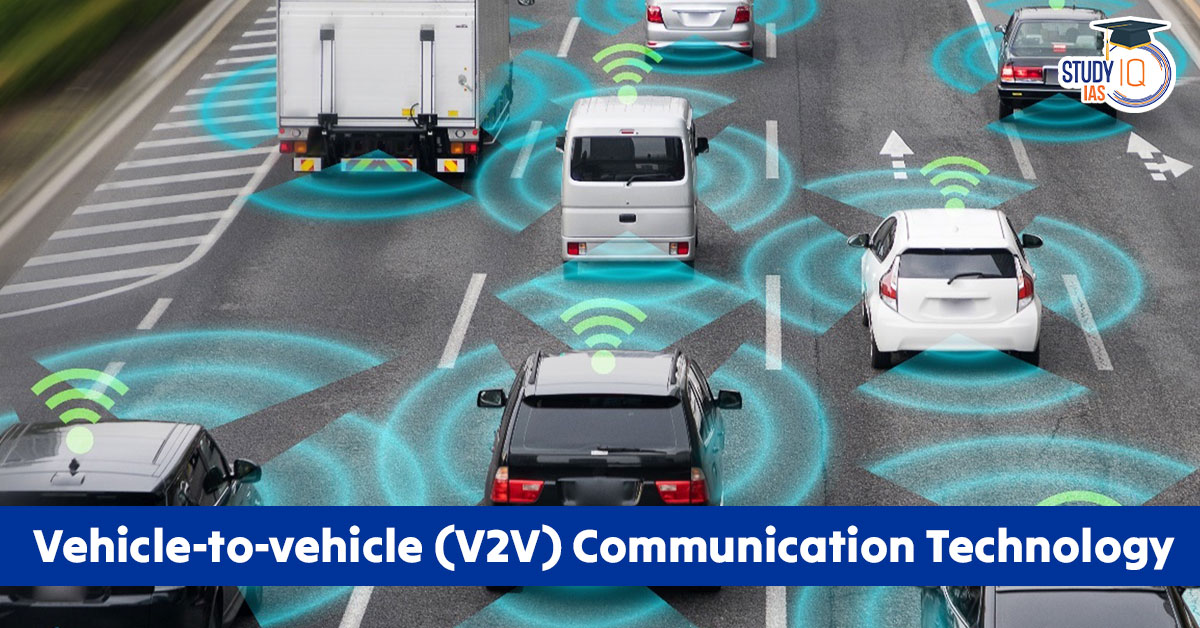
Vehicle-to-Vehicle (V2V) communication is a wireless technology that allows vehicles to exchange real-time information directly with one another without human intervention. Each vehicle is equipped with onboard communication units that continuously broadcast and receive critical data such as:
-
Speed
-
Position
-
Direction of travel
-
Braking status
-
Road and traffic conditions
-
Emergency alerts
This constant flow of information creates a connected ecosystem where vehicles become “aware” of their surroundings far beyond what the driver or onboard sensors can see.
How V2V Technology Works
-
Onboard Units (OBUs): Each vehicle is fitted with communication hardware.
-
Wireless Communication: Vehicles use dedicated short-range communication (DSRC) or cellular-based V2X (C-V2X) technology.
-
Real-Time Data Exchange: Vehicles broadcast their status several times per second.
-
Instant Alerts: If a potential hazard is detected—such as sudden braking ahead or a collision risk—warnings are sent immediately.
-
Preventive Action: The driver or the vehicle’s automated system can respond in time to avoid accidents.
Significance of V2V Communication in India
V2V technology is especially relevant for India, which has one of the highest numbers of road accidents globally. Its implementation can bring major benefits:
-
Significant reduction in road accidents
-
Early warning system for collisions, blind spots, and sudden braking
-
Improved traffic flow through better coordination between vehicles
-
Enhanced safety for pedestrians and cyclists
-
Support for autonomous and connected vehicles in the future
By enabling vehicles to “talk” to each other, V2V technology adds an invisible layer of safety to Indian roads.
V2V Communication vs Advanced Driver Assistance Systems (ADAS)
| Aspect | V2V Communication | ADAS |
|---|---|---|
| Core Principle | Vehicle-to-vehicle data sharing | Sensor-based perception |
| Dependency | Requires other connected vehicles | Works independently |
| Range of Awareness | Beyond line of sight and sensors | Limited to sensor range |
| Infrastructure | Needs communication standards and network penetration | Only onboard hardware |
| Decision Basis | Shared external data from nearby vehicles | Local sensor inputs |
While ADAS relies on cameras, radar, and lidar to detect obstacles, V2V goes a step further by allowing vehicles to share intentions and actions, such as sudden braking or lane changes, even before sensors can detect danger.
Why V2V is a Game-Changer for Road Safety
Traditional safety systems react to visible threats. V2V communication, on the other hand, is predictive in nature. It can:
-
Warn drivers about accidents ahead
-
Alert about vehicles hidden behind curves or fog
-
Notify of sudden traffic congestion
-
Enable cooperative driving behavior
This proactive approach can drastically reduce human error, which is responsible for the majority of road accidents.
Challenges in Implementing V2V in India
Despite its promise, V2V technology faces certain challenges:
-
Standardization of communication protocols
-
High initial cost of onboard equipment
-
Requirement of mass adoption for effectiveness
-
Cybersecurity and data privacy concerns
-
Integration with existing traffic infrastructure
However, with strong government backing and policy support, these challenges can be addressed systematically.
Role of V2V in India’s Smart Mobility Vision
V2V communication aligns perfectly with India’s broader goals of:
-
Smart transportation systems
-
Reduction in carbon emissions
-
Development of autonomous vehicle ecosystems
-
Digital infrastructure expansion
It is a key building block of the future “connected mobility” framework.
Conclusion
The rollout of Vehicle-to-Vehicle (V2V) communication technology in India is a landmark move toward safer, smarter, and more efficient roads. By enabling vehicles to exchange real-time data and anticipate hazards before they become visible, V2V goes beyond traditional safety mechanisms like ADAS.
If implemented effectively and widely adopted, V2V technology has the potential to significantly cut down road accidents, improve traffic management, and pave the way for fully autonomous vehicles in the future. India’s journey toward intelligent transportation has truly begun.
Sharing is caring!
 Navigating Uncharted Waters: What Next f...
 Astronaut Reentry Explained: How Spacecr...
 Missile Interceptors Explained: Role in ...











 WhatsApp





