
Table of Contents
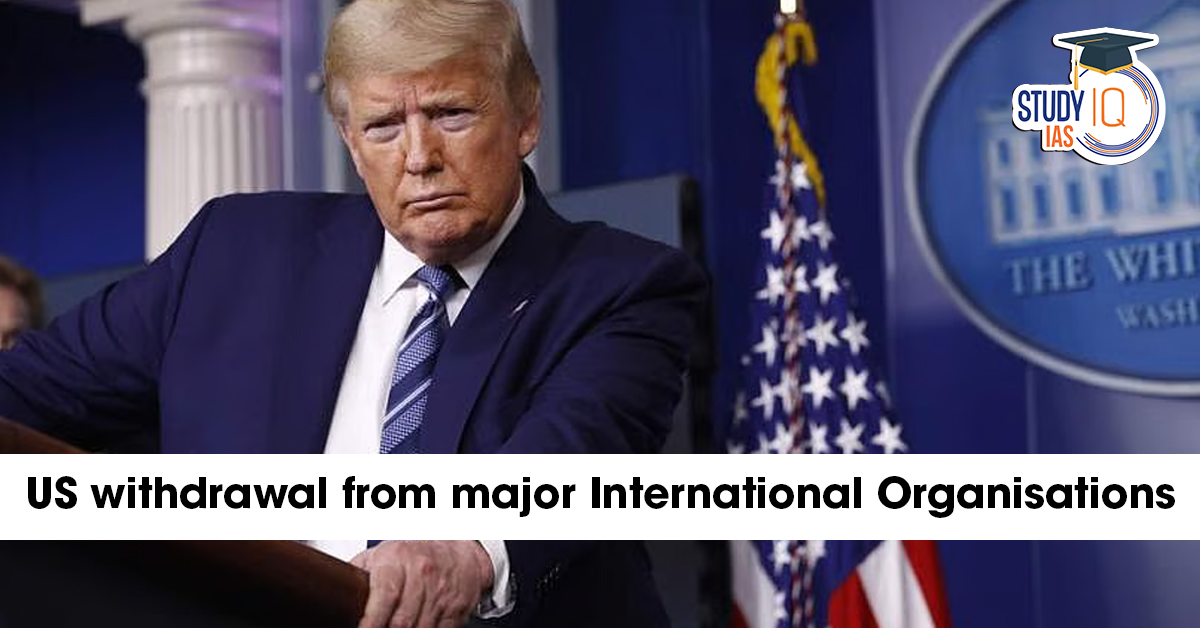
The decision of the United States to withdraw from several major international organisations has triggered intense debate across the world. Under President Donald Trump, the US has announced exits from dozens of global bodies, including UN agencies, climate institutions, and health organisations. This move signals a dramatic retreat from the multilateral leadership role that Washington has played since the end of World War II.
The implications go far beyond diplomacy. They affect global health, climate action, development finance, women’s rights, and even technological standards. More importantly, they reshape the balance of power in international governance, opening space for China and other emerging powers.
Why Is the US Withdrawing from International Organisations?
1. Perceived Financial Burden
The US argues that it contributes disproportionately to international bodies while receiving limited influence in decision-making. Many UN agencies rely heavily on American funding, which Trump considers an unfair cost.
2. Sovereignty and “America First” Policy
Trump views multilateral institutions as constraints on national sovereignty. His administration prefers bilateral agreements where power asymmetry works in favour of the US.
3. Allegations of Pro-China Bias
The US claims that several international organisations show systemic bias towards China. It argues that American funding indirectly strengthens institutions that protect Beijing’s strategic interests.
4. Precedent Set by WHO Withdrawal
The US exit from the World Health Organization in 2025 became a template for wider disengagement. It was justified on grounds of political influence, inefficiency, and lack of accountability.
Major International Organisations the US Has Withdrawn From
-
World Health Organization (WHO)
Weakens global pandemic preparedness and disease surveillance. -
UN Framework Convention on Climate Change (UNFCCC)
Undermines global climate cooperation and climate finance mechanisms. -
International Solar Alliance (ISA)
A blow to climate diplomacy, especially affecting India–France leadership. -
UN Women
Impacts global gender equality and women empowerment programmes. -
UN Population Fund (UNFPA)
Affects maternal health, reproductive health, and family planning initiatives. -
UNESCO and Other UN Agencies
Reduces support for education, culture, and science cooperation.
Impact on Global Governance
1. Weakening of Multilateral Institutions
The US has been a major funder and agenda-setter. Its withdrawal leads to:
-
Financial crises in UN agencies
-
Reduced programme scale
-
Leadership vacuum
2. Decline in Global Trust
Countries begin questioning the reliability of international institutions and collective agreements.
3. Fragmentation of Global Order
Instead of unified responses, the world moves towards:
-
Regional blocs
-
Bilateral arrangements
-
Power-based diplomacy
China’s Strategic Advantage
With the US stepping back:
-
China gains greater influence in UN agencies.
-
It can shape rules on:
-
Development finance
-
Digital governance
-
Climate funding
-
Infrastructure standards
-
China already:
-
Heads several UN bodies.
-
Expands Belt and Road diplomacy.
This shift risks transforming global governance from a rules-based order to a power-centric one.
Impact on Climate Action
US exit from UNFCCC:
-
Weakens the Paris Agreement architecture.
-
Reduces climate finance for developing nations.
-
Slows global renewable energy transition.
The absence of the world’s largest economy undermines credibility of climate commitments.
Impact on Global Health
US withdrawal from WHO:
-
Reduces pandemic response funding.
-
Weakens disease surveillance networks.
-
Hampers vaccine cooperation.
Global health becomes more fragmented and less coordinated.
Impact on India
-
US exit from ISA weakens India’s climate leadership.
-
Shrinking multilateral platforms reduce India’s diplomatic space.
-
China’s rising dominance complicates India’s strategic environment.
How the US Continues to Exercise Power
Despite withdrawal, the US relies on:
-
Military Power:
Continued global military operations. -
Tariff Diplomacy:
Trade pressure as a geopolitical tool. -
Selective Multilateralism:
Retains membership in technical bodies like:-
ITU
-
IMO
-
ILO
-
These shape global standards and commercial competitiveness.
Does This End Multilateralism?
Not entirely, but it:
-
Weakens institutional authority
-
Encourages power politics
-
Promotes “transactional diplomacy”
Way Forward for Global Governance
-
Greater role for middle powers like India, EU, Japan.
-
Financial diversification of UN agencies.
-
Stronger South–South cooperation.
-
Institutional reforms for transparency and efficiency.
Conclusion
The US withdrawal from major international organisations marks a historic turning point in global governance. It erodes multilateral cooperation, weakens international institutions, and accelerates geopolitical competition—especially benefiting China.
Unless new leadership and funding mechanisms emerge, the world risks entering an era of fragmented global governance dominated by power politics rather than collective responsibility.
 Sahitya Akademi Award 2025 Winners List:...
 Viksit Bharat Shiksha Adhishthan Bill 20...
 Cyclone Maila Intensifies Over Solomon S...








 WhatsApp





