
Table of Contents
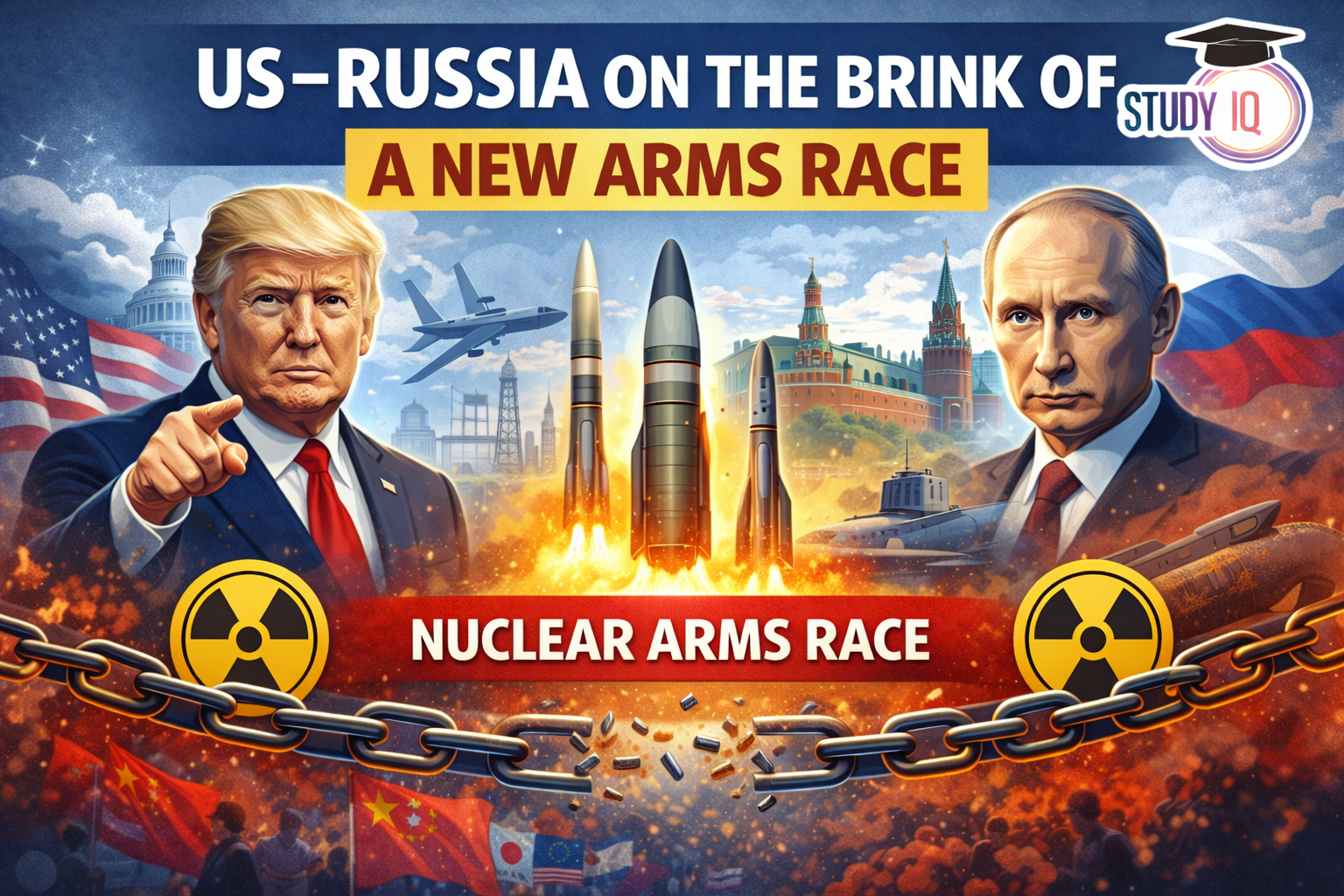
The world stands at a critical juncture as the New START Treaty, the last remaining nuclear arms control agreement between the United States and Russia, approaches expiry. In the absence of a replacement or interim arrangement, the two largest nuclear powers could enter an unrestrained nuclear arms race for the first time since the Cold War—raising profound concerns for global security and strategic stability.
Background: New START and Nuclear Arms Control
Signed in 2010, New START was designed to preserve strategic stability after decades of Cold War rivalry.
Key Provisions of New START
-
Limit of 1,550 deployed strategic nuclear warheads for each side
-
Cap of 700 delivery systems (ICBMs, SLBMs, heavy bombers)
-
Robust verification, inspections, and data-sharing mechanisms
The treaty reduced mistrust and prevented arms competition based on worst-case assumptions.
Why the Risk of a New Arms Race Is Rising
1. Treaty Expiry Without Replacement
If New START lapses, there will be no legally binding constraints on US and Russian strategic arsenals for the first time in over five decades.
2. Emergence of New Weapons Systems
Russia has developed advanced nuclear-capable systems that fall outside New START’s framework, complicating negotiations and verification.
3. Missile Defence and Strategic Balance
US plans for advanced missile defence systems are perceived by Moscow as undermining nuclear deterrence, fuelling mistrust.
4. The China Factor
China’s rapidly expanding nuclear arsenal has altered the strategic landscape:
-
Estimated ~600 warheads, projected to exceed 1,000 by 2030
-
Beijing refuses to join arms control talks, citing the much larger US and Russian stockpiles
This has intensified US concerns about simultaneous deterrence of Russia and China.
Divergent Approaches in the United States and Russia
Russia’s Position
Russian President Vladimir Putin has proposed maintaining existing limits temporarily to buy time for negotiations, while signalling readiness for all outcomes.
United States’ Position
US President Donald Trump has expressed scepticism about extending the treaty, arguing for a “better deal” that also addresses China’s rise.
Within the US, opinion is divided between:
-
Arms control advocates, who stress risk reduction and cost concerns
-
Strategic hardliners, who argue for expanding nuclear capabilities to deter multiple adversaries
Implications for Global Security
1. Strategic Instability
Without transparency and verification, both sides may plan based on worst-case scenarios, increasing the risk of miscalculation and accidental escalation.
2. Revival of Costly Arms Races
Unrestricted competition could trigger massive spending on nuclear weapons, diverting resources from development and global challenges.
3. Weakening of the Global Arms Control Architecture
The collapse of New START would undermine decades of arms control efforts and weaken global non-proliferation norms.
4. Multipolar Nuclear Competition
An unchecked US–Russia arms race could encourage further nuclear build-up by China and other nuclear-armed states, increasing systemic risk.
Implications for the Global South and India
-
Increased global instability affects energy security, trade, and multilateral cooperation.
-
Weakening of arms control regimes undermines global non-proliferation efforts, which are vital for regional stability.
-
India, as a responsible nuclear power, has an interest in strategic restraint and predictable global security environments.
Way Forward
1. Interim Risk-Reduction Measures
-
Temporary caps on warheads
-
Continued data-sharing and communication channels
2. Revitalising Arms Control Diplomacy
-
Exploring flexible or issue-based agreements rather than comprehensive treaties.
3. Multilateral Engagement
-
Gradual inclusion of other nuclear powers through confidence-building measures.
4. Separating Arms Control from Broader Conflicts
-
Preventing geopolitical rivalries from paralysing nuclear risk reduction efforts.
Conclusion
The looming possibility of a new US–Russia arms race represents one of the gravest challenges to global security in the post-Cold War era. At a time of heightened geopolitical tensions and technological disruption, arms control remains not a concession but a necessity. Whether the world steps back from the brink will depend on political will, strategic restraint, and the recognition that nuclear competition offers no winners—only shared risks.
|
Read More Notes |
|
| Environment Notes | Art and Culture Notes |
| Science and Tech | History Notes |
| Geography Notes | Indian Polity Notes |
| General Knowledge | International Relation |
|
Explore StudyIQ Courses |
|
Sharing is caring!
 Bharat Audyogik Vikas Yojana (BHAVYA Sch...
 NavIC Satellite Clock Failures: Causes, ...
 Rare Earth Elements (REE) Sites in India...






 WhatsApp





