
Table of Contents
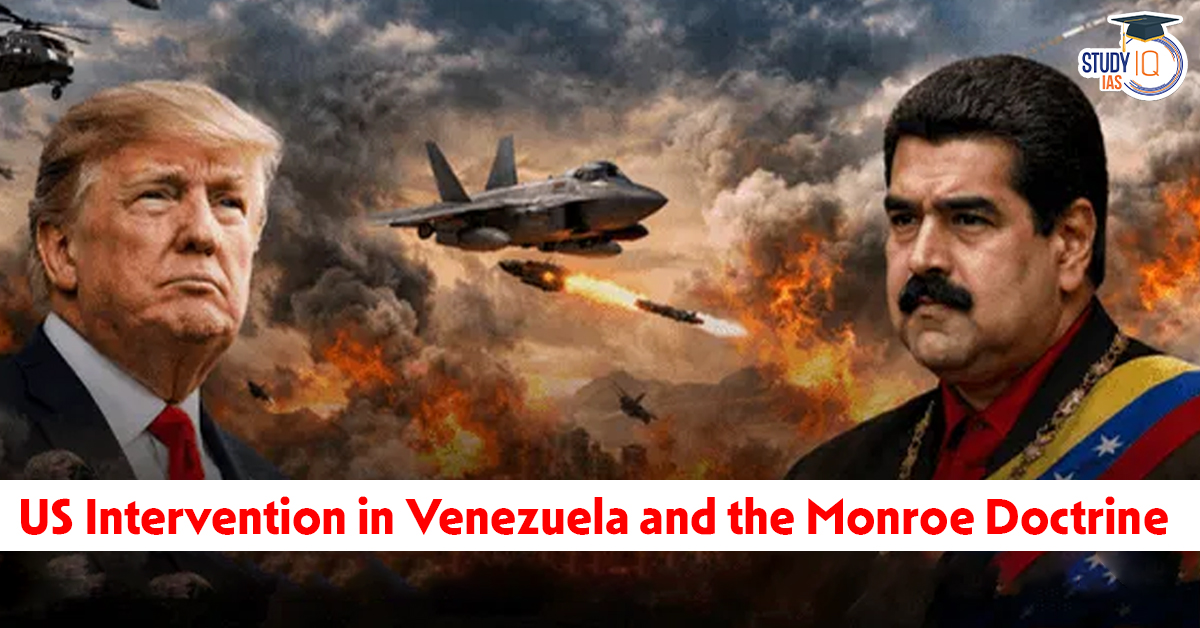
The recent US military intervention in Venezuela has brought the Monroe Doctrine back into global geopolitical discourse. The operation, which resulted in the capture of Venezuelan President Nicolás Maduro, marks a significant escalation in American interventionism in Latin America and raises serious questions about sovereignty, international law, and the future of a multipolar world order.
Why is US Intervention in Venezuela in News?
The United States conducted a military operation in Venezuela, justifying its actions under a revived interpretation of the Monroe Doctrine. The move is projected as necessary to counter narco-terrorism, protect US security interests, and limit the influence of extra-regional powers in the Western Hemisphere.
This development signals a renewed assertion of US dominance in Latin America, reminiscent of Cold War–era interventionism.
What is the Monroe Doctrine?
The Monroe Doctrine was articulated in 1823 by US President James Monroe. It laid down three core principles:
-
Non-colonisation: European powers should not establish new colonies in the Americas
-
Non-interference: External intervention in Western Hemisphere nations would be considered hostile
-
US restraint in Europe: The US would avoid involvement in European conflicts
Originally defensive in nature, the doctrine gradually evolved into a tool for asserting American strategic influence.
Evolution of the Monroe Doctrine
-
Roosevelt Corollary (1904): Expanded US authority to intervene in Latin America to prevent instability
-
Cold War Period: Used to counter Soviet influence in Cuba and Central America
-
Post–Cold War Phase: De-emphasised in favour of multilateralism
-
Contemporary Phase: Revived selectively to reassert US primacy, as seen in Venezuela
The present intervention is often described as a modern corollary, aimed at restoring US strategic dominance in its traditional sphere of influence.
Why Did the US Intervene in Venezuela?
1. Security and Narco-Terrorism Narrative
The US accused Venezuelan leadership of involvement in drug trafficking and transnational crime, portraying the regime as a direct threat to American security.
2. Oil and Energy Geopolitics
Venezuela possesses the world’s largest proven crude oil reserves, yet produces far below its potential due to sanctions, economic crisis, and infrastructure decay. Control over Venezuelan energy assets is seen as critical for global energy stability and strategic leverage.
3. Countering Extra-Regional Powers
Venezuela’s growing ties with China, Russia, and Iran were viewed as a challenge to US influence in the Western Hemisphere, prompting Washington to act within a Monroe Doctrine framework.
US Intervention and International Law
Under the United Nations Charter:
-
Use of force against another state is generally prohibited
-
Military action is allowed only in self-defence or with UN Security Council authorisation
The unilateral nature of US action has therefore raised concerns regarding the erosion of international legal norms and state sovereignty.
Impact of the US–Venezuela Conflict on India
Limited Economic Impact
India’s trade with Venezuela is minimal due to prolonged sanctions, limiting immediate economic consequences.
Energy Security Perspective
India’s crude oil imports from Venezuela have declined sharply in recent years. However, any future easing of sanctions could allow discounted Venezuelan oil to re-enter global markets, enhancing India’s energy diversification.
Strategic Autonomy
India traditionally supports non-interventionism and respect for sovereignty. The US action complicates India’s diplomatic balancing between its partnership with the US and solidarity with the Global South.
Broader Geopolitical Implications
-
Signals a revival of unilateralism in global politics
-
Raises fears of sovereignty erosion in Latin America
-
Challenges the idea of a rules-based international order
-
Intensifies great power rivalry in the Global South
Conclusion
The US intervention in Venezuela marks a decisive revival of the Monroe Doctrine in the 21st century. While presented as a move to restore democracy and security, it risks destabilising Latin America and weakening global norms of sovereignty and multilateralism. For countries like India, the episode reinforces the importance of strategic autonomy, non-alignment, and a balanced multipolar world order.
 Viksit Bharat Shiksha Adhishthan Bill 20...
 Cyclone Maila Intensifies Over Solomon S...
 List of Military Exercises of India 2026...













 WhatsApp





