
Table of Contents
The Union Budget 2026, announced by Finance Minister Nirmala Sitharaman, is a historic event as she has been able to deliver her ninth consecutive Union Budget. The Budget has been announced at a time when India is experiencing robust macroeconomic stability, managed inflation, and growth momentum despite global uncertainties.
The Union Budget 2026 has been approved by the Cabinet headed by Prime Minister Narendra Modi, and it has been designed to achieve a balance between growth acceleration, fiscal discipline, domestic manufacturing growth, and global trade competitiveness.
Budget 2026 LIVE
Finance Minister Nirmala Sitharaman is currently presenting the Union Budget 2026-27 in Parliament, marking her ninth consecutive budget—a record in India’s parliamentary history. The budget focuses on infrastructure development, strategic manufacturing, and inclusive growth.
Key Announcements So Far
-
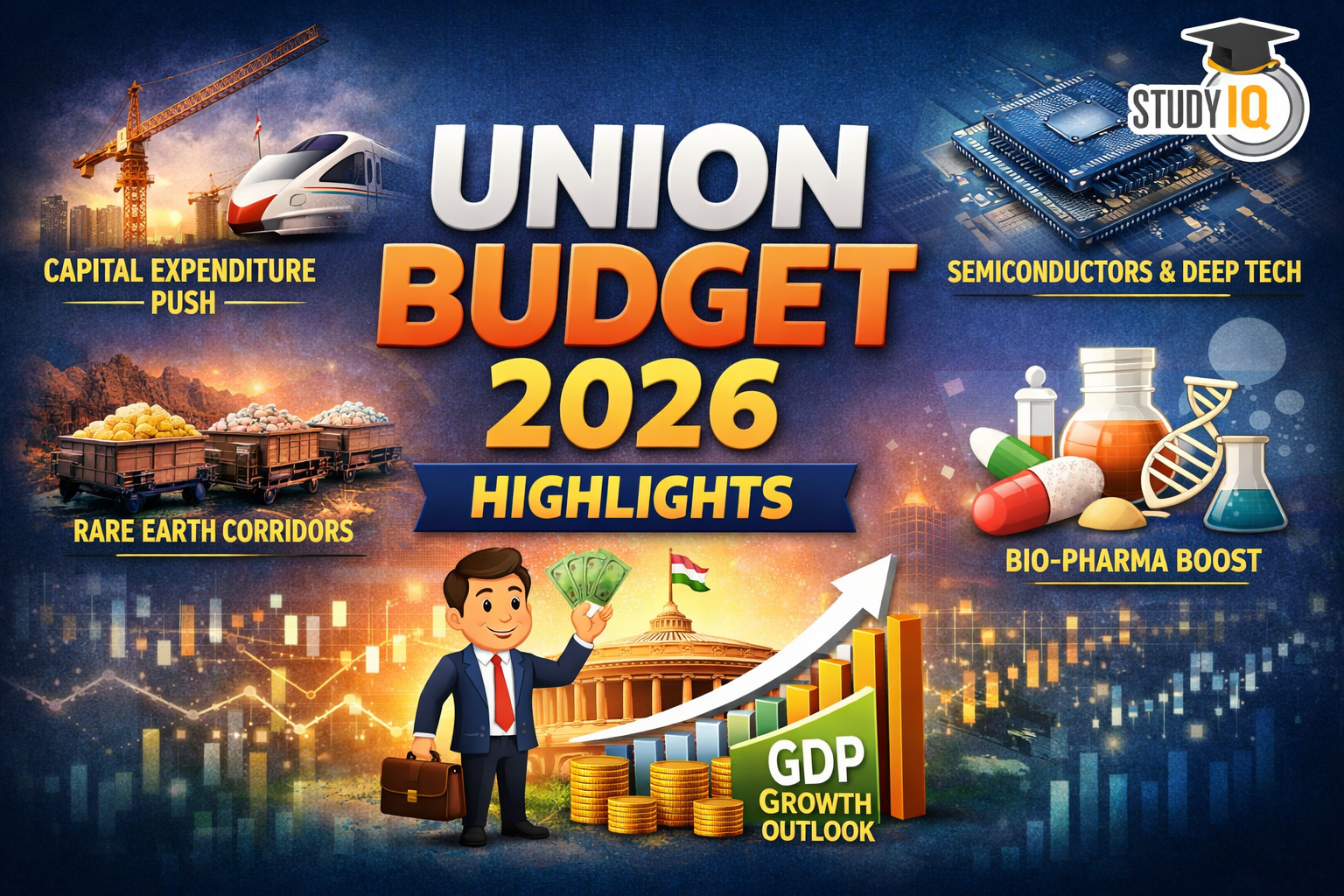
India Semiconductor Mission 2.0: A ₹40,000 crore initiative to bolster semiconductor manufacturing and research.
-
Biopharma Shakti: ₹10,000 crore allocated to develop India as a global biopharmaceutical hub.
-
Rare Earth Corridors: Establishment of dedicated corridors in Odisha, Kerala, Andhra Pradesh, and Tamil Nadu to enhance mineral exploration and processing.
-
High-Speed Rail Corridors: Seven new corridors announced, including Mumbai-Pune and Delhi-Varanasi, to improve connectivity.
-
Content Creator Labs: Introduction of labs in 15,000 schools and 500 colleges to promote the Animation, Visual Effects, Gaming, and Comics (AVGC) sector.
-
Mahatma Gandhi Gram Swaraj Yojana: A new scheme aimed at revitalizing the khadi and handloom sectors in rural areas.
Fiscal Highlights
-
Capital Expenditure: Increased to ₹12.2 lakh crore, reflecting a 9% rise from the previous year.
-
Fiscal Deficit: Estimated at 4.3% of GDP for FY27.
Taxation Updates
The Finance Minister has begun outlining direct tax proposals, with expectations of changes in income tax slabs and deductions. For detailed updates on income tax announcements, you can follow this live blog.
Union Budget 2026 Key Highlights
The Union Budget 2026, presented by Finance Minister Nirmala Sitharaman, is a historic one as it is the ninth consecutive Union Budget that she is presenting. The Budget aims at sustaining the high growth momentum in India, developing the manufacturing sector, maintaining fiscal discipline, and improving global trade competitiveness as part of the overall vision of economic stability and development.
Overall Budget Estimates
| Parameter | Amount / Target | Key Insight |
|---|---|---|
| Non-Debt Receipts | ₹36.5 Lakh Crore | Govt income without borrowing |
| Total Expenditure | ₹53.5 Lakh Crore | High spending for growth push |
| Net Tax Receipts | ₹28.7 Lakh Crore | Strong tax collection expectation |
| Fiscal Deficit | 4.3% of GDP | Fiscal consolidation path continues |
| Debt to GDP | 55.6% | Slight improvement from previous year |
| Capital Expenditure | ₹12.2 Lakh Crore | Infra & growth focus |
First Kartavya: Economic Growth & Manufacturing Push
Manufacturing & Strategic Sectors
| Scheme / Initiative | Allocation / Action | Purpose |
|---|---|---|
| Biopharma SHAKTI | ₹10,000 Cr | Make India global pharma manufacturing hub |
| NIPER Expansion | 3 New + 7 Upgraded | Pharma research ecosystem |
| Clinical Trial Network | 1000 Sites | Boost medical innovation |
| Semiconductor Mission 2.0 | New Launch | Chip self-reliance & supply chain |
| Electronics Component Scheme | ₹40,000 Cr | Electronics manufacturing boost |
| Rare Earth Corridors | 4 Coastal States | Strategic mineral security |
| Chemical Parks | 3 Parks | Chemical manufacturing clusters |
Textile & Traditional Sector
| Initiative | Focus | Impact |
|---|---|---|
| National Fibre Scheme | Natural + Manmade Fibre | Import reduction |
| Textile Expansion Scheme | Cluster modernization | Jobs + Exports |
| Mega Textile Parks | Technical textiles | Value addition |
| Gram Swaraj Textile Push | Khadi, Handloom | Rural economy |
MSME & SME Development
| Initiative | Allocation | Benefit |
|---|---|---|
| SME Growth Fund | ₹10,000 Cr | Create global SME champions |
| Self Reliant India Fund | +₹2,000 Cr | Micro enterprise funding |
| Corporate Mitra Program | Skill courses | Support small businesses |
Infrastructure & Logistics
| Sector | Initiative | Goal |
|---|---|---|
| Infrastructure | Infra Risk Guarantee Fund | Private investment confidence |
| Rail | New Freight Corridor (Dankuni–Surat) | Cargo efficiency |
| Waterways | 20 New Waterways | Reduce logistics cost |
| Inland Ship Repair | Varanasi & Patna | River logistics ecosystem |
| Coastal Cargo Scheme | Modal shift 6% → 12% | Green logistics |
| Seaplane Scheme | VGF Support | Remote connectivity |
Energy & Future Tech
| Initiative | Allocation | Purpose |
|---|---|---|
| CCUS (Carbon Capture) | ₹20,000 Cr | Climate & net-zero support |
| City Economic Regions | ₹5000 Cr per region | Urban economic clusters |
High Speed Rail Corridors
| Corridors |
|---|
| Mumbai – Pune |
| Pune – Hyderabad |
| Hyderabad – Bengaluru |
| Hyderabad – Chennai |
| Chennai – Bengaluru |
| Delhi – Varanasi |
| Varanasi – Siliguri |
Second Kartavya: People Capacity Building
Health & Medical
| Initiative | Target |
|---|---|
| Allied Health Professionals | 1 Lakh in 5 Years |
| Regional Medical Hubs | 5 Hubs |
| Ayurveda Institutes | 3 New |
Education & Skills
| Initiative | Target |
|---|---|
| University Townships | 5 |
| Girls Hostel | Every District |
| AVGC Labs | 15,000 Schools + 500 Colleges |
Tourism & Culture
| Initiative | Details |
|---|---|
| Guide Upskilling | 10,000 Guides |
| Digital Heritage Grid | National cultural documentation |
| Heritage Sites | 15 sites development |
Third Kartavya: Inclusive Growth
Agriculture & Rural
| Initiative | Focus |
|---|---|
| 500 Reservoir Development | Water security |
| High Value Crops | Coconut, Cocoa, Cashew |
| Bharat VISTAAR AI | AI based farming advisory |
Social Sector
| Initiative | Purpose |
|---|---|
| Divyangjan Kaushal Yojana | Skill + Employment |
| NIMHANS-2 | Mental health expansion |
| NE & Purvodaya | Industrial corridor + Tourism |
Direct Tax Changes
| Reform | Change |
|---|---|
| New Income Tax Act | From April 2026 |
| TCS on Foreign Tour | Reduced to 2% |
| Education/Medical LRS TCS | 2% |
| Return Revision | Extended till 31 March |
| Small Taxpayer Disclosure | 6 Month Window |
IT & Global Investment
| Reform | Benefit |
|---|---|
| IT Services Safe Harbour | 15.5% Margin |
| Threshold | ₹300 Cr → ₹2000 Cr |
| Data Centre Cloud Tax Holiday | Till 2047 |
| Non Resident MAT Exemption | Yes |
Market & Corporate Tax
| Change | Impact |
|---|---|
| Buyback Tax | Capital gains taxation |
| STT Futures | 0.02 → 0.05% |
| STT Options | 0.1 → 0.15% |
| MAT Final Tax | 14% |
Indirect Tax & Customs
Energy & Strategic Sector
| Sector | Change |
|---|---|
| Lithium Battery Capital Goods | Duty Exempt |
| Solar Glass Raw Material | Duty Exempt |
| Nuclear Power Imports | Duty Exempt till 2035 |
| Critical Mineral Processing | Duty Exempt |
Aviation & Electronics
| Sector | Change |
|---|---|
| Aircraft Parts | Duty Exempt |
| Defence Aviation Raw Material | Duty Exempt |
| Microwave Parts | Duty Exempt |
Trade & Export Promotion
| Reform | Impact |
|---|---|
| Courier Export Limit Removed | Boost MSME exports |
| Fishing in High Seas | Duty Free Export |
| SEZ Domestic Sale | Concessional Duty |
Ease of Living
| Reform | Benefit |
|---|---|
| Personal Import Duty | 20% → 10% |
| 17 Medicines | Duty Exempt |
| Rare Disease Drugs | Duty Free Import |
Overall Budget Theme Summary
| Focus Area | Direction |
|---|---|
| Growth Model | Manufacturing + Infra + Services |
| Social Model | Skills + Health + Education |
| Fiscal Strategy | Gradual deficit reduction |
| Global Strategy | Attract foreign investment |
| Future Economy | AI + Semiconductor + Green Tech |
Sector-Wise Impact of Budget 2026
Manufacturing Sector
-
Strong policy push through strategic sector manufacturing
-
Supply chain localisation
-
Export competitiveness focus
Winners: Electronics, defence manufacturing, auto components
Technology Sector
-
Semiconductor ecosystem boost
-
AI and digital infrastructure push
-
Research and innovation funding
Winners: Chip manufacturing, AI startups, electronics ecosystem
Infrastructure Sector
-
Record capex allocation
-
Rail, logistics, and urban infrastructure expansion
Winners: Construction, cement, steel, EPC companies
Agriculture and Rural Economy
-
Continued support for allied sectors
-
Rural industrialisation via textiles and handicrafts
Winners: Rural MSMEs, agri value chains
Textile Sector
-
Textile Expansion Scheme
-
National Fibre Scheme
-
Mega textile parks
Winners: Technical textiles, export apparel sector
Financial Sector
-
Banking reforms and NBFC restructuring
-
Corporate bond market deepening
-
Forex framework review
Winners: Banks, NBFCs, bond markets
Why Union Budget 2026 Is Important
The Union Budget 2026 assumes significance for three important reasons.
First, it is expected to harmonise fiscal policies with the future development plans of India, which is also referred to as the vision of Viksit Bharat @2047. Second, it is being presented at a time when there is a need to restructure the tax laws, which provides an opportunity to make taxation simpler and easier to comply with. Third, it is being presented at a time when there are global challenges like geopolitical conflicts, supply chain disruptions, and climate change risks, which demand a balanced and forward-looking fiscal policy response.
The Union Budget 2026 is very relevant for UPSC aspirants as it provides practical examples of various concepts like fiscal consolidation, capital expenditure, inclusive growth, and sustainable development.
Policy Philosophy Behind Budget 2026
The Budget reflects a shift toward:
- Capex-led growth model
- Manufacturing competitiveness
- Technology leadership
- Strategic mineral security
- Financial market deepening
- MSME ecosystem strengthening
UPSC and Policy Analysis Relevance
GS Paper 3
-
Fiscal policy and capex growth model
-
Semiconductor and strategic sector policy
-
Financial sector reforms
-
Export competitiveness strategy
Essay Themes
-
Infrastructure as growth multiplier
-
Technology sovereignty and national security
-
MSMEs as growth engines
Conclusion
Union Budget 2026 represents a long-term structural growth budget focused on infrastructure expansion, advanced manufacturing, technology leadership, and financial sector strengthening. It signals India’s transition toward a high-productivity, innovation-driven, globally competitive economy aligned with the Viksit Bharat vision.
 The Transgender Persons (Protection of R...
 WASH (Water, Sanitation, and Hygiene) Se...
 Vairamuthu Wins Jnanpith Award 2026: Tam...









 WhatsApp





