
Table of Contents
Context
Recent advances in space science, astrophysics, black hole imaging, gravitational waves, and satellite navigation have renewed interest in gravity.
Classical Theory
- The Invisible Force That Holds Us Together: Gravity is the force by which all objects with mass attract one another. This classic explanation traces back to Isaac Newton.
- Gravity as a Force of Motion: Gravity does not always pull objects straight into each other. When an object has sideways motion, gravity acts as a centripetal force, causing it to move in a circular or elliptical path.
- The Moon revolves around Earth due to Earth’s gravity
- The Earth revolves around the Sun due to the Sun’s gravity
|
Earth’s Astonishing Speed Through Space |
| ● Earth completes one revolution around the Sun every year, travelling nearly one billion kilometres annually. This means Earth moves at about 1,07,000 kilometres per hour.
Why Earth Does Not Slow Down: ● Earlier scientists believed space was filled with an invisible substance called aether. This idea was disproved by the famous Michelson–Morley experiment, which showed that space is essentially a vacuum. Because of this: ● Earth faces no friction in space ● Once set in motion, it continues moving without energy input. |
From Newton to Einstein: How Our Understanding of Gravity Evolved
For centuries, gravity was explained using the ideas of Isaac Newton, who described it as a force acting at a distance between masses. Newton’s laws accurately explained:
- Falling objects
- Planetary motion
- Orbits of the Moon and planets
However, Newton could not explain how gravity worked instantaneously across vast distances.
Einstein’s Theory of Gravity: Curvature of Space-Time: According to Einstein:
- Gravity is not a force in the traditional sense
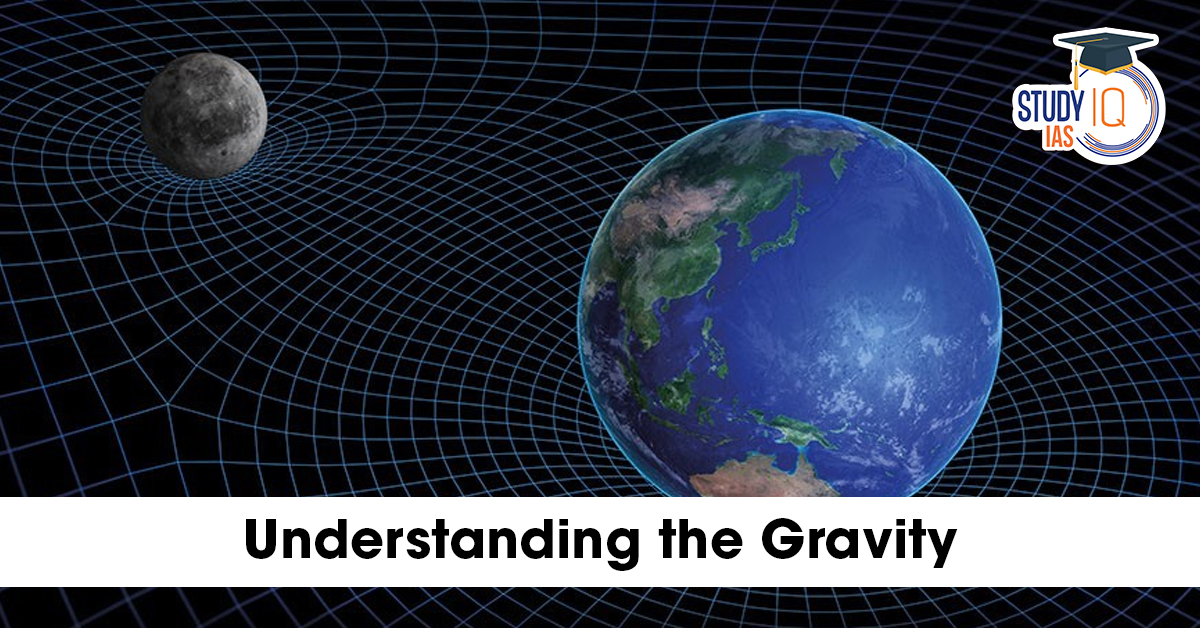
- Massive objects bend space and time around them
- Objects move along this curved space-time
A simple analogy is a heavy ball placed on a stretched rubber sheet—smaller balls roll toward it not because of force, but due to curvature.
Gravitational Lensing: Seeing the Invisible Universe
One of the most powerful confirmations of Einstein’s theory is gravitational lensing.
|
What is Gravitational Lensing? |
| When light from a distant star or galaxy passes near a massive object (like another galaxy or a black hole), the curved space-time bends the path of light.
Why is it Important? ● Allows astronomers to see distant galaxies ● Helps detect dark matter, which does not emit light ● Confirms Einstein’s predictions with high precision Gravitational lensing is now routinely used by space telescopes to map the universe. |
Extreme Gravity in Black Holes
Einstein’s equations also predicted the existence of black holes—regions where gravity is so strong that not even light can escape.
Modern observations have:
- Imaged black holes
- Detected stars orbiting invisible massive cores
- Confirmed that gravity governs the birth and death of stars
Black holes represent the most extreme expression of gravity, pushing physics to its limits.
Gravitational Waves: Ripples in Space-Time
Another major prediction of Einstein was gravitational waves—tiny ripples in space-time caused by violent cosmic events like:
- Black hole mergers
- Neutron star collisions
Detected for the first time in 2015, gravitational waves opened an entirely new way of observing the universe, known as gravitational astronomy.
Gravity in Everyday Technology
Gravity is not just theoretical—it directly affects modern life:
- GPS satellites correct for relativistic time differences caused by gravity
- Space missions rely on gravity assists to save fuel
- Earth’s climate system depends on gravity holding atmosphere and oceans
Without precise understanding of gravity, modern navigation, communication, and space exploration would fail.
From Newton’s apple to Einstein’s curved space-time, gravity remains the most universal and mysterious force we know. As science advances, gravity continues to reveal deeper truths about our planet, our universe, and our place within it.
|
Read More Notes |
|
| Environment Notes | Art and Culture Notes |
| Science and Tech | History Notes |
| Geography Notes | Indian Polity Notes |
| General Knowledge | International Relation |
|
Explore StudyIQ Courses |
|
 Tropical Cyclone Narelle Red Sky Western...
 Wildlife Crime Control Bureau (WCCB): Ro...
 Hope Island in News: Significance, Locat...













 WhatsApp





