
Table of Contents
Context
Coastal MLAs urged Karnataka Legislative Assembly to declare Tulu as second official language.
About Tulu
- Language family and classification: It is a Dravidian language that branched early from Proto-South Dravidian and retains several archaic linguistic features not found in Tamil–Kannada.
- Geographical distribution: Tulu is primarily spoken in Tulu Nadu, comprising Dakshina Kannada and southern Udupi districts of Karnataka and the northern part of Kasaragod district of Kerala. Smaller pockets exist in parts of Chikkamagaluru and Shivamogga districts.
- Ethnolinguistic identity: Native speakers are known as Tuluvas, and the cultural region is informally referred to as Tulu Nadu, known for a distinct linguistic and cultural identity.
- Linguistic features: Tulu has unique grammatical constructions such as the pluperfect and future perfect tenses without auxiliary verbs, a feature rare among Indian languages and comparable to some European languages.
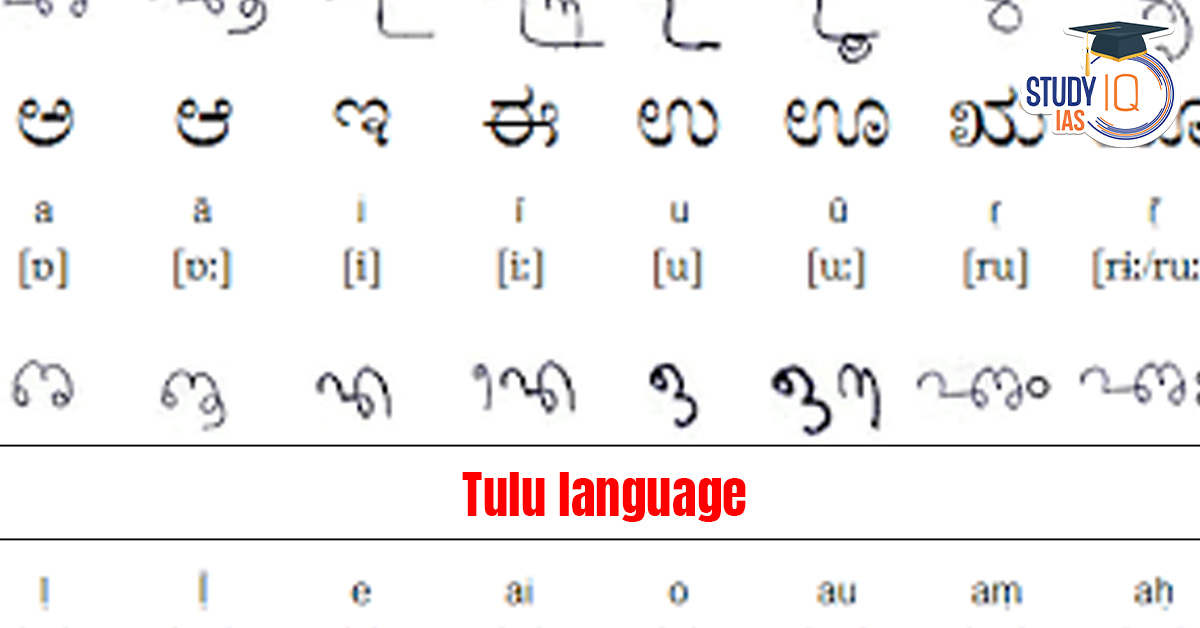
- Scripts used: Historically, Tulu was written in the Tigalari script (also called Tulu script). In modern times, Kannada script is commonly used, with occasional use of Malayalam script in Kerala.
- Literary tradition: Tulu has a rich oral literature, especially epic ballads called pardana. Famous examples include the Epic of Siri and the legends of Koti and Chennayya, which reflect social values and folk history
- Written Tulu literature includes medieval texts such as Sri Bhagavato and Kaveri (17th century), composed in the Tigalari script.
- Inscriptions and antiquity: The oldest Tulu inscriptions date back to the 7th–8th century CE, found around Barkur and Kundapura. These inscriptions indicate early literary and administrative usage.
- Ancient Tamil Sangam texts such as Akananuru (c. 300 BCE) and works of poet Mamular mention Tulu Nadu, suggesting the antiquity of the Tulu language and culture (over 2,300 years old).
- Speakers and demographics: According to the 2011 Census, India has about 1.85 million native Tulu speakers.
|
Read More Notes |
|
| Environment Notes | Art and Culture Notes |
| Science and Tech | History Notes |
| Geography Notes | Indian Polity Notes |
| General Knowledge | International Relation |
|
Explore StudyIQ Courses |
|
 Distinct Enumeration of DNTs in Census 2...
 Top 10 Richest Indians 2026 Full List Ne...
 The Transgender Persons (Protection of R...







 WhatsApp





