
Table of Contents
The emergence of social media has significantly transformed the articulation, reception, and evaluation of criminal allegations, especially those pertaining to sexual harassment, in modern culture. Although digital platforms have enabled individuals, particularly women, to voice their strong objections to injustice, they have simultaneously cultivated a concurrent system of immediate judgment that frequently bypasses due process. The unfortunate suicide of U. Deepak, a 42-year-old sales executive from Kozhikode, Kerala, after the widespread dissemination of a video alleging sexual harassment, highlights the perils of “trial by social media.” The episode has significantly divided society, juxtaposing concerns for women’s safety with apprehensions about false accusations, public humiliation, and permanent reputational damage. This instance exemplifies how social media, when used as a means of accusation rather than evidence, can obscure the distinctions among justice, outrage, and vigilantism.
The Event and Its Subsequent Consequences
On January 16, Shimjitha Musthafa, a 35-year-old woman identifying as a qualified psychologist, released a video on Instagram. She accused Deepak of sexually harassing her aboard a private bus in Payyannur, Kannur district, by intentionally elbowing her breast. Sexual harassment on public transportation is a prevalent and experienced reality for women throughout India, and the film struck a chord with numerous viewers. Within hours, it became viral, accumulating over two million views. The predominant public response initially positioned Musthafa as a victim exercising her agency in a hostile public environment.
Nonetheless, inquiries promptly emerged in the comments section concerning the framing, purpose, and definitiveness of the film. Musthafa removed the initial footage and subsequently shared a follow-up, clarifying that her purpose was not to single out an individual but to underscore a more extensive societal and mental health concern. At that point, the harm had already occurred. Deepak, having learned about the footage from a friend, was allegedly profoundly concerned, apprehensive of public disgrace. The subsequent morning, on his birthday, he was discovered dead in his room, having succumbed to suicide.
Personal Tragedy and Societal Catalyst
Deepak’s parents found the death incomprehensible. He exhibited no apparent signs of depression and was organising a pilgrimage with them to the Guruvayur temple. Family relatives characterised him as quiet, emotionally sensitive, and currently managing the trauma of a divorce. His abrupt demise shifted the initial dialogue over women’s safety into a contentious public debate concerning false allegations, mental health, and the detrimental influence of social media.
Public outrage intensified swiftly. Deepak’s family alleged that Musthafa exploited the video for fame and social media engagement. Protest videos surfaced, featuring men on buses adorned with cardboard boxes over their bodies, symbolising fear and vulnerability, while advocating for the creation of a men’s commission. Social media transformed into a battleground where narratives were weaponised, empathy was polarised, and nuance was overshadowed by outrage.
Legal Advancements and Police Investigation
Subsequent to a report lodged by Deepak’s mother, the Kozhikode Medical College police initiated a case against Musthafa under Section 109 of the Bharatiya Nyaya Sanhita, 2023, pertaining to abetment of suicide, classified as a non-bailable offence. Musthafa was arrested and placed in judicial custody for a duration of 14 days. The State Human Rights Commission requested an in-depth police report.
The police’s remand report indicated that Deepak’s suicide was precipitated by the humiliation stemming from the dissemination of the videos. Significantly, the bus’s CCTV footage was scrutinised and, as per the police, revealed no unusual or inappropriate conduct. Testimonies from bus personnel and other passengers allegedly confirmed the lack of any objectionable misbehaviour. The police observed that Musthafa had recorded and subsequently deleted multiple videos, and her phone was sent for forensic examination.
Simultaneously, Musthafa submitted a counter-complaint from jail, reaffirming her accusation of sexual harassment, which initiated a preliminary investigation by the Payyannur police. The legal proceedings exposed the case’s complexity, with factual determination remaining unresolved despite the occurrence of irreversible consequences.
Comprehending “Trial by Social Media”
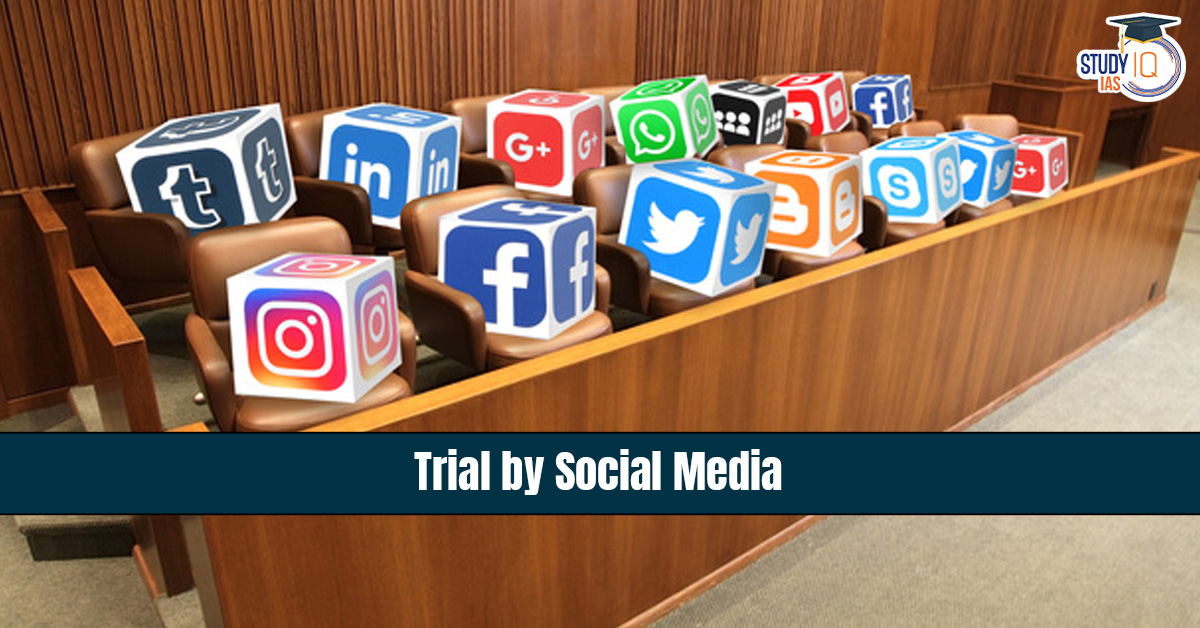
“Trial by social media” denotes the occurrence in which persons are publicly accused, adjudicated, and condemned via digital channels, devoid of the protections afforded by legal procedures. In contrast to courts, social media functions based on virality, emotion, and immediacy. Accusations are rapidly magnified, reputations are destroyed within a night, and the accused frequently lacks the benefit of the presumption of innocence.
In India, where social media penetration is extensive and digital literacy is quickly advancing, as demonstrated by Kerala’s achievement of 100% digital literacy, the risks associated with informal justice are magnified. Once content achieves virality, retractions, clarifications, or acquittals seldom garner equivalent attention. The Deepak case illustrates how social media shaming can serve as a sort of extrajudicial punishment, with repercussions affecting mental health, familial dignity, and, in severe instances, life itself.
Women’s Safety, Liberty, and the Digital Dilemma
Women’s rights advocates warn against interpreting the case through oversimplified dichotomies. Sexual harassment on public transportation is pervasive, inadequately reported, and frequently downplayed by officials. Data from the National Crime Records Bureau reveals a consistent increase in crimes against women, with public areas continuing to be notably dangerous. A multitude of women contend that the indifference of police and slow judicial procedures necessitate their reliance on social media for self-defence and deterrence.
Supporters of Musthafa cite incidents like that of Savad Sha, who was arrested in 2023 following a woman’s upload of a video showing him masturbating on a bus. Notwithstanding significant opposition directed at the woman, a subsequent reoffending occurrence in 2025 corroborated her complaint. From this viewpoint, cell phones and social media are perceived as instruments that undermine established power dynamics in patriarchal countries and render public areas slightly more secure.
Simultaneously, even feminist perspectives warn against replacing investigation with immediate public condemnation. Recording can function as evidence; nevertheless, disseminating allegations prior to verification jeopardises justice and diminishes the credibility of legitimate complaints.
Legal Framework and Protections under Indian Law
Indian law offers many protections against sexual harassment and the exploitation of internet platforms. The Indian Penal Code and the Bharatiya Nyaya Sanhita criminalise sexual harassment, defamation, and abetment of suicide. The Information Technology Act, 2000, governs online behaviour, although privacy rights enshrined in Article 21 of the Constitution prohibit unauthorised recording and distribution of photographs.
The Supreme Court has consistently underscored due process and the presumption of innocence. In State of Bihar v. Lal Krishna Advani (2003), the Court ruled that public perception cannot supplant judicial determination. In Shreya Singhal v. Union of India (2015), the Court cautioned against the stifling effects and capricious punishments stemming from online discourse. Recently, courts have warned about media trials affecting investigations and compromising fair trials, as demonstrated in Sahara India Real Estate Corp. v. SEBI (2012).
Mental Health, Public Stigmatization, and Societal Accountability
Psychiatrists and mental health professionals emphasise that suicide is seldom attributable to a singular cause. Deepak’s divorce, introverted personality, fear of public humiliation, and absence of professional support may have combined to accelerate his death. However, public shaming served as a trigger, intensifying his distress.
The normalisation of suicide as a reaction to trauma signifies a comprehensive cultural inadequacy in proactively addressing mental health issues. Legal literacy and psychological support systems are not accessible, resulting in persons experiencing isolation during crises.
The Function of the Judiciary
The judiciary holds a precarious role in reconciling conflicting rights: women’s rights to safety and expression, and individuals’ rights to dignity, reputation, and due process. Courts must guarantee that legitimate complaints are addressed expeditiously and with sensitivity, while also preventing the criminalisation of allegations through public spectacle.
The Deepak case highlights the pressing necessity for more explicit regulations regarding digital evidence, accountable social media practices, and commensurate legal actions. Judicial restraint, together with institutional reform, is crucial to avert social media from evolving into an informal, unaccountable judiciary.
Conclusion
The tragedy surrounding U. Deepak’s death is not merely a story of one allegation, one video, or one suicide. It reflects a civilisation contending with technology, patriarchy, fear, and grief. Social media trials reveal the vulnerability of the social contract, as justice becomes progressively crowdsourced, immediate, and ruthless. Although women should be empowered to voice their experiences of harassment, justice cannot be confined to viral videos and public outrage. In the digital world, protecting dignity, due process, and mental health is essential. A measured response, grounded in legal principles, empathy, and institutional accountability, is essential to avert the recurrence of such disasters.
 Governors’ Address to State Legislatur...
 Mandating Prior Approval for Corruption ...
 Transferring Judges and the Integrity of...










 WhatsApp





