
Table of Contents
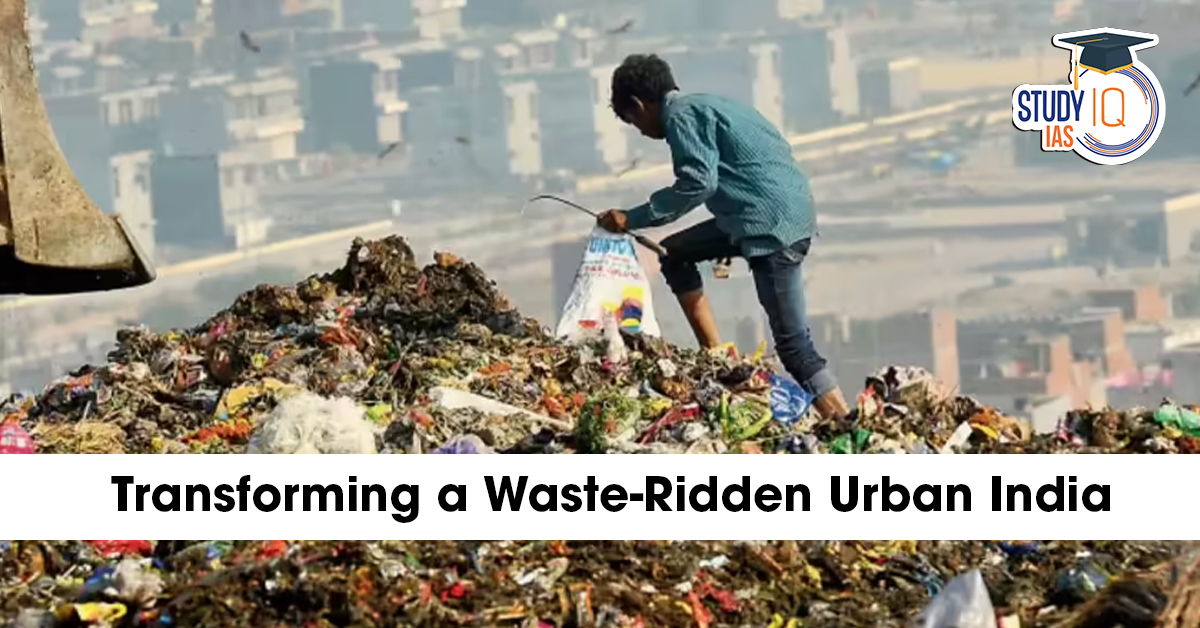
Urban India is standing at a critical crossroads. Rapid urbanisation, changing consumption patterns and population growth have turned solid waste management into one of the most pressing governance challenges of the 21st century. From overflowing landfills on city outskirts to plastic-choked drains, the problem of urban waste is no longer just an environmental concern—it is a public health, economic and sustainability crisis.
Yet, with the right policies, technologies and citizen participation, India has the opportunity to transform its waste-ridden cities into models of circular economy and urban resilience.
The Scale of the Urban Waste Crisis in India
India’s cities generate over 65 million tonnes of municipal solid waste annually, a figure expected to nearly double by 2035. Most urban local bodies (ULBs) struggle with:
-
Poor waste segregation at source
-
Heavy dependence on open dumping and landfills
-
Limited recycling and scientific processing capacity
-
Inadequate institutional and financial resources
Unsegregated waste leads to methane emissions, groundwater contamination, air pollution from landfill fires and the spread of vector-borne diseases.
Why Urban Waste Management Is Failing
1. Rapid Urbanisation Without Infrastructure
India’s urban population is projected to cross 600 million in the coming decades, but waste management infrastructure has not kept pace with this growth.
2. Linear Consumption Model
Cities largely follow a “take–use–dispose” model, with minimal emphasis on reuse and recycling.
3. Weak Implementation at the Local Level
Despite clear rules, enforcement by ULBs remains inconsistent due to staff shortages, poor monitoring and limited technical capacity.
4. Behavioural Gaps
Lack of public awareness and participation undermines segregation, composting and recycling efforts.
Policy Push to Clean Urban India
India has taken significant steps to address the waste challenge through national missions and regulatory frameworks.
Swachh Bharat Mission (Urban)
Launched under the leadership of the Ministry of Housing and Urban Affairs, the Swachh Bharat Mission (Urban) has transformed the discourse around cleanliness and waste.
Key achievements include:
-
Universal door-to-door waste collection in many cities
-
Expansion of waste processing capacity
-
Behavioural change campaigns at scale
Solid Waste Management Rules, 2016
These rules mandate:
-
Segregation at source (wet, dry, hazardous waste)
-
User fees for waste services
-
Scientific landfilling and waste processing
However, implementation remains uneven across cities.
Technology and Innovation: Game Changers
Waste-to-Energy (WtE)
WtE plants can reduce landfill burden while generating power, though concerns over emissions and feedstock quality persist.
Composting and Bio-Methanation
Decentralised composting and bio-methanation plants help manage organic waste locally and produce manure or biogas.
Digital and Smart Solutions
-
GPS-enabled waste collection
-
AI-based sorting technologies
-
Data-driven monitoring under Smart City initiatives
These tools can significantly improve efficiency and transparency.
Informal Sector: The Invisible Backbone
India’s waste ecosystem relies heavily on informal waste pickers, who recover recyclables worth billions annually. Integrating them into formal systems can:
-
Improve recycling rates
-
Provide social security and dignity of labour
-
Reduce pressure on landfills
Several cities have begun registering and training waste pickers, but scaling remains a challenge.
Towards a Circular Urban Economy
Transforming urban waste management requires shifting from disposal to resource recovery.
Key strategies include:
-
Extended Producer Responsibility (EPR) for plastics and e-waste
-
Promotion of reuse, repair and recycling industries
-
Green public procurement
-
Market development for recycled products
A circular economy approach can generate jobs while reducing environmental costs.
Role of Citizens and Urban Governance
No waste reform can succeed without citizen participation. Segregation at source, home composting and reduced plastic use are critical.
Urban local bodies must:
-
Strengthen institutional capacity
-
Ensure financial sustainability through user charges
-
Improve accountability and service quality
Conclusion
Transforming a waste-ridden urban India is not just about cleaner streets—it is about building healthier cities, protecting the environment and ensuring sustainable urban growth. With strong political will, technological innovation, inclusive governance and active citizen participation, India can turn its waste challenge into an opportunity for green growth and urban renewal.
 Who Was Ayatollah Ali Khamenei? Biograph...
 The Cycle of Deprivation and Affluence
 NCERT Textbook Controversy and Supreme C...











 WhatsApp





